









1 / 10 Questions
0 Points
Points won
0
Correct score
0%

More Questions

More Articles

Did You Know These Directors Added Hidden Symbols?

Did You Know These Directors Added Hidden Symbols?

⏱️ 5 min read

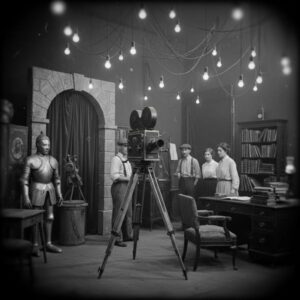
Cinema has always been a medium rich with visual storytelling, but some directors take their craft to another level by embedding hidden symbols, recurring motifs, and secret messages throughout their films. These Easter eggs and symbolic elements add depth to the narrative, reward attentive viewers, and often reveal the filmmaker's personal obsessions, philosophical beliefs, or commentary on society. Understanding these hidden symbols can transform a casual viewing experience into a treasure hunt that unveils layers of meaning beneath the surface.

Stanley Kubrick's Obsession with Geometric Patterns and Color Coding

Stanley Kubrick remains one of cinema's most meticulous directors, known for embedding complex symbolism throughout his work. In "The Shining," Kubrick utilized impossible architecture and geometric patterns to create subliminal unease. The Overlook Hotel contains windows in windowless rooms and hallways that couldn't physically exist, subtly suggesting that something is fundamentally wrong with the space itself.

Kubrick also employed color coding as symbolic language. In "Eyes Wide Shut," the Christmas lights shift between warm and cool tones to indicate safety versus danger. Red appears prominently during moments of sexual tension and forbidden knowledge, while blue represents the protagonist's mundane reality. This color symbolism extends to "The Shining," where the shifting carpet patterns and color schemes mirror Danny's psychological state and foreshadow supernatural encounters.

Alfred Hitchcock's Strategic Use of Objects and Numbers

The Master of Suspense frequently planted symbolic objects throughout his films that served as visual metaphors for his themes. Birds appear repeatedly across Hitchcock's filmography long before "The Birds" was released, often symbolizing chaos, danger, or fate. In "Psycho," stuffed birds in Norman Bates' parlor foreshadow the predatory nature of the character and the violence to come.

Hitchcock also had a fascination with staircases as symbols of moral descent or ascent. In "Vertigo," spiral staircases represent the protagonist's psychological unraveling and obsession. The number 13 appears frequently in his films as a harbinger of doom, reflecting both superstition and Hitchcock's love of unsettling his audience through subtle psychological triggers.

Christopher Nolan's Temporal and Circular Motifs

Christopher Nolan consistently incorporates circular imagery and spiral patterns to represent his obsession with time, memory, and cyclical narratives. In "Inception," spinning tops, revolving doors, and circular architecture reflect the film's themes of infinite loops and uncertain realities. The wedding ring that appears and disappears on Cobb's finger serves as a hidden symbol that reveals whether scenes occur in reality or dreams—a detail many viewers miss on first viewing.

Nolan's use of watches and timepieces throughout his films functions as more than mere props. In "Interstellar," the watch becomes a literal communication device across dimensions. In "Dunkirk," the ticking watch sound in Hans Zimmer's score creates auditory symbolism that heightens tension and emphasizes the film's temporal structure.

Guillermo del Toro's Recurring Insect and Eye Imagery

Guillermo del Toro weaves intricate symbolic tapestries throughout his films, with insects and eyes appearing as consistent motifs. Insects represent transformation, survival, and often the overlooked or discarded members of society. In "Pan's Labyrinth," the insect-fairy creatures signal Ofelia's journey between worlds, while the Pale Man's eyes in his hands symbolize the willful blindness of authority figures to atrocity.

Del Toro's emphasis on eyes and vision carries thematic weight across his filmography. Characters who truly "see" are often those society dismisses—children, outcasts, and innocents. The director frequently places eyes in unexpected locations or emphasizes watching and being watched, exploring themes of surveillance, judgment, and perspective.

Wes Anderson's Symmetry and Color Palettes as Character Language

Wes Anderson's distinctive visual style includes deliberate symmetry that symbolizes control, order, and the characters' desire for structure in chaotic worlds. His precisely centered compositions reflect characters' attempts to maintain composure and dignity despite emotional turmoil. When Anderson breaks his own symmetrical rules, it signals significant emotional disruption or character transformation.

Anderson assigns specific color palettes to characters and emotional states throughout his films. In "The Grand Budapest Hotel," the color pink represents nostalgia and an idealized past, while the shifting color grades between time periods symbolize the loss of innocence and elegance. Yellow frequently appears during moments of hope or adventure, creating a consistent symbolic language across his body of work.

David Fincher's Hidden Corporate Logos and Consumer Symbols

David Fincher embeds corporate logos and consumer product symbols throughout his films to critique materialism and modern society's commodification. In "Fight Club," Starbucks cups appear in nearly every scene, representing the ubiquity of consumer culture and corporate homogenization. This visual motif reinforces the film's anti-consumerist themes without requiring explicit dialogue.

Fincher also uses yellow as a recurring symbol of decay, danger, and moral corruption. In "Se7en," the sickly yellow-green color grade emphasizes the city's moral rot. In "Zodiac," yellow appears during moments connected to the killer, creating a subtle visual connection across seemingly unrelated scenes.

The Lasting Impact of Cinematic Symbolism

These hidden symbols serve multiple purposes beyond mere artistic flourish. They create cohesion across a director's body of work, establishing recognizable signatures that deepen appreciation for their craft. Symbols encourage multiple viewings and active engagement, transforming passive audiences into active participants who decode meaning. They also allow filmmakers to communicate themes and ideas that might be too controversial, complex, or subtle to convey through dialogue alone.

Understanding these symbolic languages enhances film literacy and appreciation. When viewers recognize that a director's choices are deliberate and meaningful, even seemingly mundane details become rich with significance. This awareness transforms how we consume cinema, encouraging closer attention to composition, color, recurring objects, and visual patterns that might otherwise go unnoticed.

Did You Know These Little-Known Facts About Technology?

Did You Know These Little-Known Facts About Technology?

⏱️ 5 min read

Technology surrounds us in every aspect of modern life, yet many fascinating facts about its history, development, and impact remain surprisingly unknown to most people. From the origins of everyday devices to the quirky stories behind major innovations, the world of technology holds countless intriguing secrets that deserve recognition. Understanding these lesser-known details not only enriches our appreciation for technological advancement but also provides valuable context for how we interact with these tools daily.

The Unexpected Origins of Common Technology Terms

Many technological terms we use casually today have fascinating etymological backgrounds. The word "bug" to describe software errors originated in 1947 when engineers found an actual moth trapped in Harvard University's Mark II computer, causing malfunctions. Grace Hopper, a computer science pioneer, taped the moth into the computer's logbook with the notation "First actual case of bug being found." This literal bug established the terminology that programmers worldwide use today.

The term "spam" for unwanted emails comes from a 1970 Monty Python sketch where Vikings repeatedly chant "spam" until it drowns out all other conversation. Early internet users adopted this term to describe repetitive, unwanted messages that similarly overwhelmed legitimate communication. These linguistic connections demonstrate how technology terminology often emerges from unexpected cultural references.

Revolutionary Inventions That Nearly Failed

Several groundbreaking technologies faced initial rejection or skepticism that could have prevented their success. The computer mouse, invented by Douglas Engelbart in 1964, remained relatively obscure for nearly two decades before Apple popularized it with the Macintosh in 1984. Engelbart's original prototype was made of wood and featured just one button, a far cry from today's sophisticated pointing devices.

Similarly, the first digital camera, created by Kodak engineer Steve Sasson in 1975, was actively suppressed by his own company. Kodak executives feared it would threaten their lucrative film business, delaying widespread digital photography adoption for years. This decision ultimately contributed to Kodak's decline when competitors embraced digital technology, illustrating how resistance to innovation can prove catastrophic for established companies.

Surprising Facts About Internet Infrastructure

The internet's physical infrastructure contains remarkable details that most users never consider. Approximately 95% of international data travels through undersea cables stretching across ocean floors. These cables, often no thicker than a garden hose, carry hundreds of terabytes of information per second between continents. Sharks have occasionally damaged these cables by biting them, possibly attracted by electromagnetic fields, prompting engineers to develop protective sheathing.

Furthermore, the internet technically weighs about 50 grams, equivalent to a large strawberry. This calculation, derived by researcher John Kubiatowicz, represents the combined weight of all electrons in motion when the internet operates at full capacity. While theoretical, this measurement provides a tangible way to conceptualize the otherwise abstract digital realm.

Hidden Features in Everyday Devices

Common devices contain numerous lesser-known capabilities that manufacturers rarely advertise prominently. Most people don't realize that airplane mode on smartphones isn't just for flights—it can significantly extend battery life during emergencies or charge devices faster by preventing constant network scanning. Additionally, the small hole near smartphone cameras isn't decorative; it's a secondary microphone for noise cancellation during calls and video recording.

Keyboard design also harbors interesting secrets. The bumps on the F and J keys exist to help touch typists find the home row position without looking. Additionally, the QWERTY keyboard layout, now universal, was deliberately designed to slow typing on mechanical typewriters to prevent jamming—an outdated necessity that persists despite modern technology eliminating the original problem.

Groundbreaking Technological Achievements That Went Unnoticed

Many technological milestones achieved remarkable feats with minimal public recognition. The Apollo Guidance Computer that landed astronauts on the moon operated with just 64 kilobytes of memory and a 0.043 MHz processor—less computing power than a modern digital watch. This achievement showcases how innovative programming and engineering can overcome severe hardware limitations.

The first text message, sent on December 3, 1992, simply read "Merry Christmas." Engineer Neil Papworth sent this message from a computer to Richard Jarvis's mobile phone on the Vodafone network. At the time, phones lacked keyboards for replies, so Jarvis couldn't respond—an ironic beginning for a communication method that would eventually eclipse voice calls in popularity.

The Environmental Impact of Digital Technology

Digital technology's environmental footprint contains surprising statistics that challenge common perceptions. Sending a standard email produces approximately 4 grams of carbon dioxide, while an email with large attachments can generate up to 50 grams—equivalent to a traditional light bulb running for one hour. Data centers worldwide consume roughly 200 terawatt-hours annually, approximately 1% of global electricity demand.

However, technology also offers environmental solutions. A single e-reader can store thousands of books, and reading just 23 books electronically offsets the carbon footprint of manufacturing the device. Cloud storage similarly reduces physical waste from obsolete storage media, though the energy requirements of server farms present ongoing sustainability challenges.

Conclusion: Technology's Hidden Depths

These lesser-known technological facts reveal the rich history, unexpected challenges, and remarkable ingenuity behind innovations we often take for granted. From accidental terminology origins to suppressed inventions that eventually revolutionized industries, technology's journey has been anything but straightforward. Understanding these hidden aspects helps us appreciate the complexity, creativity, and occasional serendipity involved in technological progress. As technology continues evolving at an unprecedented pace, countless new stories and surprising facts will undoubtedly emerge, reminding us that even the most familiar tools contain depths waiting to be discovered.