
Why Rainbows Are Actually Full Circles You Never See
By Trivia Daily, Nature Desk — Published July 20, 2026
Table of Contents
- Key Takeaways
- The Physics Behind Rainbows Actually Full Circles of Light
- Where and When You Can See Complete Rainbow Circles
- Why No Two People See the Same Rainbow
- Primary Versus Secondary Rainbows in Nature
- Conditions That Create Rainbow Weather Phenomena
- Frequently Asked Questions
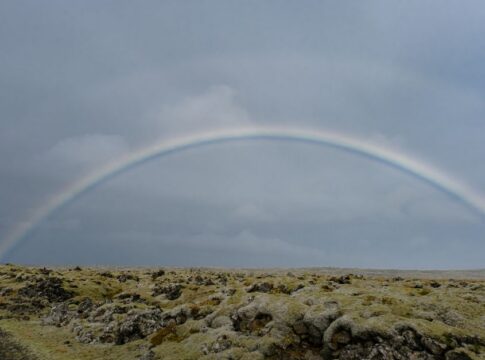
Every time you spot a rainbow arcing across the sky after a storm, you’re only seeing half the story. Those brilliant bands of color stretching from horizon to horizon are actually complete circles—rainbows actually full circles that exist in three-dimensional space around a specific point opposite the sun. You’re standing in the way of seeing the bottom half. The ground blocks your view of what would otherwise be a perfect ring of refracted light, a geometric marvel that reveals how perspective shapes everything we observe in nature.
Pilots and passengers in airplanes occasionally glimpse what earthbound observers never can: the full circular glory of a rainbow floating in the clouds below. It’s not magic or a trick of altitude—it’s simply geometry freed from the obstacle of terrain.
Key Takeaways
- Rainbows form complete circles around the antisolar point—the spot directly opposite the sun from your perspective—but the ground blocks the lower half from view.
- Each person sees their own unique rainbow because the phenomenon depends on the precise angle between the sun, water droplets, and the observer’s eyes.
- Airplane passengers and people on mountain peaks with clouds below them can occasionally witness full circular rainbows.
- The primary rainbow appears at a consistent 42-degree angle from the antisolar point, while secondary rainbows form at 51 degrees with reversed colors.
- Rainbows aren’t physical objects you can approach—they’re optical phenomena that move with you, always maintaining the same angular relationship to your position.
- Water droplets act as tiny prisms, splitting white sunlight into its component wavelengths through refraction and internal reflection.
The Physics Behind Rainbows Actually Full Circles of Light
Understanding why rainbows are circular requires grasping three elements: sunlight, water droplets, and geometry. When sunlight enters a spherical water droplet, it slows down and bends—a process called refraction. The light bounces off the back interior surface of the droplet, then bends again as it exits toward your eye. Different wavelengths of light bend at slightly different angles, separating white light into its spectrum of colors.
Here’s the critical part: this reflection and refraction creates light rays that emerge from water droplets at a specific angle—roughly 42 degrees from the antisolar point. The antisolar point is an imaginary spot in the sky directly opposite the sun from where you stand. Draw an imaginary line from the sun through your head, and it points to this location. Every water droplet positioned at that 42-degree angle from this point can send rainbow light to your eyes.
Those droplets form a cone shape in three-dimensional space, with your eye at the tip. Slice through a cone and you get a circle. That’s your rainbow—a complete ring that exists wherever conditions allow. The Earth simply gets in the way of the bottom portion, leaving you with the familiar arc.
Where and When You Can See Complete Rainbow Circles
The higher your vantage point above the landscape, the more of the circle you can see. Mountain climbers standing above cloud layers report seeing fuller rainbow arcs that dip below the horizon line. The phenomenon becomes truly spectacular from aircraft.
Commercial airline passengers occasionally spot circular rainbows projected onto clouds thousands of feet below. These sightings often appear around the shadow of the airplane itself—that shadow marks the antisolar point, the center of the rainbow circle. The same physics that creates ground-level arcs produces these aerial rings, just without terrain blocking the view.
Garden sprinklers and fountain spray can create miniature circular rainbows on sunny days. Stand with your back to the sun and position yourself above the mist. You might see a complete, tiny rainbow circle in the droplets. The principle remains identical whether the water source is a storm cloud or a backyard hose—it’s all about angles and perspective in the natural environment.
Why No Two People See the Same Rainbow
Rainbows are profoundly personal optical phenomena. The rainbow you see is created by light rays entering your eyes from specific droplets at specific angles. Someone standing beside you sees light from entirely different droplets, positioned at the correct angle relative to their eyes. You’re each observing your own private rainbow, even though you’re looking at the same patch of weather and sky.
This explains why you can never reach a rainbow’s end, despite countless legends about pots of gold. As you move, the geometric relationship changes. The droplets that were sending rainbow light to your previous position are no longer at the right angle. New droplets, now correctly positioned, create your rainbow in a new location. The rainbow moves with you, always maintaining that 42-degree angle from the antisolar point. It’s not an object in space—it’s a relationship between light, water, and observer.
Primary Versus Secondary Rainbows in Nature
Sometimes a fainter, larger rainbow appears outside the primary arc. This secondary rainbow forms when light bounces twice inside water droplets instead of once. That extra reflection reverses the color order—red appears on the inside edge, violet on the outside, opposite to the primary rainbow’s arrangement.
| Rainbow Type | Angle from Antisolar Point | Color Order (Outside to Inside) | Brightness |
|---|---|---|---|
| Primary | 42 degrees | Red, Orange, Yellow, Green, Blue, Violet | Bright |
| Secondary | 51 degrees | Violet, Blue, Green, Yellow, Orange, Red | Fainter |
The region between primary and secondary rainbows appears noticeably darker than the sky outside them. Called Alexander’s band, this dark zone exists because of the specific angles at which light exits water droplets. Less light emerges in that angular range, creating a dimmer band. Both the primary and secondary rainbows are complete circles, though observers on the ground typically see only the arcs.
Conditions That Create Rainbow Weather Phenomena
Rainbows require simultaneous sunshine and rain—or at least airborne water droplets. The sun must be behind you and relatively low in the sky. When the sun sits higher than 42 degrees above the horizon, the antisolar point drops too low, pushing the entire rainbow circle below ground level. That’s why rainbows are most common in early morning or late afternoon, and rare at midday during summer months in temperate climates.
The best rainbow weather combines passing showers with breaks of sunshine. Storm systems moving across the landscape create ideal conditions, with dark clouds providing a contrasting backdrop that makes colors pop. Coastal areas and regions with frequent afternoon thunderstorms see more rainbows than arid climates or places with persistent overcast skies.
Climate and seasonal patterns influence rainbow frequency. Spring weather often delivers the perfect combination of sun showers and dramatic cloud formations. Mountain environments with their complex terrain and localized weather systems also generate frequent rainbow displays, particularly when clouds sit in valleys below peaks.
Frequently Asked Questions
Can you see a full circular rainbow from the ground?
Only rarely, and usually partially. You’d need to be on a high mountain or tower with mist or clouds far below you, creating water droplets at the right angle beneath your position. Most ground observers will only ever see arcs because Earth blocks the lower portion of the circle.
Are rainbows actually seven distinct colors?
Rainbows are continuous spectrums with countless gradations of color blending smoothly from red to violet. The seven-color tradition comes from Isaac Newton, who divided the spectrum to match the seven notes of the musical scale, but the divisions are somewhat arbitrary in nature.
Why do rainbows always appear opposite the sun?
Light must enter water droplets from the sun, reflect internally, and exit back toward your eyes at specific angles. This geometry requires the sun to be behind you, creating the antisolar point in front of you where the rainbow circle centers itself in the sky.
Can moonlight create rainbows?
Yes—these “moonbows” or lunar rainbows occur when bright moonlight refracts through water droplets at night. They’re much fainter than solar rainbows because moonlight is reflected sunlight and therefore dimmer, but they follow the same optical principles and form complete circles.
Next time rain sweeps across the landscape and sun breaks through behind you, remember you’re seeing just the visible arc of a perfect circle. Somewhere above you, that same storm might be revealing its full circular glory to a passenger gazing down through an airplane window, watching a complete rainbow float against the clouds.