
Why Flamingos Stand on One Leg: The Surprising Science
By Trivia Daily, Staff Writer — Published July 20, 2026
Table of Contents
- Key Takeaways
- The Energy Conservation Theory: Why Flamingos Stand Science Reveals Efficiency
- Temperature Regulation in Cold Water
- The Biomechanics Behind the Balance
- Comparing One-Legged Standing Across Bird Species
- Debunking Common Myths About Flamingo Behavior
- The Pink Bird’s Other Fascinating Adaptations
- Frequently Asked Questions
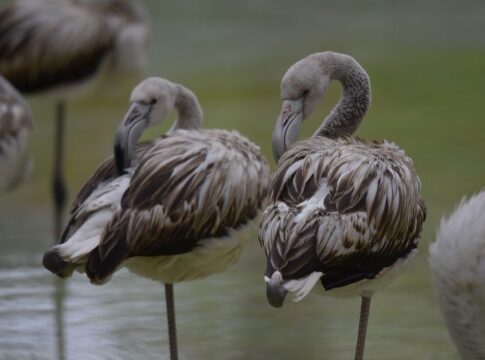
Watch a flock of flamingos for any length of time and you’ll notice something odd: these pink wading birds spend much of their day balancing effortlessly on a single leg. It looks uncomfortable, even exhausting, yet flamingos do it constantly—while feeding, resting, and even sleeping. The surprising science behind why flamingos stand on one leg reveals fascinating facts about energy conservation, body temperature regulation, and biomechanics that scientists have only recently begun to fully understand.
For decades, researchers assumed this quirky behavior was purely about thermoregulation. The truth is far more interesting. Recent studies have discovered that flamingos stand on one leg not despite it being difficult, but because it’s actually easier than standing on two.
Key Takeaways
- Flamingos can maintain one-legged balance with virtually no muscular effort, making it more energy-efficient than standing on two legs.
- The behavior helps reduce heat loss by minimizing the surface area exposed to cold water, which is particularly important for flamingos standing in lakes and lagoons for hours.
- A flamingo’s unique skeletal structure and ligament system create a passive locking mechanism that holds the leg in place without active muscle engagement.
- Both wild and captive flamingos display this behavior regardless of water temperature, suggesting multiple evolutionary advantages.
- Dead flamingos cannot balance on one leg, proving that some biological mechanism—not just skeletal structure alone—enables the posture.
- Flamingos alternate legs regularly, though they may favor one leg over the other, similar to human handedness.
The Energy Conservation Theory: Why Flamingos Stand Science Reveals Efficiency
The most compelling explanation for one-legged standing involves biomechanics and energy savings. Researchers at the Georgia Institute of Technology studied both living and deceased flamingos to understand the mechanics. They discovered that when a flamingo stands on one leg, its body weight naturally aligns over the supporting leg in a way that requires minimal muscular effort.
The bird’s body essentially locks into place. The hip, knee, and ankle joints align in a configuration that creates stability through passive support rather than active muscle contraction. Think of it like a folding chair that snaps into an open position—once locked, it stays put without effort. This passive mechanism means a flamingo can maintain the pose while resting or even sleeping, conserving energy for other activities like foraging and flying.
When researchers attempted to make deceased flamingos stand on one leg, they succeeded—but only if they carefully positioned the body to achieve the proper alignment. Standing on two legs, interestingly, proved impossible with dead specimens. This curious discovery demonstrates that one-legged standing is the bird’s natural resting position, while two-legged standing actually requires active muscle engagement.
Temperature Regulation in Cold Water
The thermoregulation hypothesis remains valid alongside the energy conservation explanation. Flamingos spend extensive time wading in water that’s often cooler than their body temperature. Birds lose heat primarily through their unfeathered legs and feet, which lack the insulating plumage covering the rest of their bodies.
By tucking one leg up into their belly feathers, flamingos reduce heat loss by roughly half. The tucked leg stays warm against the bird’s body, while only one leg remains exposed to the cold water. This strategy becomes especially important during extended feeding sessions, when flamingos may stand in shallow lakes for hours filtering tiny organisms from the water.
Researchers have observed that flamingos in colder water tend to stand on one leg more frequently than those in warmer conditions. However, the behavior persists even in warm water, confirming that temperature regulation alone doesn’t fully explain the habit. The combination of energy savings and heat conservation makes one-legged standing a win-win adaptation.
The Biomechanics Behind the Balance
Several anatomical features enable flamingos to pull off this balancing act with such apparent ease. The birds possess a specialized arrangement of bones, ligaments, and tendons that work together to create stability.
When a flamingo lifts one leg, its body weight shifts to center directly over the supporting limb. The bird’s long legs aren’t just for wading—they’re perfectly engineered for this weight distribution. The leg bones stack vertically, and the joints lock into position through a system of ligaments that hold everything in place without requiring conscious effort or muscle fatigue.
The flamingo’s center of gravity plays a crucial role too. By pulling one leg up and tucking it close to the body, the bird actually improves its balance rather than compromising it. The elevated leg shifts the center of mass directly over the supporting leg, creating a more stable configuration than a wide two-legged stance would provide.
Comparing One-Legged Standing Across Bird Species
| Bird Species | One-Legged Standing Frequency | Primary Reason |
|---|---|---|
| Flamingos | Very frequent (hours at a time) | Energy conservation and thermoregulation |
| Herons | Common during rest | Heat conservation in water |
| Storks | Occasional | Resting posture |
| Ducks | Frequent while sleeping | Heat retention |
| Geese | Common on land and water | Temperature regulation |
Debunking Common Myths About Flamingo Behavior
Several misconceptions surround this iconic flamingo behavior. One persistent myth suggests that standing on one leg helps flamingos avoid predators by making them look like reeds or sticks. No scientific evidence supports this camouflage theory. Flamingos are bright pink and highly visible—subtlety isn’t their survival strategy.
Another false belief claims that flamingos stand on one leg because their legs get tired. The opposite is true. Standing on one leg is the resting position that prevents fatigue. Two-legged standing requires more muscular effort.
Some people wonder whether flamingos lose circulation in their legs from standing so long. Their circulatory system is well-adapted to their lifestyle, with specialized valves and blood vessel arrangements that maintain healthy blood flow even during extended one-legged sessions.
The Pink Bird’s Other Fascinating Adaptations
One-legged standing represents just one of many remarkable flamingo adaptations. These birds filter-feed by holding their heads upside down in the water, using specialized lamellae (comb-like structures) in their beaks to strain tiny algae, crustaceans, and other organisms from the water. Their distinctive pink coloration comes from carotenoid pigments in their diet—flamingos are actually born gray.
Flamingos also demonstrate impressive endurance. They can fly at speeds up to 35 miles per hour and cover distances of over 300 miles in a single night during migration. Their long legs and necks, while awkward-looking, provide perfect tools for their ecological niche in shallow alkaline or saline lakes where few other large animals can survive.
Frequently Asked Questions
Do flamingos alternate which leg they stand on?
Yes, flamingos regularly switch legs throughout the day, though some individuals show a preference for one leg over the other, similar to right- or left-handedness in humans. The switching prevents any one leg from becoming too cold.
Can flamingos sleep while standing on one leg?
Absolutely. The passive locking mechanism in their legs allows flamingos to sleep soundly while balanced on one leg without risk of falling over. This ability lets them rest in the water where they’re safer from land-based predators.
Do baby flamingos stand on one leg?
Young flamingos begin practicing one-legged standing as they mature, but chicks initially use both legs. As their skeletal structure develops and they gain coordination, the behavior becomes more frequent until it matches adult patterns.
Do flamingos ever stand on two legs?
Yes, flamingos use both legs when walking, running, or when they need to actively engage with their environment. Two-legged standing occurs but requires more energy, so they typically reserve it for active periods rather than resting.
The next time you see a flamingo balancing serenely on one leg, remember you’re witnessing millions of years of evolutionary refinement. What looks like a circus trick is actually an elegant solution to the challenges of life as a wading bird—proof that nature’s designs often outperform anything engineers could imagine. These pink birds have turned standing still into an art form, one leg at a time.