
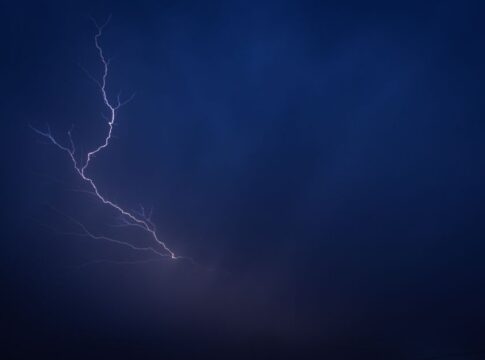
Why Lightning Never Strikes the Same Place Twice Is a Myth
By Trivia Daily, Science Desk — Published July 23, 2026
Table of Contents
- Key Takeaways
- How Lightning Actually Works
- Famous Lightning Magnets Around the World
- The Science Behind Lightning Protection
- Why the Myth Persists
- Frequently Asked Questions
The old saying that “lightning never strikes the same place twice” is one of the most persistent myths in popular culture. In reality, lightning frequently strikes the same locations over and over again, especially tall structures and isolated objects. The Empire State Building, for instance, gets struck roughly 20 to 25 times every year. This scientific fact reveals how lightning behaves according to the laws of physics, not folklore.
Understanding why this myth persists—and what actually happens during a lightning strike—offers a fascinating glimpse into atmospheric physics and the powerful forces at work during thunderstorms.
Key Takeaways
- Lightning frequently strikes the same place multiple times, especially tall or isolated structures like skyscrapers and towers.
- The Empire State Building is struck by lightning approximately 20 to 25 times annually, making it a lightning magnet in New York City.
- Lightning follows the path of least resistance, which means any object that provides a good conducting path to the ground will be struck repeatedly.
- Research shows that certain geographic features and structures are hit thousands of times over their lifetime.
- Understanding lightning behavior has led to the development of lightning rods and protection systems based on solid physics principles.
- The myth likely originated from the improbability of witnessing the same location struck twice, not from scientific observation.
How Lightning Actually Works
Lightning is essentially a massive electrical discharge between clouds and the ground, or between different regions within clouds. During a thunderstorm, ice particles and water droplets collide within clouds, creating electrical charge separation. The bottom of the cloud becomes negatively charged, while the top becomes positively charged. This charge imbalance creates an electric field so strong that it eventually overcomes the insulating properties of air.
When the electrical potential becomes great enough—typically around 100 million volts—the air breaks down and becomes conductive. A channel of ionized air forms, allowing electricity to flow. This creates the brilliant flash we see as lightning, which can reach temperatures of about 30,000 Kelvin—roughly five times hotter than the surface of the Sun.
The path lightning takes is determined by physics, not randomness. It seeks the route of least resistance to the ground, which explains why tall objects are struck more frequently. A skyscraper, tower, or even a lone tree on a hilltop provides a shorter, more direct path for the electrical discharge than the surrounding landscape.
Famous Lightning Magnets Around the World
Certain structures and locations have become famous for their frequent lightning strikes, providing researchers with valuable data about this atmospheric phenomenon. These lightning magnets demonstrate beyond any doubt that the same place can—and will—be struck repeatedly.
| Location/Structure | Approximate Annual Strikes | Notable Features |
|---|---|---|
| Empire State Building, New York | 20-25 times | Height and isolation make it a prime target |
| Willis Tower, Chicago | Multiple times yearly | One of the tallest buildings in North America |
| Lake Maracaibo, Venezuela | Thousands of strikes nightly | Experiences near-constant lightning activity |
| Mount Everest summit | Frequent during monsoon | Highest point on Earth attracts strikes |
Lake Maracaibo in Venezuela holds a special place in lightning research. The area experiences a phenomenon known as Catatumbo lightning, where thunderstorms occur up to 260 nights per year, producing thousands of lightning strikes. This consistent activity has made the region invaluable for atmospheric scientists studying lightning formation and behavior.
The Science Behind Lightning Protection
Benjamin Franklin’s invention of the lightning rod in the 18th century was based on his understanding that lightning could be directed and controlled. His experiments with electricity—though dangerous by modern standards—led to the discovery that pointed metal conductors could safely channel lightning’s energy into the ground.
Modern lightning protection systems work on the same fundamental principle. They don’t prevent lightning strikes; instead, they provide a preferred path for the electrical discharge. A well-designed system includes:
- Air terminals (lightning rods) placed at the highest points of a structure
- Down conductors that carry the electrical current safely to the ground
- Grounding systems that disperse the electricity into the earth
- Surge protection devices that safeguard electrical and electronic equipment
These systems have saved countless lives and prevented enormous property damage. The physics behind them is straightforward: provide lightning with an easier path than the one it would otherwise take through the building’s structure, plumbing, or electrical wiring.
Why the Myth Persists
Despite clear scientific evidence, the “lightning never strikes twice” saying remains common. The myth likely survives for several reasons. First, the probability of any random spot being struck even once is extremely low, making two strikes at the exact same location seem impossibly rare to casual observers. Second, most people don’t witness lightning strikes directly, so they rely on anecdotal evidence and folk wisdom rather than systematic observation.
The saying has also taken on metaphorical meaning, suggesting that rare misfortunes don’t repeat—a comforting thought that may explain its cultural staying power. In this figurative sense, the phrase serves a psychological purpose rather than a scientific one.
Research by meteorological organizations like NOAA has documented lightning patterns extensively, using detection networks and satellite data to track millions of strikes. This data consistently shows that geography and topography create “hot spots” where lightning concentrates its activity year after year, season after season.
Frequently Asked Questions
Can a person be struck by lightning more than once?
Yes, and it has happened to several people throughout history. Roy Sullivan, a U.S. park ranger, was reportedly struck by lightning seven times during his lifetime and survived all encounters, earning him recognition in record books for this unfortunate distinction.
What makes some places more prone to lightning strikes?
Height, isolation, and geographic features all play roles. Tall structures provide shorter paths to ground, while certain weather patterns and topography create conditions favorable for thunderstorm formation. Areas near large bodies of water or mountain ranges often experience more lightning activity.
Is it safe to be in a car during a lightning storm?
Yes, enclosed metal vehicles provide good protection because the metal frame conducts electricity around the passengers and into the ground—a phenomenon called the Faraday cage effect. However, you should avoid touching metal surfaces inside the vehicle and stay away from convertibles or vehicles with fiberglass bodies.
How fast does lightning travel?
The visible lightning bolt travels at about one-third the speed of light, or roughly 100,000 kilometers per second. However, the electrical discharge itself propagates at different speeds during different phases of the strike, with some components moving much slower than others.
Next time you hear someone repeat the old saying about lightning never striking twice, you’ll know the real story. The physics of electrical discharge doesn’t respect folklore—it follows the laws of nature, striking wherever and whenever conditions create the path of least resistance. Those towering skyscrapers and lonely mountaintops will keep getting hit, year after year, proving that in science, facts always trump myths.