
Why Popcorn Pops: The Science Behind Movie Theater Snacks
By Trivia Daily, Staff Writer — Published July 22, 2026
Table of Contents
- Key Takeaways
- The Anatomy of a Popcorn Kernel Explains Why Popcorn Pops Science
- Why Only Certain Corn Pops
- The Two Shapes of Popped Corn
- The Ancient History of Popcorn
- Why Some Kernels Don’t Pop
- The Physics of the Pop
- Frequently Asked Questions
Every kernel of popcorn is a tiny pressure cooker waiting to explode. When you hear that satisfying pop at the movies or in your microwave, you’re witnessing a remarkable transformation driven by water, heat, and the unique anatomy of a single seed. Understanding why popcorn pops science reveals one of nature’s most delightful kitchen tricks—a combination of moisture, pressure, and structural design that turns a hard, inedible kernel into a fluffy, crispy snack. The facts behind this everyday wonder are surprisingly fascinating.
Only one variety of corn—Zea mays everta—can pop. Other types of corn lack the precise combination of hull strength and moisture content needed for the explosive transformation. This makes popcorn not just a snack, but a botanical curiosity.
Key Takeaways
- Popcorn kernels contain about 13-14% moisture trapped inside a hard, non-porous hull that acts as a pressure vessel.
- When heated to around 356°F (180°C), the water inside turns to steam and builds pressure up to approximately 135 pounds per square inch.
- The kernel’s starch gelatinizes under heat and pressure, then rapidly expands and solidifies when the hull ruptures, creating the fluffy white structure.
- Popcorn can pop into two distinct shapes: “mushroom” (round) and “butterfly” (irregular with wings), each suited for different commercial purposes.
- Ancient popcorn discovered in caves in New Mexico dates back roughly 5,600 years, making it one of humanity’s oldest snack foods.
- Unpopped kernels, called “old maids,” result from either insufficient moisture content or tiny cracks in the hull that allow steam to escape.
The Anatomy of a Popcorn Kernel Explains Why Popcorn Pops Science
A popcorn kernel is engineered by nature to explode. Three components work together to create the pop. The outer shell, called the pericarp or hull, is remarkably strong—about five times thicker than the hull of regular corn. This hull is essentially waterproof and airtight, capable of containing tremendous pressure.
Inside this fortress sits the endosperm, a dense mass of hard and soft starch surrounding a small droplet of water. That water is the key. As the kernel heats, the moisture turns to steam. But unlike a pot of boiling water where steam can escape freely, the sealed hull traps it inside. Pressure builds. The starch begins to gelatinize, turning from hard granules into a gel-like substance.
When the internal pressure reaches a critical point—around 135 psi—the hull can no longer contain it. The kernel explodes. The sudden pressure release causes the gelatinized starch to expand rapidly, turning inside-out. As it hits cooler air, the starch solidifies almost instantly into the foam-like structure we recognize as popcorn. The entire process takes less than a second.
Why Only Certain Corn Pops
Not all corn is created equal. Field corn, sweet corn, and ornamental corn won’t pop no matter how much you heat them. Their hulls are either too weak to build sufficient pressure or too porous to trap steam effectively. Popcorn’s hull has a unique crystalline structure that makes it both strong and brittle—strong enough to contain pressure, brittle enough to shatter explosively when the limit is reached.
The moisture content must also fall within a narrow range. Kernels with less than 11% moisture won’t generate enough steam. Those with more than 16% may pop poorly because the excess water makes the starch too soft. Commercial popcorn producers carefully control moisture levels, often storing kernels in climate-controlled environments to maintain that ideal 13-14% range.
The Two Shapes of Popped Corn
Popcorn doesn’t pop randomly. It creates two distinct shapes based on the kernel’s variety and how the hull ruptures. Understanding these shapes reveals interesting trivia about the snack industry.
| Shape Type | Appearance | Commercial Use | Characteristics |
|---|---|---|---|
| Butterfly (Snowflake) | Irregular with protruding “wings” | Movie theaters, home popping | Light, airy texture; holds seasonings in crevices; more fragile |
| Mushroom | Round, compact ball | Caramel corn, candy coating | Denser structure; resists breaking during coating; uniform appearance |
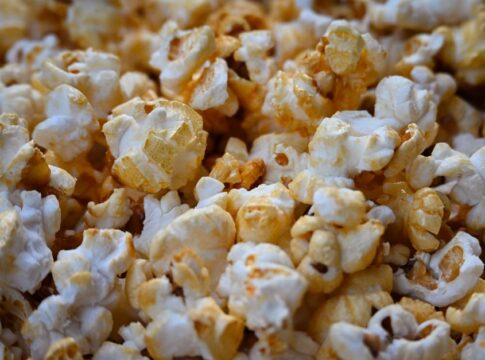
The shape depends on how the kernel’s hull breaks. Butterfly popcorn ruptures at multiple points, creating irregular wings. Mushroom popcorn has a more controlled rupture, typically at a single weak point, allowing the starch to expand more uniformly. Farmers grow specific varieties to produce each shape.
The Ancient History of Popcorn
Popcorn predates recorded history in the Americas. Archaeological evidence from Peru suggests people were popping corn as early as 4700 BCE. In North America, ancient popcorn ears and kernels found in New Mexico’s Bat Cave have been dated to approximately 3600 BCE. Indigenous peoples across the Americas enjoyed popcorn long before European contact, using it not only as food but also in ceremonial headdresses and decorations.
The Aztecs used popcorn in ceremonies honoring their gods, and early Spanish explorers documented seeing Native Americans wearing popcorn garlands. When English colonists celebrated the first Thanksgiving, some historical accounts suggest the Wampanoag brought popcorn to share, though this detail remains debated among historians. What’s certain is that popcorn was already an established food across the Americas by the time Europeans arrived.
Why Some Kernels Don’t Pop
Those stubborn unpopped kernels at the bottom of the bowl have earned the nickname “old maids.” Several factors prevent a kernel from popping. Most commonly, the moisture content is too low—perhaps the bag was stored improperly or the kernels are simply old. Water evaporates slowly even through the tough hull.
Tiny cracks or damage to the hull also create failures. Even a microscopic fracture allows steam to leak out gradually rather than building to explosive pressure. Some kernels may have genetic defects that make their hulls too weak or too strong. Interestingly, you can sometimes revive old maids by storing them in a sealed container with a tablespoon of water for a few days, allowing them to reabsorb moisture.
The Physics of the Pop
The sound of popcorn popping comes from two sources. The initial crack is the hull shattering. But the distinctive “pop” is actually a tiny sonic boom created by the rapid expansion and release of water vapor. High-speed cameras reveal that the kernel actually jumps into the air during popping—sometimes up to three feet—as the starch turns inside-out and pushes against the ground.
Scientists have measured the force of a popping kernel at about 20 times the force of gravity. The expansion rate is extraordinary: a kernel increases in volume by 40 to 50 times within a fraction of a second. This rapid expansion and cooling creates the characteristic crispy, crunchy texture that makes popcorn so satisfying to eat.
Frequently Asked Questions
Why does popcorn sometimes burn before all kernels pop?
Different kernels have slightly different moisture levels and hull thickness, causing them to pop at varying temperatures. Once most kernels have popped, continued heating scorches the already-popped corn before the remaining kernels reach popping temperature. Shaking the pan helps distribute heat more evenly.
Can you pop popcorn without oil?
Yes, popcorn contains enough internal moisture to pop without added oil. Air poppers use hot air alone, and kernels can even pop in a dry pan or paper bag in the microwave. Oil is added primarily for flavor and to help salt and seasonings stick to the popped kernels.
Why is movie theater popcorn so much better?
Theater popcorn typically uses coconut oil or butter-flavored oils with high amounts of salt and artificial butter flavoring. The combination of fats, salt, and flavorings at levels much higher than home preparation creates the distinctive taste. Some theaters also use specialized popping equipment that maintains optimal temperatures.
Is popcorn actually a healthy snack?
Air-popped popcorn is a whole grain that’s high in fiber and relatively low in calories—about 30 calories per cup. It contains polyphenol antioxidants and provides some B vitamins. However, adding butter, oil, salt, or sugar significantly increases calories and can reduce the health benefits.
The next time you hear that familiar popping sound, you’re listening to a miniature explosion powered by nothing more than water and heat. Each kernel is a self-contained pressure vessel, a testament to how even the simplest foods hide remarkable science just beneath the surface.