
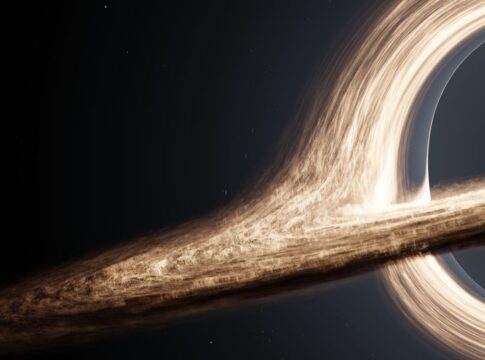
Black Holes Do Not Actually Suck Everything Into Them
By Trivia Daily, Space Desk — Published July 20, 2026
Table of Contents
- Key Takeaways
- How Black Holes Actually Work in Space
- The Event Horizon: Where the Point of No Return Begins
- Why Black Holes Seem So Destructive
- Comparing Black Hole Types and Their Influence
- What NASA Has Discovered About Black Hole Behavior
- Frequently Asked Questions
Despite their terrifying reputation in science fiction, black holes actually behave far more predictably than most people imagine. These cosmic objects don’t roam through space like vacuum cleaners, devouring everything in sight. If our Sun suddenly transformed into a black hole—which, by the way, it never will—Earth would continue orbiting exactly as it does now. The gravitational pull would remain identical. Black holes only consume matter that ventures too close to a specific boundary, and beyond that threshold, they’re no more dangerous than any other massive object in the universe.
The misconception likely stems from black holes’ extreme density and the dramatic way they warp spacetime. When a massive star collapses, it compresses all its mass into an incredibly small volume, creating gravitational forces so intense that not even light can escape from within a certain radius. But gravity itself doesn’t change. A black hole with the mass of our Sun exerts the same gravitational influence as our Sun does right now—it’s just concentrated in a much smaller space.
Key Takeaways
- Black holes only pull in objects that come within a specific distance called the event horizon, which varies based on the black hole’s mass.
- If the Sun became a black hole, Earth and all the planets would continue their orbits unchanged because the gravitational force would remain the same.
- Supermassive black holes sit at the centers of most galaxies, including our Milky Way, without consuming the entire galaxy around them.
- Objects can safely orbit black holes just as planets orbit stars, provided they maintain sufficient distance and velocity.
- The “sucking” effect only becomes irresistible once matter crosses the event horizon, a point of no return specific to each black hole.
- NASA and other space agencies study black holes using X-ray telescopes because matter heating up as it spirals inward emits detectable radiation.
How Black Holes Actually Work in Space
Black holes form when massive stars—typically at least 20 times the mass of our Sun—exhaust their nuclear fuel and collapse under their own gravity. This collapse compresses the star’s entire mass into an extraordinarily small region, creating a gravitational field so strong that it warps the fabric of spacetime itself. The boundary surrounding this collapsed core is the event horizon, the point beyond which escape becomes impossible.
Here’s the crucial part: the gravitational influence of a black hole extends outward following the same inverse-square law that governs all gravity in the cosmos. Double your distance from a black hole, and the gravitational pull becomes four times weaker. This means objects far away from a black hole experience relatively normal gravitational effects. Planets, stars, and even entire solar systems can orbit black holes safely, just as Earth orbits the Sun.
The supermassive black hole at the center of our Milky Way galaxy, known as Sagittarius A*, contains roughly four million times the mass of our Sun. Yet stars orbit this monster at safe distances, following predictable paths that astronomers have tracked for decades. These stars aren’t being sucked in. They’re simply obeying the laws of orbital mechanics, the same principles that keep satellites circling Earth.
The Event Horizon: Where the Point of No Return Begins
The event horizon represents the true danger zone around a black hole. This spherical boundary marks the distance at which the escape velocity equals the speed of light. Inside this radius, not even light travels fast enough to break free from the gravitational pull. Outside this boundary, however, objects can escape if they have sufficient velocity, just like a rocket leaving Earth’s atmosphere.
The size of an event horizon depends entirely on the black hole’s mass. A black hole with the mass of Earth would have an event horizon roughly the size of a marble. A black hole with ten times the Sun’s mass would have an event horizon with a radius of about 30 kilometers. Supermassive black holes at galactic centers have event horizons millions of kilometers across. But in all cases, you must actually cross this boundary to be irrevocably trapped.
Think of it this way: you can orbit just outside a black hole’s event horizon indefinitely, provided you maintain the right speed and trajectory. Matter does exactly this in accretion disks, the swirling rings of gas and dust that spiral around black holes. This material heats to millions of degrees as it compresses and accelerates, emitting X-rays and other radiation that astronomers detect from Earth.
Why Black Holes Seem So Destructive
The reputation of black holes as cosmic destroyers comes partly from what happens to matter that does venture too close. Tidal forces—differences in gravitational pull across an object—become extreme near a black hole’s event horizon. An astronaut falling feet-first toward a black hole would experience much stronger gravity at their feet than at their head, stretching them like spaghetti in a process scientists call “spaghettification.” This is genuinely terrifying, but it only occurs very close to the event horizon.
Black holes also appear destructive because of the violence surrounding them. When matter spirals inward, friction and compression generate tremendous heat and energy. Some black holes produce jets of particles shooting outward at nearly the speed of light, extending for thousands of light-years. These phenomena make black holes seem like aggressive cosmic predators, when in reality they’re simply converting gravitational potential energy into other forms.
Comparing Black Hole Types and Their Influence
| Black Hole Type | Mass Range | Event Horizon Size | Where Found |
|---|---|---|---|
| Stellar-mass | 3–100 solar masses | 9–300 kilometers | Throughout galaxies, remnants of massive stars |
| Intermediate-mass | 100–100,000 solar masses | 300 km–300,000 km | Dense star clusters, possibly in dwarf galaxies |
| Supermassive | Millions to billions of solar masses | Millions to billions of kilometers | Centers of most large galaxies |
What NASA Has Discovered About Black Hole Behavior
NASA missions have revolutionized our understanding of how black holes interact with their surroundings. The Chandra X-ray Observatory has observed black holes in binary systems, where a black hole orbits a normal star. In these systems, the black hole doesn’t simply consume its companion. Instead, it gradually pulls gas from the star’s outer layers, and this gas forms an accretion disk before eventually crossing the event horizon. The process can continue for millions of years with the star remaining largely intact.
The Event Horizon Telescope collaboration, which includes NASA among other institutions, produced the first direct image of a black hole’s shadow in 2019. This image of the supermassive black hole in galaxy M87 showed the glowing accretion disk surrounding the dark event horizon. The black hole wasn’t devouring the entire galaxy. It was sitting at the center, with matter orbiting at safe distances, only occasionally falling in when orbital paths decayed or collisions occurred.
Observations have also revealed that black holes can be surprisingly dormant. Sagittarius A* at our galaxy’s center is relatively quiet, consuming material at a modest rate. If black holes truly sucked in everything around them, galactic centers would be far more active and violent than what astronomers observe.
Frequently Asked Questions
Could a black hole ever reach Earth?
No black hole is close enough to Earth to pose any threat. The nearest known black hole is thousands of light-years away, and black holes don’t move through space any differently than stars do—they follow gravitational laws and orbital paths just like any other massive object in the cosmos.
What would happen if you fell into a black hole?
You would be stretched by tidal forces as you approached the event horizon, eventually being torn apart. After crossing the event horizon, you would inevitably reach the singularity at the center, though what happens there remains beyond our current understanding of physics.
Do black holes ever stop growing?
Black holes can stop growing if they run out of nearby matter to consume. Many black holes are essentially dormant, with little material crossing their event horizons. They can theoretically lose mass through Hawking radiation, though this process is extremely slow for large black holes.
Can anything escape from a black hole?
Nothing can escape from inside the event horizon, but matter outside this boundary can escape just like anything else in space. The event horizon is the absolute point of no return—inside it, all paths lead to the singularity at the center.
The universe contains billions of black holes, and galaxies continue to exist around them without being consumed. These enigmatic objects follow the same gravitational rules as everything else in space—they just take those rules to their most extreme conclusion. Rather than cosmic monsters, black holes are natural consequences of stellar evolution, sitting quietly in space unless something ventures too close to their event horizon.