
Black Holes: The Truth About What Really Happens Inside
By Trivia Daily, Space Desk — Published July 20, 2026
Table of Contents
- Key Takeaways
- The Black Holes Truth About Gravity and the Event Horizon
- Time Dilation and the Warping of Space
- What Lies Beyond the Event Horizon
- Types of Black Holes Across the Universe
- Black Holes and the Information Paradox
- Observing Black Holes from Earth
- Frequently Asked Questions
Black holes are among the most misunderstood objects in the cosmos. Popular culture has painted them as cosmic vacuum cleaners that suck up everything in sight, but the black holes truth is far stranger and more fascinating. These dense regions of space warp the fabric of the universe itself, creating conditions so extreme that our everyday understanding of physics breaks down completely. What actually happens inside a black hole remains one of astronomy’s most captivating mysteries.
NASA and other space agencies have spent decades studying these cosmic enigmas, and while we can’t see inside them directly, modern physics gives us remarkable insights into their nature. From the event horizon to the singularity at the center, black holes challenge everything we think we know about time, space, and matter.
Key Takeaways
- Black holes don’t actually “suck” objects in—they exert gravitational pull just like any massive object, and you’d need to get extremely close to be captured.
- Time appears to stop at the event horizon when viewed from the outside, but someone falling in would experience time normally until they reach the singularity.
- Spaghettification is the real term scientists use for the process where tidal forces stretch objects into long, thin shapes near a black hole.
- Supermassive black holes exist at the centers of most galaxies, including our own Milky Way, where one called Sagittarius A* resides roughly 26,000 light-years from Earth.
- Black holes can actually emit radiation through a quantum process called Hawking radiation, meaning they very slowly evaporate over unimaginably long timescales.
- Nothing that crosses the event horizon can escape, not even light, which is why these objects appear completely black against the backdrop of space.
The Black Holes Truth About Gravity and the Event Horizon
The event horizon is the point of no return. Cross this boundary, and escape becomes physically impossible. But here’s what many people get wrong: black holes don’t reach out and grab things. Their gravitational influence works exactly like that of any other massive object in the universe. If our Sun suddenly became a black hole of the same mass, Earth would continue orbiting at the same distance—we wouldn’t spiral inward.
The danger comes from getting close. Near the event horizon, gravity becomes so intense that the difference in gravitational pull between your head and feet (if you were falling feet-first) would be enormous. This tidal force stretches objects vertically while compressing them horizontally. Scientists call this spaghettification, and yes, that’s the actual technical term used in peer-reviewed astronomy papers.
The size of an event horizon depends on the black hole’s mass. Stellar black holes, formed from collapsed stars, might have event horizons just a few miles across. Supermassive black holes at galactic centers can have event horizons larger than our entire solar system.
Time Dilation and the Warping of Space
Einstein’s general relativity predicts something truly bizarre happens to time near black holes. An outside observer watching someone fall toward the event horizon would see them slow down, moving more and more sluggishly as they approached the boundary. They would appear to freeze at the horizon itself, their image dimming and redshifting as light struggled to escape the intense gravity.
But the falling person experiences something completely different. From their perspective, time flows normally. They would cross the event horizon without noticing anything special at that exact moment—no barrier, no wall, just empty space. Only the increasingly intense tidal forces would signal their doom.
This time dilation effect is real and measurable. GPS satellites orbiting Earth experience it on a tiny scale and must account for relativistic effects to maintain accuracy. Near a black hole, these effects become extreme.
What Lies Beyond the Event Horizon
Once past the event horizon, all paths lead to the singularity at the center. In classical general relativity, the singularity is a point of infinite density where the curvature of spacetime becomes infinite. At this point, our current physics breaks down completely. We simply don’t have equations that can describe what happens there.
The journey from event horizon to singularity would be brief for a stellar black hole—perhaps a fraction of a second. For a supermassive black hole, you might have hours. During this time, the tidal forces would intensify catastrophically. Every atom in your body would be torn apart, then every subatomic particle, until nothing recognizable remained.
Some theoretical physicists have proposed alternatives to the classical singularity. Quantum gravity effects might prevent true infinite density, creating instead a region of extremely compressed but not infinite matter. Others have speculated about wormholes connecting to other regions of spacetime. These remain speculative ideas without observational evidence.
Types of Black Holes Across the Universe
| Type | Mass Range | Formation | Where Found |
|---|---|---|---|
| Stellar | 3-100 solar masses | Collapse of massive stars | Scattered throughout galaxies |
| Intermediate | 100-100,000 solar masses | Unknown (possibly merged stellar black holes) | Globular clusters, dwarf galaxies |
| Supermassive | Millions to billions of solar masses | Unknown (formed early in universe) | Centers of most large galaxies |
| Primordial (theoretical) | Less than stellar mass | Early universe density fluctuations | Possibly scattered through cosmos |
Black Holes and the Information Paradox
Stephen Hawking discovered that black holes aren’t completely black. Quantum effects near the event horizon cause them to emit thermal radiation, now called Hawking radiation. This means black holes very slowly lose mass over time, eventually evaporating completely after an almost incomprehensibly long period.
This discovery created a major problem in physics. Quantum mechanics says information cannot be destroyed, but if a black hole evaporates completely, what happens to all the information about the matter that fell in? This information paradox has puzzled physicists for decades. Recent theoretical work suggests the information might be encoded in the Hawking radiation itself, but the debate continues.
The evaporation timescale is staggering. A solar-mass black hole would take roughly 10^67 years to evaporate—far longer than the current age of the universe. Supermassive black holes would take even longer. For practical purposes, black holes are gaining mass faster than they’re losing it through Hawking radiation.
Observing Black Holes from Earth
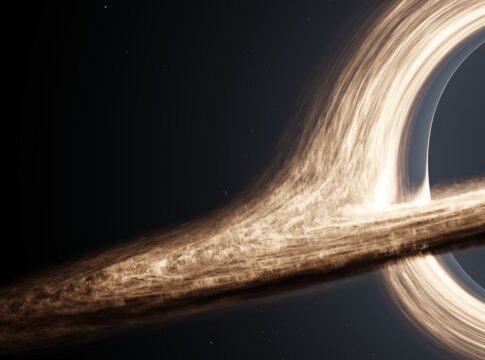
We can’t see black holes directly, but astronomers have become expert at detecting their effects. When matter falls toward a black hole, it forms an accretion disk—a swirling disk of superheated gas that emits intense radiation across the electromagnetic spectrum. These are among the brightest objects in the universe.
The Event Horizon Telescope collaboration made history by capturing the first image of a black hole’s shadow in 2019. The target was the supermassive black hole at the center of galaxy M87. The image showed a dark region surrounded by a glowing ring of hot gas, exactly as predicted by general relativity.
Gravitational wave detectors like LIGO have opened another window into black hole physics. When two black holes spiral together and merge, they create ripples in spacetime itself that propagate outward at the speed of light. These detections have confirmed that stellar-mass black holes are common throughout the universe.
Frequently Asked Questions
Could you survive falling into a supermassive black hole?
You could theoretically survive crossing the event horizon of a supermassive black hole because tidal forces would be gentler than near a stellar black hole. However, you’d still be doomed to reach the singularity within hours, and there would be no way to send information back out or escape.
What would you see looking out from inside a black hole?
Theoretically, you’d see the entire future history of the outside universe play out in fast-forward due to extreme time dilation effects. The view would be compressed into a shrinking circle behind you, while ahead you’d see only darkness leading to the singularity.
Are white holes the opposite of black holes?
White holes are theoretical solutions to Einstein’s equations that would expel matter and light instead of absorbing them. However, no observational evidence suggests they exist in nature, and most physicists consider them mathematical curiosities rather than real objects.
Can anything escape from a black hole?
Nothing that crosses the event horizon can escape—this is fundamental to the definition of a black hole. However, Hawking radiation is emitted from just outside the event horizon, and intense jets of matter can be expelled from the accretion disk before it crosses the point of no return.
Black holes remain laboratories for testing the most extreme predictions of physics. Every new observation refines our understanding of these cosmic mysteries, yet fundamental questions remain unanswered. As NASA missions and ground-based observatories continue mapping the universe, each discovery brings us closer to understanding what truly happens in the most extreme environments the cosmos has to offer.