
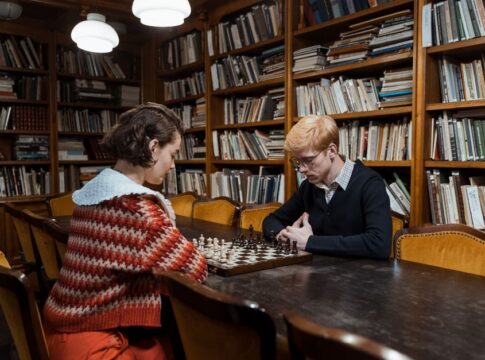
Why Do Chess Grandmasters Play Multiple Games Blindfolded
By Triv Central, Staff Writer — Published September 19, 2026
Table of Contents
- Key Takeaways
- How Chess Grandmasters Play Without Seeing the Board
- The Surprising History of Blindfold Chess
- What Makes Simultaneous Blindfold Play Possible
- Comparing Blindfold Chess Records
- Why Grandmasters Continue This Practice
- Frequently Asked Questions
Picture a chess grandmaster sitting with their back to a dozen boards, eyes closed or wearing a blindfold, playing against a dozen opponents simultaneously. They call out moves like “Knight to f3” and “Queen takes e5” without seeing a single piece. It sounds impossible, yet chess grandmasters play blindfold chess regularly, and some have managed more than forty games at once. This astonishing feat reveals something fascinating about how the human brain stores and manipulates information.
Blindfold chess isn’t a party trick. It’s a window into the sophisticated mental architecture that separates masters from beginners. The ability to visualize multiple chess positions simultaneously demonstrates a level of pattern recognition and memory organization that neuroscientists find remarkable.
Key Takeaways
- Chess grandmasters memorize positions as meaningful patterns rather than individual pieces, allowing them to hold entire games in their minds.
- The record for simultaneous blindfold games stands at 48, demonstrating extraordinary working memory capacity.
- Blindfold play was once suspected of causing insanity and was briefly banned in the Soviet Union during the 1930s.
- Strong players don’t visualize the board photographically; they represent positions as networks of piece relationships and tactical themes.
- Regular blindfold practice doesn’t necessarily improve overall chess strength but does enhance calculation depth and visualization skills.
- Many grandmasters find blindfold chess easier than casual players imagine because they’ve internalized chess patterns through thousands of hours of study.
How Chess Grandmasters Play Without Seeing the Board
The secret lies in chunking. When beginners look at a chess position, they see thirty-two individual pieces. Masters see patterns: a fianchettoed bishop, a backward pawn, a rook lift preparation. Research has shown that grandmasters organize chess information into meaningful clusters, dramatically reducing the mental load required to remember positions.
A famous study from the 1970s demonstrated this beautifully. When shown actual game positions for just a few seconds, masters could reproduce them almost perfectly while beginners struggled. But when shown random arrangements of pieces, masters performed no better than novices. The difference wasn’t photographic memory. Masters had learned to recognize the logical structures that arise in real games.
During blindfold play, grandmasters maintain a dynamic mental model of each board. They don’t “see” the position like a photograph. Instead, they track piece locations, control of key squares, pawn structures, and tactical motifs. When an opponent announces a move, the grandmaster updates their mental representation and calculates responses.
The Surprising History of Blindfold Chess
Blindfold chess dates back centuries. Early masters performed it as a demonstration of their skill, often in royal courts or public exhibitions. The practice gained popularity in the 19th century when strong players began attempting multiple simultaneous blindfold games.
Authorities once viewed blindfold chess with suspicion. In 1930s Soviet Russia, officials briefly banned the practice after a psychiatrist claimed it could damage mental health. The ban didn’t last long, and no credible evidence ever supported the claim. Still, the myth that blindfold chess causes psychological harm persisted for decades.
The number of simultaneous blindfold games has grown dramatically over time. Early exhibitions might involve three or four boards. By the mid-20th century, masters were tackling twenty or more. The current record, recognized by Guinness World Records, stands at 48 simultaneous blindfold games, achieved in 2011.
What Makes Simultaneous Blindfold Play Possible
Playing one blindfold game requires intense concentration. Playing dozens simultaneously seems to defy the limits of human working memory, which psychological research suggests can hold only about seven items at once. How do grandmasters manage it?
The answer involves several cognitive strategies working together. First, grandmasters don’t hold all positions in active memory simultaneously. They mentally “file away” each board after making a move, then retrieve it when the next move arrives. This cycling through positions uses long-term memory storage, not just working memory.
Second, many positions in simultaneous exhibitions follow familiar patterns. Grandmasters often employ similar opening systems across multiple boards, creating overlapping mental structures. If twelve boards feature the same opening variation, the master only needs to track how each position diverges from the standard pattern.
Third, not all games demand equal attention. Some opponents make obvious mistakes, allowing quick responses. Others play more challenging moves requiring deeper calculation. Masters allocate mental resources dynamically, spending more time on difficult positions.
Memory Techniques Masters Use
Grandmasters develop personalized memory systems for tracking multiple games. Some assign each board a mental location, creating a “memory palace” where position details are stored. Others use verbal coding, maintaining running narratives about each game’s strategic themes.
The boards themselves provide structure. Knowing that Board 7 is the opponent playing the French Defense, Board 12 has the isolated queen pawn position, and Board 3 just entered a rook endgame creates distinct mental categories. These labels serve as retrieval cues when cycling through positions.
Comparing Blindfold Chess Records
| Record Type | Number of Games | Notable Achievement |
|---|---|---|
| Most simultaneous blindfold games | 48 | Recognized by Guinness World Records |
| Longest single blindfold game | Over 7 hours | Required remembering 100+ moves |
| Highest score in blindfold simul | 45 wins, 2 draws, 1 loss | From 48-board exhibition |
| Youngest blindfold simul (10+ boards) | Age 12 | Demonstrates early pattern mastery |
Why Grandmasters Continue This Practice
Blindfold chess serves multiple purposes beyond spectacle. It sharpens calculation skills by forcing players to visualize variations without external references. When you can’t glance at the board to verify a sequence, you must calculate more carefully and trust your mental representation.
The practice also builds confidence. A player who can conduct entire games mentally develops unwavering trust in their visualization ability during regular play. This confidence translates to more ambitious combinations and deeper strategic planning.
Some masters find blindfold chess artistically satisfying. Without visual distractions, the game becomes purely abstract—a dance of patterns and ideas. The aesthetic pleasure of seeing (mentally) a beautiful combination unfold provides its own reward.
Training camps and chess schools sometimes incorporate blindfold exercises, though not at the extreme level of simultaneous exhibitions. Even playing a single game blindfolded challenges intermediate players to strengthen their board vision and piece coordination understanding.
Frequently Asked Questions
Can anyone learn to play blindfold chess?
Yes, with practice most chess players can learn to play at least one game blindfolded. The skill develops gradually as players internalize piece movements and common patterns. Strong club players often find they can manage blindfold games after dedicated practice, though simultaneous exhibitions require master-level expertise.
Do chess computers play blindfold chess?
Chess engines don’t “see” the board visually at all—they process positions as data structures, making all their chess effectively blindfolded. However, the term blindfold chess specifically refers to human players performing without visual access to the board, so it doesn’t apply to computer play.
Does blindfold chess improve your regular chess strength?
Blindfold practice enhances visualization and calculation skills, which can improve tactical ability. However, it doesn’t directly address other crucial chess skills like opening preparation, endgame technique, or strategic planning. Most grandmasters view it as a supplementary training tool rather than a primary method for improvement.
What’s the difference between blindfold chess and playing with your eyes closed?
They’re essentially the same. Some exhibitions use actual blindfolds for dramatic effect, while others simply have the master sit facing away from the boards or keep their eyes closed. The cognitive challenge remains identical: maintaining mental representations of all positions without visual input.
The next time you struggle to remember where you parked your car, consider that somewhere a chess grandmaster is simultaneously tracking the positions of 1,536 pieces across 48 boards—all in their head. The human brain’s capacity for pattern recognition, when properly trained, remains one of nature’s most impressive achievements.