Why Rubik's Cube Has 43 Quintillion Combinations Possible
By Triv Central, Staff Writer — Published July 27, 2026
Table of Contents
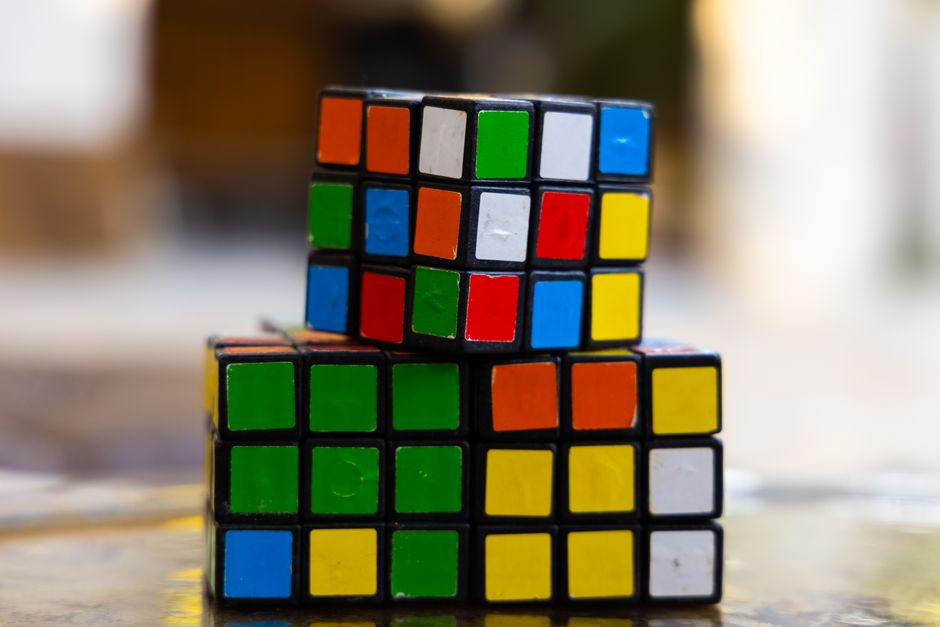
The colorful puzzle that has captivated minds since the 1980s holds a mathematical secret so staggering it defies comprehension. A standard Rubik's Cube possesses exactly 43,252,003,274,489,856,000 possible configurations—that's 43 quintillion combinations. This number isn't just trivia; it reveals the hidden complexity lurking within a simple 3x3x3 cube of plastic and stickers, transforming what looks like a children's toy into one of the most mathematically interesting objects ever created.
Understanding why the Rubik cube quintillion figure exists requires exploring the mathematics of permutations, the constraints of physical reality, and the surprising facts about how these colorful squares can be arranged. What seems like a straightforward counting problem becomes a fascinating journey into combinatorics.
Key Takeaways
- The Rubik's Cube has exactly 43,252,003,274,489,856,000 possible combinations—a number so large it would take longer than the age of the universe to try them all at one per second.
- Despite the astronomical number of combinations, any scrambled cube can be solved in 20 moves or fewer, a fact proven mathematically in 2010.
- The calculation involves factorial mathematics, but physical constraints reduce the theoretical number significantly.
- Corner pieces and edge pieces follow different mathematical rules, with corners having 8! arrangements and edges having 12! arrangements.
- Only one in twelve random arrangements of a disassembled cube can actually be solved through legal moves.
- If you laid out every possible Rubik's Cube combination, you'd need more cubes than there are atoms in approximately 300 Earth-sized planets.
The Mathematics Behind the Rubik Cube Quintillion Combinations
1. Eight Corner Pieces Create the Foundation
A Rubik's Cube contains eight corner pieces, each displaying three colors. These corners can be arranged in 8! (8 factorial) ways, which equals 40,320 different positions. Each corner can also be oriented in three different ways while staying in the same position, giving us 3^8 or 6,561 orientations. Multiply these together and corners alone contribute over 264 million possibilities.
2. Twelve Edge Pieces Multiply the Complexity
The twelve edge pieces, each showing two colors, can be arranged in 12! ways—that's 479,001,600 positions. Each edge piece has two possible orientations, giving us 2^12 or 4,096 orientation combinations. The edge pieces alone create roughly 1.96 trillion possibilities before we even combine them with corner calculations.
3. Physical Constraints Divide by Twelve
Here's where it gets interesting. Not every mathematical arrangement is physically possible through legal moves. The cube's mechanical design creates parity constraints: you cannot flip a single edge piece or rotate a single corner in isolation. These constraints divide the theoretical maximum by twelve, giving us our famous quintillion figure.
4. The Center Pieces Don't Move
Each face has a center piece that defines that face's color. These centers never move relative to each other—they only rotate around their own axis. This fixed framework is why we can always determine which color belongs on which face, regardless of how scrambled the cube appears.
5. Factorial Growth Explains the Explosion
Factorial numbers grow shockingly fast. While 3! equals just 6, by the time you reach 12!, you're at nearly half a trillion. This exponential growth in permutations explains why adding just a few more pieces creates mind-boggling increases in possible combinations.
6. The Exact Formula Revealed
The precise calculation is (8! × 3^7 × 12! × 2^11) / 12. The division by twelve accounts for the parity constraints mentioned earlier. This elegant formula captures all the mathematical relationships governing the cube's possible states.
7. God's Number Is Twenty
Despite 43 quintillion combinations, every possible scramble can be solved in twenty moves or fewer. This maximum number, called "God's number," was proven in 2010 using massive computer calculations funded by Google. The proof required examining billions of cube positions.
8. Most Positions Require Eighteen to Twenty Moves
While twenty is the maximum, most scrambled cubes need between eighteen and twenty moves for optimal solution. Very few positions can be solved in fewer than fifteen moves, making those simpler scrambles relatively rare in the vast landscape of possibilities.
9. One Second Per Combination Would Take Eons
If you could examine one combination every second, working through all 43 quintillion would require roughly 1.4 trillion years. The universe is only about 13.8 billion years old—you'd need over 100 times the current age of the universe to complete the task.
10. More Combinations Than Atoms in Many Scenarios
The human body contains approximately 7 × 10^27 atoms. The Rubik's Cube has about 4.3 × 10^19 combinations. While the body has more atoms, the cube's combination count exceeds the number of grains of sand on Earth's beaches by a comfortable margin.
11. Only One Starting Position Exists
Of all those quintillions of combinations, only one represents a solved cube. Every other configuration is some degree of scrambled. This means solving the cube is literally finding one specific arrangement among 43 quintillion possibilities.
12. Disassembling Creates Unsolvable Cubes
If you take apart a cube and reassemble it randomly, there's an eleven in twelve chance you'll create an impossible configuration. Only one-twelfth of all physical arrangements can be reached through legal moves from a solved state.
13. The Inventor Took a Month to Solve His Creation
Ernő Rubik, the Hungarian architect who invented the cube in 1974, spent about a month working out how to solve his own puzzle. He initially wasn't even sure if a solution existed, making his invention as much a
discovery as a creation.
14. Symmetry Reduces Unique Patterns
While 43 quintillion combinations exist, many are symmetrical rotations of each other. If you consider rotations and reflections as identical, the number of truly unique patterns drops significantly—though it remains in the trillions.
15. Bigger Cubes Explode the Numbers
A 4x4x4 cube has approximately 7.4 × 10^45 combinations. A 5x5x5 cube reaches about 2.8 × 10^74. The growth isn't linear—it's explosively exponential, making larger cubes monumentally more complex.
16. The First Solution Method Was Published in 1979
David Singmaster published the first mathematical solution to the Rubik's Cube in 1979, creating a notation system still used today. His layer-by-layer method made solving accessible to millions, transforming the puzzle from mathematical curiosity to global phenomenon.
17. Speedcubers Use Different Algorithms
Modern speedcubing champions use methods like CFOP (Cross, F2L, OLL, PLL) that can solve any combination in under ten seconds. These advanced techniques require memorizing dozens of algorithms but dramatically reduce move counts.
18. Random Moves Create Maximum Scrambling Quickly
Surprisingly, just twenty random moves from a solved state will typically produce a thoroughly scrambled cube. Beyond twenty moves, you're not making it significantly "more scrambled"—you're just moving through the same vast space of possibilities.
19. The Cube Has Group Theory Structure
Mathematicians classify the Rubik's Cube as a permutation group, specifically the Rubik's Cube group. This mathematical structure helps explain why certain move sequences always produce predictable results, regardless of the starting position.
20. Corner Orientation Parity Rule
You cannot twist just one corner by a third of a turn. The sum of all corner twists must be divisible by three. This constraint is built into the cube's mechanical design and eliminates two-thirds of theoretically possible corner orientations.
21. Edge Orientation Parity Rule
Similarly, you cannot flip just one edge piece. The total number of flipped edges must be even. This halves the number of possible edge orientations that can be reached through legal moves.
22. Position Parity Rule
You cannot swap just two pieces—corners or edges—in isolation. Any legal sequence of moves either swaps an even number of piece pairs or none at all. This rule eliminates half of the theoretical positional arrangements.
23. The Superflip Position Is Famous
One specific position called "superflip" flips all twelve edges while keeping everything else solved. It requires exactly twenty moves to reach from a solved state, making it one of the positions that demonstrates God's number.
24. Checkerboard Patterns Are Relatively Close
The striking checkerboard pattern, where each face shows a checkerboard of two colors, requires only six moves from solved. Despite looking dramatically scrambled, it's actually very close to the starting position in the space of all possibilities.
25. Blindfolded Solving Is Humanly Possible
Competitors regularly solve Rubik's Cubes blindfolded after a brief inspection period. They memorize the scramble pattern and execute a solution entirely from memory, demonstrating that human minds can navigate this quintillion-combination space with practice.
26. Computers Can Generate Optimal Solutions
Modern algorithms can find optimal solutions (the shortest possible) for any cube position, though this requires significant computing power. These optimal solutions demonstrate that the seemingly chaotic scramble follows precise mathematical rules.
27. The Cube Was Originally Called the Magic Cube
Rubik initially named his invention the "Magic Cube" when it launched in Hungary in 1977. The name changed to Rubik's Cube when Ideal Toy Corporation began international distribution in 1980, creating the brand we know today.
28. Over 400 Million Cubes Have Been Sold
The Rubik's Cube is one of the best-selling puzzles in history, with over 400 million sold worldwide. If each owner explored just one unique combination, they'd still only see a tiny fraction of the possible arrangements.
29. The World Record Is Under Four Seconds
The current world record for solving a Rubik's Cube is under four seconds. These speedcubers have internalized hundreds of algorithms and can recognize patterns instantly, navigating the quintillion possibilities with remarkable efficiency.
30. Robots Solve Even Faster
Specialized robots have solved Rubik's Cubes in under half a second. These machines use computer vision to analyze the scramble and execute optimal solutions with mechanical precision far exceeding human capabilities.
31. The Cube Inspired Mathematical Research
The Rubik's Cube has generated serious mathematical research in group theory, algorithms, and combinatorics. Academic papers continue to explore its mathematical properties, proving that this toy has genuine intellectual depth.
32. Notation Systems Make Algorithms Shareable
Standardized notation (R for right, L for left, U for up, etc.) allows cubers worldwide to share solutions. This common language transforms the quintillion-combination problem into a collaborative puzzle-solving community.
33. The Cube Has Inspired Countless Variations
From pyramids to dodecahedrons to cubes with different dimensions, the original has spawned hundreds of variations. Each new shape creates its own astronomical number of combinations based on similar mathematical principles.
34. Some Positions Look Similar But Differ Vastly
Two cube states might look nearly identical but could be hundreds of moves apart in solution distance. The mathematical space of combinations doesn't correspond neatly to visual similarity, creating counterintuitive relationships.
35. Pattern Databases Help Computers Solve Efficiently
Computer programs use pattern databases that pre-calculate solutions for millions of sub-positions. By breaking the quintillion-combination problem into manageable chunks, these databases enable fast optimal solving.
36. The Cube's Mechanism Enables the Mathematics
The internal mechanism with its clever ball-and-socket design is what makes the mathematical possibilities physical reality. The engineering had to match the mathematics—a remarkable achievement in mechanical design.
37. Color Schemes Vary by Region
While the number of combinations remains constant, official color schemes differ between Western and Japanese cubes. These variations don't affect the mathematics but show how cultural preferences influence even mathematical objects.
38. The Cube Appears in Popular Culture
From movies to television to art installations, the Rubik's Cube has become a cultural icon representing problem-solving and intelligence. Its quintillion combinations make it a perfect metaphor for complex challenges.
39. Collectors Seek Rare Vintage Models
Early Hungarian-made cubes from the late 1970s are collector's items. Despite having the same 43 quintillion combinations as modern versions, these vintage models command premium prices for their historical significance.
40. The Cube Teaches Perseverance
Facing 43 quintillion possibilities, new solvers must learn persistence. The cube's difficulty—and ultimate solvability—makes it an effective tool for teaching problem-solving strategies and mathematical thinking.
41. One-Handed Solving Is a Competitive Category
Competitors solve cubes using only one hand, navigating the same quintillion combinations with reduced dexterity. Current one-handed world records are under ten seconds, demonstrating remarkable skill adaptation.
42. Feet Solving Was Once an Official Category
Until recently, solving with feet was an official World Cube Association category. Competitors would manipulate the cube using only their feet, proving that humans can navigate this mathematical space through various methods.
43. The Cube Remains Mathematically Fascinating
Decades after its invention, mathematicians continue discovering new properties of the Rubik's Cube group. The 43 quintillion combinations ensure that this simple-looking puzzle retains genuine mathematical depth, with research applications extending into computer science, robotics, and abstract algebra.
Frequently Asked Questions
Can every Rubik's Cube combination be solved?
Yes, every one of the 43 quintillion possible combinations can be solved and returned to the starting position. However, if you physically disassemble and randomly reassemble a cube, there's an eleven in twelve chance you'll create an impossible configuration that cannot be solved through legal moves.
How long would it take to try every Rubik's Cube combination?
At one combination per second, trying all 43,252,003,274,489,856,000 possibilities would take approximately 1.4 trillion years—roughly 100 times longer than the current age of the universe. This makes exhaustive searching completely impractical.
What's the minimum number of moves to solve any scrambled Rubik's Cube?
The maximum number of moves needed to solve any scrambled Rubik's Cube is twenty, a number mathematically proven in 2010 and known as "God's number." Most scrambled positions require between eighteen and twenty moves for optimal solution