










1 / 10 Questions
0 Points

What Sea Creature Has Blue Blood Due To Copper?

Clownfish

Octopus

Sea Turtle

Dolphin

Points won
0
Correct score
0%

More Questions

More Articles

Why Do Chess Grandmasters Play Multiple Games Blindfolded

Why Do Chess Grandmasters Play Multiple Games Blindfolded

Why Do Chess Grandmasters Play Multiple Games Blindfolded

By Triv Central, Staff Writer — Published September 19, 2026

Table of Contents

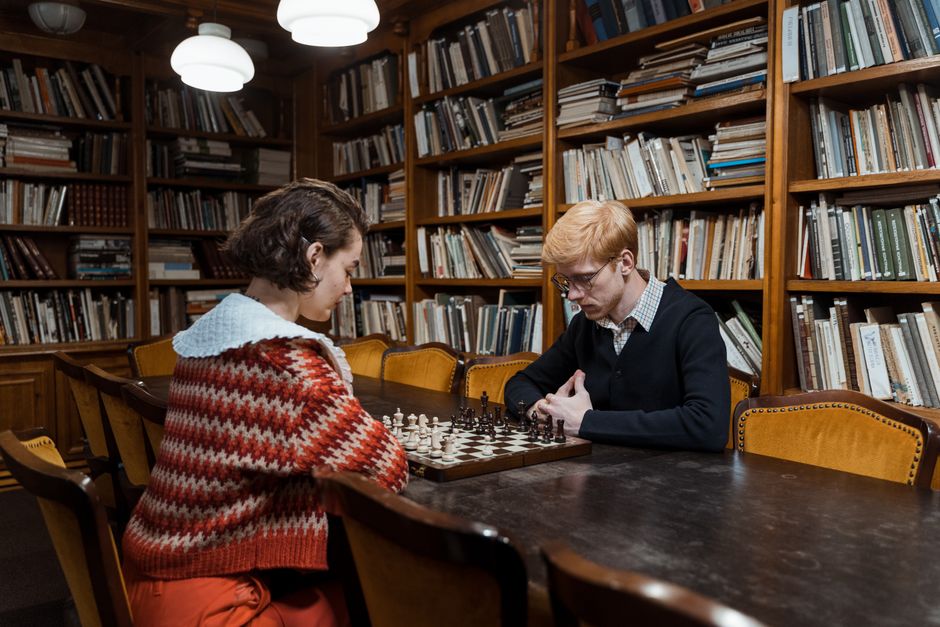
Picture a chess grandmaster sitting with their back to a dozen boards, eyes closed or wearing a blindfold, playing against a dozen opponents simultaneously. They call out moves like "Knight to f3" and "Queen takes e5" without seeing a single piece. It sounds impossible, yet chess grandmasters play blindfold chess regularly, and some have managed more than forty games at once. This astonishing feat reveals something fascinating about how the human brain stores and manipulates information.

Blindfold chess isn't a party trick. It's a window into the sophisticated mental architecture that separates masters from beginners. The ability to visualize multiple chess positions simultaneously demonstrates a level of pattern recognition and memory organization that neuroscientists find remarkable.

Key Takeaways

  • Chess grandmasters memorize positions as meaningful patterns rather than individual pieces, allowing them to hold entire games in their minds.
  • The record for simultaneous blindfold games stands at 48, demonstrating extraordinary working memory capacity.
  • Blindfold play was once suspected of causing insanity and was briefly banned in the Soviet Union during the 1930s.
  • Strong players don't visualize the board photographically; they represent positions as networks of piece relationships and tactical themes.
  • Regular blindfold practice doesn't necessarily improve overall chess strength but does enhance calculation depth and visualization skills.
  • Many grandmasters find blindfold chess easier than casual players imagine because they've internalized chess patterns through thousands of hours of study.

How Chess Grandmasters Play Without Seeing the Board

The secret lies in chunking. When beginners look at a chess position, they see thirty-two individual pieces. Masters see patterns: a fianchettoed bishop, a backward pawn, a rook lift preparation. Research has shown that grandmasters organize chess information into meaningful clusters, dramatically reducing the mental load required to remember positions.

A famous study from the 1970s demonstrated this beautifully. When shown actual game positions for just a few seconds, masters could reproduce them almost perfectly while beginners struggled. But when shown random arrangements of pieces, masters performed no better than novices. The difference wasn't photographic memory. Masters had learned to recognize the logical structures that arise in real games.

During blindfold play, grandmasters maintain a dynamic mental model of each board. They don't "see" the position like a photograph. Instead, they track piece locations, control of key squares, pawn structures, and tactical motifs. When an opponent announces a move, the grandmaster updates their mental representation and calculates responses.

The Surprising History of Blindfold Chess

Blindfold chess dates back centuries. Early masters performed it as a demonstration of their skill, often in royal courts or public exhibitions. The practice gained popularity in the 19th century when strong players began attempting multiple simultaneous blindfold games.

Authorities once viewed blindfold chess with suspicion. In 1930s Soviet Russia, officials briefly banned the practice after a psychiatrist claimed it could damage mental health. The ban didn't last long, and no credible evidence ever supported the claim. Still, the myth that blindfold chess causes psychological harm persisted for decades.

The number of simultaneous blindfold games has grown dramatically over time. Early exhibitions might involve three or four boards. By the mid-20th century, masters were tackling twenty or more. The current record, recognized by Guinness World Records, stands at 48 simultaneous blindfold games, achieved in 2011.

What Makes Simultaneous Blindfold Play Possible

Playing one blindfold game requires intense concentration. Playing dozens simultaneously seems to defy the limits of human working memory, which psychological research suggests can hold only about seven items at once. How do grandmasters manage it?

The answer involves several cognitive strategies working together. First, grandmasters don't hold all positions in active memory simultaneously. They mentally "file away" each board after making a move, then retrieve it when the next move arrives. This cycling through positions uses long-term memory storage, not just working memory.

Second, many positions in simultaneous exhibitions follow familiar patterns. Grandmasters often employ similar opening systems across multiple boards, creating overlapping mental structures. If twelve boards feature the same opening variation, the master only needs to track how each position diverges from the standard pattern.

Third, not all games demand equal attention. Some opponents make obvious mistakes, allowing quick responses. Others play more challenging moves requiring deeper calculation. Masters allocate mental resources dynamically, spending more time on difficult positions.

Memory Techniques Masters Use

Grandmasters develop personalized memory systems for tracking multiple games. Some assign each board a mental location, creating a "memory palace" where position details are stored. Others use verbal coding, maintaining running narratives about each game's strategic themes.

The boards themselves provide structure. Knowing that Board 7 is the opponent playing the French Defense, Board 12 has the isolated queen pawn position, and Board 3 just entered a rook endgame creates distinct mental categories. These labels serve as retrieval cues when cycling through positions.

Comparing Blindfold Chess Records

Record Type Number of Games Notable Achievement
Most simultaneous blindfold games 48 Recognized by Guinness World Records
Longest single blindfold game Over 7 hours Required remembering 100+ moves
Highest score in blindfold simul 45 wins, 2 draws, 1 loss From 48-board exhibition
Youngest blindfold simul (10+ boards) Age 12 Demonstrates early pattern mastery

Why Grandmasters Continue This Practice

Blindfold chess serves multiple purposes beyond spectacle. It sharpens calculation skills by forcing players to visualize variations without external references. When you can't glance at the board to verify a sequence, you must calculate more carefully and trust your mental representation.

The practice also builds confidence. A player who can conduct entire games mentally develops unwavering trust in their visualization ability during regular play. This confidence translates to more ambitious combinations and deeper strategic planning.

Some masters find blindfold chess artistically satisfying. Without visual distractions, the game becomes purely abstract—a dance of patterns and ideas. The aesthetic pleasure of seeing (mentally) a beautiful combination unfold provides its own reward.

Training camps and chess schools sometimes incorporate blindfold exercises, though not at the extreme level of simultaneous exhibitions. Even playing a single game blindfolded challenges intermediate players to strengthen their board vision and piece coordination understanding.

Frequently Asked Questions

Can anyone learn to play blindfold chess?

Yes, with practice most chess players can learn to play at least one game blindfolded. The skill develops gradually as players internalize piece movements and common patterns. Strong club players often find they can manage blindfold games after dedicated practice, though simultaneous exhibitions require master-level expertise.

Do chess computers play blindfold chess?

Chess engines don't "see" the board visually at all—they process positions as data structures, making all their chess effectively blindfolded. However, the term blindfold chess specifically refers to human players performing without visual access to the board, so it doesn't apply to computer play.

Does blindfold chess improve your regular chess strength?

Blindfold practice enhances visualization and calculation skills, which can improve tactical ability. However, it doesn't directly address other crucial chess skills like opening preparation, endgame technique, or strategic planning. Most grandmasters view it as a supplementary training tool rather than a primary method for improvement.

What's the difference between blindfold chess and playing with your eyes closed?

They're essentially the same. Some exhibitions use actual blindfolds for dramatic effect, while others simply have the master sit facing away from the boards or keep their eyes closed. The cognitive challenge remains identical: maintaining mental representations of all positions without visual input.

The next time you struggle to remember where you parked your car, consider that somewhere a chess grandmaster is simultaneously tracking the positions of 1,536 pieces across 48 boards—all in their head. The human brain's capacity for pattern recognition, when properly trained, remains one of nature's most impressive achievements.

The Truth About Why Tip-of-Tongue Moments Happen

The Truth About Why Tip-of-Tongue Moments Happen

The Truth About Why Tip-of-Tongue Moments Happen

By Trivia Daily, Staff Writer — Published October 22, 2026

Table of Contents

You know the feeling. A name, a word, or a fact hovers just beyond reach in your mind—so close you can almost taste it. You might even know the first letter or how many syllables it has, yet the complete word refuses to materialize. These tip-of-the-tongue moments are among the most frustrating experiences our brains produce, and the truth about tongue moments reveals surprising facts about how memory actually works. Scientists have spent decades exploring this curious phenomenon, uncovering amazing insights into the intricate machinery of human recall.

Far from being a sign of memory failure, these moments actually demonstrate how efficiently our brains organize information. The phenomenon is so universal that researchers have documented it across virtually every language and culture studied.

Key Takeaways

  • Tip-of-the-tongue states occur when the brain successfully retrieves semantic information about a word but fails to access its phonological form—the actual sounds that make up the word.
  • These moments happen to everyone, typically once or twice per week, and become slightly more frequent with age but remain a normal part of healthy brain function.
  • People experiencing tip-of-the-tongue states can often correctly identify the first letter of the target word about 50% of the time, showing partial retrieval is occurring.
  • Proper names trigger these moments more than any other category of words because names carry less semantic information and fewer contextual cues for retrieval.
  • The phenomenon proves memory isn't stored as complete units but rather as networks of interconnected features that must be reassembled during recall.
  • Trying harder to remember during these states often makes them worse—distraction and returning to the problem later typically works better.

The Truth About Tongue Moments: What Your Brain Is Actually Doing

When a tip-of-the-tongue moment strikes, your brain isn't failing—it's revealing the architecture of how we store and retrieve information. Memory researchers call this phenomenon a TOT state, and it provides a window into the complex filing system inside our heads.

Our brains don't store words as single, indivisible units. Instead, each word exists as a network of separate components: its meaning, its sound, its spelling, and its grammatical properties. When you recall a word successfully, your brain rapidly activates all these components simultaneously. A tip-of-the-tongue moment happens when the semantic network fires up—you know what the word means, what concept it represents—but the phonological network, which contains the actual sounds of the word, remains stubbornly inactive.

Think of it like having the definition of a word without the word itself. You might remember that you're trying to recall a type of large gray animal, that it has a trunk, and that you saw one at the zoo. You know everything about the concept except the label "elephant." This disconnect between meaning and form is precisely what makes these moments so maddening.

Interestingly, people in TOT states can often access partial phonological information. They might know the word starts with "S" or has three syllables, even though the complete word remains elusive. This partial access suggests the phonological representation isn't completely blocked—it's just weakly activated, like a radio signal that's almost strong enough to come through clearly.

Why Proper Names Are Memory's Nemesis

If you've ever struggled to remember someone's name while easily recalling where you met them, what they do, and what you discussed, you've encountered one of memory's most consistent patterns. Proper names cause tip-of-the-tongue moments more frequently than any other type of word.

The reason lies in how arbitrarily names connect to their owners. Common nouns like "hammer" or "telephone" have meanings that relate to their referents—a hammer is something you use for hammering. But the name "Jennifer" tells you nothing about the person who carries it. This lack of semantic richness means fewer pathways lead to the name in your memory network.

Names also suffer from what researchers call the "baker/Baker paradox." If you learn someone's occupation is baker, you can connect that information to bread, ovens, flour, and the smell of fresh pastries. But if you learn their surname is Baker, it's just an arbitrary label with no meaningful associations to strengthen the memory trace. The same word becomes dramatically easier to remember when it carries meaning rather than serving merely as a label.

The Age Factor: Myths and Realities

Popular belief holds that tip-of-the-tongue moments signal declining mental sharpness, particularly in older adults. The reality is more nuanced and less alarming.

Research confirms these moments do become somewhat more common as we age. Young adults might experience one or two per week, while older adults might have several. But this increase doesn't indicate memory deterioration in the way most people fear. Older adults actually have larger vocabularies and more accumulated knowledge than younger people—their brains simply have more information to sort through when retrieving a specific word.

The phonological networks that store word sounds do show some age-related weakening, making retrieval slightly less efficient. But the semantic networks—the meaning and knowledge systems—often remain robust or even improve with age. This explains why older adults might struggle with a specific name while easily discussing complex topics and drawing on decades of accumulated wisdom.

Healthy older adults who experience tip-of-the-tongue moments aren't showing signs of serious cognitive decline. These moments become concerning only when they increase dramatically, interfere with daily communication, or accompany other memory problems.

What Makes the Word Finally Click

The resolution of a tip-of-the-tongue state feels like a sudden breakthrough, but several factors influence whether and when the elusive word surfaces.

Counterintuitively, intense concentration often prolongs the problem. When you fixate on retrieving the word, you may repeatedly activate the same incorrect pathways, strengthening the wrong associations. This phenomenon, called "blocking," occurs when a similar but incorrect word comes to mind and won't budge. If you're trying to remember "chronometer" but keep thinking "barometer," the incorrect word can actually block access to the correct one.

Distraction frequently succeeds where concentration fails. When you stop actively searching and think about something else, your brain continues processing in the background. The correct word often pops into consciousness minutes or hours later, seemingly from nowhere. This spontaneous retrieval suggests that relaxing the intense focus allows alternative pathways to activate.

Systematic strategies can also help. Working through the alphabet to find the first letter, thinking of related concepts, or recalling the context where you last encountered the word can provide the cue needed to unlock the memory. These approaches work by activating different parts of the semantic network, potentially triggering the phonological form through a side entrance.

Comparing TOT Triggers Across Categories

Word Category TOT Frequency Why It's Vulnerable
Proper Names Very High Arbitrary labels with minimal semantic content
Low-Frequency Words High Infrequent use means weaker memory traces
Abstract Nouns Moderate Less concrete imagery to support retrieval
Common Verbs Low Frequent use maintains strong connections
High-Imagery Words Very Low Multiple sensory associations aid recall

The Universal Experience

Tip-of-the-tongue moments transcend culture and language. Researchers have documented the phenomenon in speakers of English, Spanish, Mandarin, Korean, Italian, and numerous other languages. Each language has its own expression for the experience—in Italian, it's "sulla punta della lingua," while in Russian, it's "на кончике языка" (na konchike yazyka).

This universality reveals that TOT states arise from fundamental properties of how human brains organize and retrieve information, not from quirks of particular languages or cultures. The experience emerges from the architecture of memory itself, making it as much a part of the human condition as dreaming or forgetting where you left your keys.

Frequently Asked Questions

How long do tip-of-the-tongue moments typically last?

Most tip-of-the-tongue states resolve within a minute or two, though some persist for hours or even days. About half resolve spontaneously when you stop actively trying to remember, while others require external cues like hearing the word from someone else or encountering it in text.

Can bilingual people have tip-of-the-tongue moments in both languages?

Yes, bilingual individuals experience TOT states in both languages, and interestingly, knowing a word in one language doesn't always help retrieve it in another. The phenomenon can even occur where someone remembers the word in their non-target language but can't access it in the language they're currently speaking.

Do tip-of-the-tongue moments happen with other types of memory besides words?

Similar "feeling of knowing" states occur with faces, melodies, and factual information. You might recognize a face as familiar while being unable to recall the person's name or context, or know you've heard a song before without being able to hum the tune—these reflect the same principle of partial memory activation.

Is there any way to prevent tip-of-the-tongue moments?

Complete prevention isn't possible because these moments stem from how memory fundamentally works. However, regular use of vocabulary, staying mentally active, and maintaining good overall brain health through sleep, exercise, and social engagement can help keep memory networks strong and reduce frequency.

The next time a word hovers maddeningly out of reach, remember you're experiencing one of memory's most revealing quirks. That frustrating gap between knowing and recalling isn't a bug in your mental software—it's a glimpse into the extraordinary way your brain weaves together meaning, sound, and experience into the seamless tapestry of language we use every day.