
9 Strange Facts About Bioluminescent Creatures That Glow
By Trivia Daily, Science Desk — Published August 2, 2026
Table of Contents
- Key Takeaways
- The Chemistry Behind Living Light
- Deep-Sea Dominance of Glowing Life
- Nine Strange Facts About Bioluminescent Creatures
- Comparing Bioluminescent Efficiency to Human Technology
- Frequently Asked Questions
Beneath the ocean’s surface and deep within forests, some of the strangest bioluminescent creatures on Earth produce their own light through chemistry that seems almost magical. These glowing organisms harness chemical reactions to create cold light, a phenomenon that has fascinated scientists for centuries and continues to drive cutting-edge research in biology and chemistry. The science behind their glow reveals nature’s mastery of biochemistry at its most spectacular.
From fireflies blinking in summer meadows to deep-sea fish illuminating the abyss, bioluminescence represents one of evolution’s most remarkable experiments. The physics and chemistry involved are so efficient that researchers study these creatures to develop new technologies, from medical imaging to sustainable lighting.
Key Takeaways
- Approximately 90 percent of deep-sea creatures produce their own light through chemical reactions.
- Bioluminescent light is “cold light” with nearly 100 percent energy efficiency, producing almost no heat.
- The chemical luciferin and enzyme luciferase power most bioluminescent reactions across different species.
- Some species use bioluminescence as a burglar alarm, attracting larger predators to scare away attackers.
- Firefly synchronization involves thousands of insects flashing in perfect unison through chemical signaling.
- Scientists have adapted bioluminescent proteins for revolutionary medical research and diagnostic tools.
The Chemistry Behind Living Light
The scientific discovery of how organisms create light revealed a surprisingly universal chemical process. Most bioluminescent creatures rely on a molecule called luciferin that reacts with oxygen in the presence of an enzyme called luciferase. This reaction releases energy as visible light rather than heat, achieving an efficiency that puts human-made lighting to shame. In contrast to incandescent bulbs that waste most energy as heat, bioluminescent reactions convert nearly all their chemical energy directly into light.
Different species have evolved their own variations of luciferin, though the basic chemistry remains similar. Marine organisms often use a different form than terrestrial creatures like fireflies, suggesting that bioluminescence evolved independently multiple times throughout Earth’s history. This convergent evolution demonstrates that producing light offers such significant survival advantages that nature invented it again and again through different chemical pathways.
Deep-Sea Dominance of Glowing Life
The vast majority of bioluminescent species live in the ocean’s depths, where sunlight never penetrates. Research expeditions have documented that roughly 90 percent of organisms living below 500 meters can produce their own light. In this perpetual darkness, bioluminescence serves purposes that range from attracting prey to finding mates in an environment where visual signals would otherwise be impossible.
The anglerfish exemplifies this adaptation with its famous glowing lure dangling in front of razor-sharp teeth. That eerie light comes from bioluminescent bacteria living in a specialized structure, demonstrating a symbiotic relationship where the fish provides shelter and nutrients while bacteria provide the hunting lamp. Many deep-sea creatures have evolved photophores, specialized light-producing organs positioned strategically across their bodies for camouflage, communication, or predation.
Nine Strange Facts About Bioluminescent Creatures
1. Firefly Synchronization Creates Natural Light Shows
Certain firefly species in Southeast Asia and the Great Smoky Mountains perform synchronized flashing displays involving thousands of individual insects. Scientists studying this phenomenon discovered that fireflies adjust their internal clocks through chemical signals, gradually matching their flash patterns until entire trees pulse with coordinated light. This biology experiment in group coordination happens without any central conductor, emerging from simple rules followed by each individual firefly responding to its neighbors.
2. The Immortal Jellyfish Glows and Reverses Aging
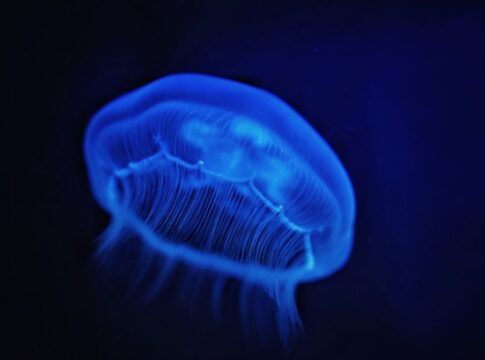
Turritopsis dohrnii, known as the immortal jellyfish, possesses bioluminescent properties and the remarkable ability to revert from adult form back to its juvenile polyp stage. This tiny creature, measuring just a few millimeters across, can theoretically cycle through its life stages indefinitely. Research into this species has opened new avenues in developmental biology, though its bioluminescence serves more conventional purposes like startling predators.
3. Bioluminescent Bacteria Outnumber All Other Glowing Organisms
Single-celled bacteria represent the most abundant bioluminescent life forms on Earth, vastly outnumbering glowing animals. These microorganisms often form symbiotic relationships with marine animals, living inside specialized organs and producing light in exchange for nutrients. The Hawaiian bobtail squid famously hosts Vibrio fischeri bacteria in its light organ, using the bacterial glow to eliminate its shadow when hunting at night—a form of counter-illumination camouflage that makes the squid invisible from below.
4. Some Species Use Bioluminescence as a Burglar Alarm
Dinoflagellates, microscopic marine organisms, flash brilliantly when disturbed by predators in a defensive strategy scientists call the “burglar alarm” effect. The sudden light attracts larger predators to the area, potentially threatening whatever disturbed the dinoflagellates in the first place. This creates a biological chain reaction where the prey essentially calls for backup, using light as a distress signal that brings danger to its attacker.
5. Railroad Worms Have Red and Green Headlights
The larvae of certain click beetles, called railroad worms, produce both red and green bioluminescent light from different body regions. They’re among the very few terrestrial organisms capable of producing red bioluminescence, with green lights running along their bodies and red lights on their heads. The physics of producing different colored light requires different chemical variations of luciferin and luciferase, making these larvae remarkably complex chemical factories.
6. Bioluminescent Proteins Revolutionized Medical Research
Scientists extracted green fluorescent protein from the jellyfish Aequorea victoria, creating a tool that transformed biological research. This discovery earned a Nobel Prize in Chemistry in 2008 because the protein allowed researchers to track cellular processes in living organisms by making specific proteins glow. Medical experiments now routinely use modified versions to study cancer progression, neural activity, and gene expression in ways impossible before this bioluminescent breakthrough.
7. Glowing Mushrooms Use Light to Attract Spore Dispersers
Approximately 80 species of fungi produce a greenish glow through chemical reactions similar to those in animals, though fungi evolved bioluminescence completely independently. Scientific research suggests these mushrooms glow to attract insects during nighttime hours, with the insects then carrying fungal spores to new locations. The light intensity peaks at night and dims during daylight, indicating sophisticated biological control over the chemistry involved.
8. Cookie-Cutter Sharks Glow Everywhere Except One Spot
The cookie-cutter shark covers its underside with bioluminescent photophores except for a dark collar around its neck. When viewed from below, this creates the silhouette of a much smaller fish, luring larger predators close enough for the cookie-cutter to bite circular chunks from their flesh. This deceptive use of bioluminescence represents one of nature’s more devious hunting strategies, turning light into camouflage and then weaponizing the disguise.
9. Bioluminescence Evolved Independently Over 40 Times
The ability to produce light has emerged separately across wildly different branches of the tree of life, from bacteria to fungi to insects to fish. This repeated evolution demonstrates that bioluminescence offers such powerful advantages that natural selection discovered the chemistry again and again. Each lineage developed its own molecular pathway, yet all arrive at the same basic physics: converting chemical energy into cold light with extraordinary efficiency.
Comparing Bioluminescent Efficiency to Human Technology
| Light Source | Energy Efficiency | Heat Production |
|---|---|---|
| Bioluminescent organisms | Nearly 100% | Almost none |
| LED bulbs | 80-90% | Low |
| Fluorescent bulbs | 21-30% | Moderate |
| Incandescent bulbs | 5% | Very high |
Frequently Asked Questions
What is the brightest bioluminescent creature?
The headlight fish produces the brightest continuous bioluminescence among known species, using symbiotic bacteria in large light organs beneath its eyes. Some squid species produce brighter flashes, but the headlight fish maintains constant illumination bright enough to read by in complete darkness.
Can humans see all bioluminescent light?
Humans can see most bioluminescent light, which typically appears blue-green because those wavelengths travel farthest through water. However, some deep-sea creatures produce red bioluminescence that many marine animals cannot see, effectively creating a private communication channel invisible to most predators and prey.
Do bioluminescent creatures glow all the time?
Most bioluminescent organisms control their light production, turning it on and off as needed for hunting, mating, or defense. Continuous glowing would waste energy and attract unwanted attention, so these creatures typically activate their bioluminescence only when it serves a specific purpose.
Are there any bioluminescent mammals?
Scientists recently discovered that platypuses and some flying squirrels exhibit biofluorescence under ultraviolet light, though this differs from true bioluminescence. No mammals are currently known to produce their own light through chemical reactions the way fireflies and jellyfish do, making bioluminescence remarkably absent from an entire class of animals.
The glowing creatures inhabiting our planet reveal nature’s mastery of chemistry and physics in ways that continue to surprise researchers. Each bioluminescent flash represents millions of years of evolutionary refinement, turning simple chemical reactions into survival tools as varied as the species that wield them. Next time you see a firefly’s brief spark or watch waves shimmer with dinoflagellate light, you’re witnessing one of Earth’s most elegant solutions to the challenge of communication in darkness.