
Why Concert Halls Are Shaped Like Shells: Acoustic Design
By Trivia Daily, Staff Writer — Published August 4, 2026
Table of Contents
- Key Takeaways
- How Concert Halls Shaped Like Shells Direct Sound Waves
- The Science of Reverberation and Acoustic Intimacy
- Comparing Classic Concert Hall Designs
- Materials That Make Music Sound Better
- Adjustable Acoustics for Versatile Performance
- Frequently Asked Questions
Step inside the Sydney Opera House or the Walt Disney Concert Hall, and you’ll notice something striking: these buildings don’t just look like shells—they’re engineered to behave like them. Concert halls shaped like shells aren’t architectural whimsy. They’re the product of centuries of acoustic science, designed to transform sound waves into an immersive listening experience. The curved, layered surfaces you see mirror the natural geometry that allows seashells to amplify and direct sound with remarkable efficiency.
This fascinating intersection of art and physics reveals why some of the world’s most celebrated performance spaces adopt organic, shell-like forms. Discover the surprising trivia behind these architectural marvels and explore the hidden science that makes music come alive.
Key Takeaways
- Shell-shaped concert halls use curved surfaces to reflect and distribute sound evenly throughout the audience, eliminating dead zones where music sounds muffled or weak.
- The fan or vineyard design, inspired by natural amphitheaters, surrounds the orchestra with tiered seating to create intimacy and direct sound reflection.
- Materials matter tremendously—wood panels, plaster, and strategically placed diffusers scatter sound waves to prevent echoes while preserving clarity.
- Reverberation time, typically between 1.8 and 2.2 seconds for orchestral music, determines how long sound lingers in the hall before fading.
- Modern concert halls often feature adjustable acoustic elements, including movable ceiling panels and retractable curtains, to optimize sound for different performances.
- The shoebox design, used in historic venues like Vienna’s Musikverein, remains acoustically superior for many experts despite its simple rectangular form.
How Concert Halls Shaped Like Shells Direct Sound Waves
Sound behaves like light in one crucial way: it bounces. When an orchestra plays, sound waves radiate outward in all directions. Flat walls would send these waves ricocheting unpredictably, creating muddy acoustics. Curved surfaces, by contrast, focus and steer sound with precision. Shell-like architecture harnesses this principle, using gentle curves to guide reflections toward the audience rather than scattering them into oblivion.
The human ear perceives direct sound first, followed by early reflections arriving within 20 to 40 milliseconds. These reflections add richness and fullness to music. Later reflections create reverberation—the lingering echo that gives concert halls their characteristic warmth. Shell-shaped designs control both timing and direction of these reflections through careful geometric planning.
Think of a seashell held to your ear. The spiral chamber doesn’t create ocean sounds—it amplifies ambient noise through resonance. Concert halls apply this same concept on a grander scale. Curved ceilings and walls form reflective surfaces that reinforce musical frequencies without distortion. The Berlin Philharmonie, designed by Hans Scharoun, pioneered the vineyard-style terraced seating arrangement that wraps around the orchestra like petals around a flower’s center, ensuring every seat receives balanced sound reflections.
The Science of Reverberation and Acoustic Intimacy
Reverberation distinguishes a great hall from a mediocre one. Too little, and music sounds dry and lifeless, as though performed outdoors. Too much, and notes blur together into sonic mud. The sweet spot for orchestral music falls between 1.8 and 2.2 seconds—the time it takes for sound to decay by 60 decibels after the source stops.
Shell-shaped halls achieve optimal reverberation through volume and surface treatment. A larger interior volume allows sound to travel farther before absorption, extending reverberation naturally. But size alone isn’t enough. The surfaces must scatter sound effectively. That’s why you’ll find intricate coffered ceilings, textured walls, and wooden panels throughout these spaces. Each element breaks up sound waves, preventing flutter echoes while maintaining tonal clarity.
Acoustic intimacy poses another challenge. In a 2,000-seat auditorium, the farthest listener sits perhaps 100 feet from the stage. Sound intensity decreases with distance, following the inverse square law. Shell designs compensate by angling reflective surfaces to boost sound reaching distant seats. Some halls use overhead reflectors—suspended panels that act like acoustic mirrors, redirecting sound downward and outward to ensure even coverage.
Comparing Classic Concert Hall Designs
| Design Type | Key Features | Acoustic Advantages | Notable Examples |
|---|---|---|---|
| Shoebox | Rectangular, parallel walls, high ceiling | Predictable reflections, strong lateral sound | Vienna Musikverein, Boston Symphony Hall |
| Fan/Shell | Curved walls, terraced seating around stage | Even distribution, visual intimacy | Berlin Philharmonie, Los Angeles Philharmonic |
| Vineyard | Asymmetric terraces, central stage | Varied reflections, audience surrounds performers | Suntory Hall Tokyo, Elbphilharmonie Hamburg |
| Arena | Circular or elliptical, 360-degree seating | Maximum capacity, democratic sightlines | Royal Albert Hall (with acoustic adjustments) |
Materials That Make Music Sound Better
Wood dominates concert hall interiors for good reason. It reflects mid and high frequencies while absorbing bass, creating a balanced tonal profile. Different woods produce subtle variations—maple offers brightness, while oak provides warmth. Many halls combine species strategically, using harder woods for ceiling panels where high-frequency reflection matters most, and softer woods for wall treatments where absorption helps.
Plaster serves a different function. Smooth plaster surfaces reflect sound efficiently across all frequencies, making them ideal for ceilings and upper walls. Textured plaster adds diffusion, scattering reflections to prevent harsh echoes. Acoustic engineers often specify plaster thickness down to the millimeter, as even small variations affect sound quality.
Upholstered seating presents an interesting challenge. Empty seats absorb sound differently than occupied ones—human bodies soak up high frequencies. To maintain consistent acoustics regardless of attendance, modern halls use specially designed seat cushions that mimic human absorption patterns whether someone sits there or not.
Adjustable Acoustics for Versatile Performance
Not all music demands identical acoustic conditions. A chamber quartet thrives in a more intimate, less reverberant space than a full symphony orchestra. Jazz benefits from quicker sound decay than Romantic-era orchestral works. Shell-shaped halls increasingly incorporate adjustable elements to accommodate diverse programming.
Movable ceiling panels can raise or lower to change room volume, directly affecting reverberation time. Retractable curtains along walls add absorption on demand, damping excessive reflections for amplified performances. Some venues feature rotating wall sections with different surface treatments—reflective on one side, absorptive on the other—allowing quick acoustic reconfiguration between events.
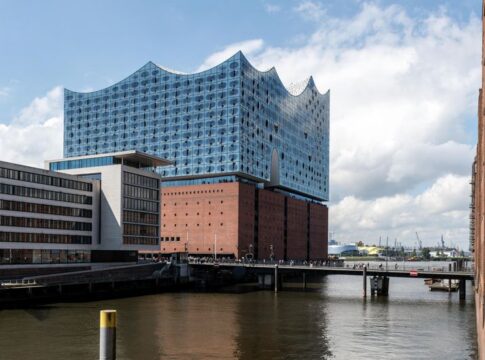
The Elbphilharmonie in Hamburg employs roughly 10,000 individually shaped acoustic panels, each machined from gypsum fiber to scatter sound in calculated directions. These “white skin” panels, designed through computer modeling and physical testing, create a diffuse sound field that adapts to different musical styles while maintaining the hall’s signature warmth.
Frequently Asked Questions
Why do some concert halls have wavy ceilings?
Wavy or undulating ceilings diffuse sound waves, breaking up reflections to prevent echoes while distributing sound evenly across the audience. The irregular surface scatters high frequencies that would otherwise create harsh, focused reflections from flat ceilings.
Do outdoor amphitheaters use shell-shaped designs?
Yes, many outdoor venues feature band shells—curved back walls and ceilings behind the stage that project sound toward the audience. Without surrounding walls to provide reflections, the shell becomes the primary acoustic element, focusing and amplifying the performers’ sound outward.
What makes Vienna’s Musikverein acoustically special?
The Musikverein’s shoebox shape, built in 1870, creates strong lateral reflections that give music a rich, enveloping quality. Its ornate plaster decorations diffuse sound naturally, while its wooden floor and seating provide optimal absorption balance, producing a reverberation time near the ideal 2.0 seconds for orchestral music.
Can modern technology replace shell-shaped acoustic design?
Electronic sound reinforcement can amplify and distribute music, but it cannot replicate the natural blending and warmth of acoustic reflections. Most concert halls rely on passive acoustic design for unamplified classical music, reserving electronic systems for amplified genres or speech that require different sound characteristics.
The next time you settle into a concert hall seat, look up and around. Those curves and surfaces aren’t decorative—they’re instruments themselves, shaped by physics to transform individual notes into collective musical experiences. Every angle has been calculated, every material chosen, to let sound bloom and fade with natural grace. The shell protects the pearl; the hall protects the music.