
Why the Dead Sea Is Called Dead But Nothing Can Sink
By Trivia Daily, Geography Desk — Published July 20, 2026
Table of Contents
- Key Takeaways
- Why the Dead Sea Is Called Dead: The Salinity Story
- The Physics of Floating: Why Nothing Can Sink
- Where the Dead Sea Sits on the World Map
- Life in the Dead Sea: Not Quite Dead After All
- The Shrinking Sea: A Changing Landmark
- Frequently Asked Questions
The Dead Sea carries one of geography’s most intriguing contradictions in its name. This legendary body of water sits at the lowest point on Earth’s land surface, yet nothing that enters it can sink. The reason the Dead Sea is called dead has nothing to do with drowning—quite the opposite. Its extreme salinity makes floating effortless while simultaneously making it nearly impossible for most life forms to survive in its waters. This natural wonder, nestled between Jordan and Israel on the world map, has fascinated travelers and scientists for millennia.
The Dead Sea represents one of the planet’s most extreme places, a landmark where the usual rules of oceans and seas simply don’t apply. Understanding why this saltwater lake earned its morbid name—and why it defies the basic physics of sinking—reveals a remarkable story of geology, chemistry, and the forces that shape our continents.
Key Takeaways
- The Dead Sea is called dead because its salt concentration—nearly 10 times that of regular ocean water—prevents almost all marine life from surviving in it.
- The extreme salinity makes the water so dense that human bodies float effortlessly on the surface without any swimming effort required.
- Located at approximately 430 meters below sea level, the Dead Sea occupies Earth’s lowest elevation on land, making it a unique geographical landmark.
- The Dead Sea is technically a hypersaline lake, not a true sea, bordered by Jordan to the east and Israel and the West Bank to the west.
- The water contains about 34% salt and minerals, compared to roughly 3.5% in typical ocean water around the world.
- Despite its name, some specialized bacteria and microbial fungi have adapted to survive in the harsh conditions.
Why the Dead Sea Is Called Dead: The Salinity Story
The Dead Sea earned its somber name from ancient observers who noticed the conspicuous absence of fish, seaweed, or any visible aquatic life. Unlike the oceans and other seas marked on world maps, this body of water appeared lifeless. The Greek and Roman writers who documented their travels through this region remarked on the eerie stillness of waters that supported no fishing industry and harbored no swimming creatures.
The culprit behind this biological desert is salt—and lots of it. The Dead Sea contains approximately 34% salinity, meaning that roughly one-third of its composition consists of dissolved minerals and salts. For comparison, the Atlantic and Pacific oceans hover around 3.5% salinity. This tenfold difference creates an environment so hostile that conventional marine life cannot survive. Fish brought in from connected waterways die almost instantly when exposed to such concentrated brine.
The salt concentration results from a perfect storm of geography. The Dead Sea sits in a closed basin with no outlet to other bodies of water. Rivers, primarily the Jordan River, flow into it but nothing flows out. In the scorching desert climate of the Middle East, intense evaporation removes pure water while leaving minerals and salts behind. This process has continued for thousands of years, concentrating the salt to extreme levels and creating one of Earth’s most distinctive natural wonders.
The Physics of Floating: Why Nothing Can Sink
The same extreme salinity that kills marine life creates the Dead Sea’s other famous characteristic: unsinkable water. Density is the key. Pure water has a density of 1.0 grams per cubic centimeter. The human body, with its mixture of bone, muscle, and air-filled lungs, has a density slightly less than water—which is why people can float in regular oceans with some effort.
The Dead Sea’s water, however, has a density of approximately 1.24 grams per cubic centimeter. This dramatic increase in density means that human bodies, which are much less dense, bob on the surface like corks. You don’t need to tread water or make any swimming motions. The water simply won’t let you sink. Visitors to this famous landmark often photograph themselves reclining on the surface while reading newspapers—a trick that would be impossible in any normal ocean or sea.
This buoyancy applies to nearly everything. Objects that would sink in regular water often float in the Dead Sea. The physics is straightforward: if an object’s density is less than the surrounding fluid, it floats. The Dead Sea’s extraordinary density ensures that most objects meet this criterion.
Where the Dead Sea Sits on the World Map
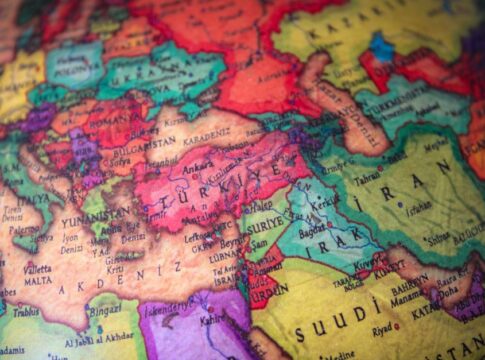
Geography places the Dead Sea at one of the planet’s most extreme locations. It occupies the Jordan Rift Valley, part of the Great Rift system that stretches across multiple countries and continents. The Dead Sea’s surface sits at roughly 430 meters below sea level—the lowest elevation on Earth’s land surface. Standing on its shores means standing at the absolute bottom of the accessible world.
The lake spans the border between Jordan on its eastern shore and Israel and the West Bank on its western shore. It measures about 50 kilometers long and 15 kilometers wide at its broadest point, though these dimensions have been shrinking. The surrounding landscape consists of stark desert terrain, with mountains rising on both sides of the valley. This location in the Middle East places it among other significant landmarks and places of historical and geographical importance.
| Feature | Dead Sea | Typical Ocean |
|---|---|---|
| Salinity | ~34% | ~3.5% |
| Water Density | 1.24 g/cm³ | 1.02 g/cm³ |
| Elevation | -430 meters | 0 meters (sea level) |
| Marine Life | Minimal (bacteria only) | Abundant and diverse |
Life in the Dead Sea: Not Quite Dead After All
While the Dead Sea’s name suggests complete sterility, modern science has discovered that it isn’t entirely lifeless. Specialized bacteria and microbial fungi have evolved to tolerate the extreme salinity. These microscopic organisms represent some of the hardiest life forms on the planet, thriving in conditions that would instantly kill almost any other living thing.
These extremophile microorganisms have developed unique cellular mechanisms to cope with the osmotic stress of hypersaline environments. They don’t just survive—they’ve made the Dead Sea their evolutionary niche. Scientists study these organisms to understand the limits of life and to explore the possibilities of life existing in extreme environments elsewhere in the world and even on other planets.
The Dead Sea also supports life indirectly. Its mineral-rich mud and waters have been used for therapeutic purposes since ancient times. The unique combination of minerals—including magnesium, calcium, and potassium—attracts visitors from countries around the globe seeking relief from skin conditions and other ailments.
The Shrinking Sea: A Changing Landmark
The Dead Sea faces an uncertain future. Water levels have been dropping by about one meter per year, a dramatic decline that has accelerated in recent decades. The sea has lost roughly one-third of its surface area since the 1960s. This shrinkage results from water diversion projects that reduce the flow of the Jordan River and from mineral extraction operations along the shores.
As the water recedes, it leaves behind a landscape pockmarked with sinkholes—sudden collapses in the ground caused by the dissolution of underground salt layers. These sinkholes pose dangers to infrastructure and have forced the closure of beaches and facilities. The changing geography of this region highlights how human activity affects even the most extreme natural places on Earth’s continents.
Countries bordering the Dead Sea have proposed various solutions, including a canal project to bring water from the Red Sea. The future of this ancient landmark remains a topic of international concern, as its loss would eliminate one of the world’s most distinctive geographical features.
Frequently Asked Questions
Can you actually drown in the Dead Sea?
Yes, drowning is possible despite the extreme buoyancy. The danger comes from flipping face-down and being unable to right yourself, or from swallowing or inhaling the highly concentrated saltwater, which can be toxic. Visitors should always exercise caution and follow safety guidelines.
Why is the Dead Sea shrinking so rapidly?
The Dead Sea is shrinking primarily because water from the Jordan River, its main source, is being diverted for agricultural and drinking water use by surrounding countries. Evaporation in the hot desert climate compounds the problem, and mineral extraction operations also remove water.
What happens if you get Dead Sea water in your eyes?
Dead Sea water causes intense burning and pain if it contacts your eyes due to the extreme salt concentration. Swimmers should avoid splashing, keep their heads above water, and have fresh water readily available to rinse their eyes if contact occurs.
Are there any other places in the world like the Dead Sea?
Several other hypersaline lakes exist worldwide, including the Great Salt Lake in Utah, Lake Assal in Djibouti, and the Gaet’ale Pond in Ethiopia. However, the Dead Sea remains unique due to its combination of extreme depth, low elevation, and historical significance as a landmark.
The Dead Sea stands as a testament to the extraordinary diversity of places on our planet. A body of water called dead because life cannot thrive in it, yet so dense that sinking becomes impossible—it’s a geographical paradox that continues to captivate scientists and travelers alike. As this ancient landmark faces an uncertain future, it reminds us that even the most extreme and seemingly permanent features of our world’s geography can change.