
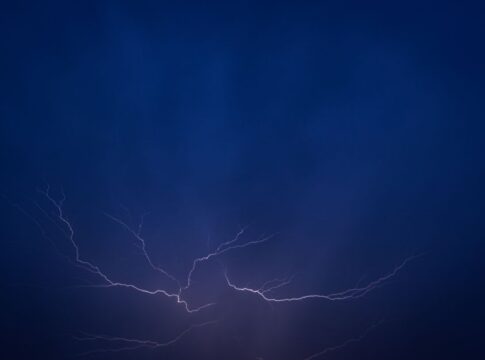
Did You Know Lightning Is Hotter Than the Sun’s Surface
By Trivia Daily, Science Desk — Published November 3, 2026
Table of Contents
- Key Takeaways
- Why Lightning Hotter Surface Temperatures Occur
- The Explosive Effects of Extreme Heat
- Comparing Natural Temperature Extremes
- The Science Behind Measuring Lightning Temperature
- Lightning’s Role in Earth’s Chemistry and Biology
- Frequently Asked Questions
When a bolt of lightning streaks across the sky, it does more than light up a storm—it creates one of the hottest phenomena on Earth. The temperature of a lightning strike reaches approximately 30,000 Kelvin (about 53,540 degrees Fahrenheit), making lightning hotter than the surface of the Sun, which hovers around 5,800 Kelvin. This incredible physics demonstration happens in a fraction of a second, right above our heads. The discovery that such extreme temperatures could exist in Earth’s atmosphere revolutionized our understanding of atmospheric electricity and plasma physics.
This scientific fact challenges our everyday assumptions about heat and energy. While we think of the Sun as the ultimate source of heat, lightning produces temperatures roughly five times hotter than the solar surface during its brief existence. The chemistry and physics involved in this natural phenomenon reveal fascinating insights into how energy, matter, and electricity interact in our world.
Key Takeaways
- Lightning reaches temperatures around 30,000 Kelvin, approximately five times hotter than the Sun’s surface temperature of 5,800 Kelvin.
- The extreme heat from lightning causes the surrounding air to expand rapidly, creating the sonic boom we hear as thunder.
- A typical lightning bolt lasts only about one-tenth of a second, yet transfers enormous amounts of energy in that brief time.
- Lightning creates plasma—the fourth state of matter—by superheating air molecules and stripping electrons from atoms.
- The intense heat can fuse sand into glass tubes called fulgurites, providing physical evidence of lightning’s extraordinary temperature.
- Research into lightning physics has contributed to advances in electrical engineering, meteorology, and our understanding of atmospheric chemistry.
Why Lightning Hotter Surface Temperatures Occur
The extreme temperature of lightning results from the rapid conversion of electrical energy into heat. When electrical charge builds up in storm clouds, the potential difference between the cloud and ground—or between different parts of clouds—can reach millions of volts. Once this charge overcomes the insulating properties of air, it creates a conductive channel called a leader. The actual lightning strike occurs when current rushes through this channel at speeds approaching one-third the speed of light.
This electrical current encounters resistance in the air, converting electrical energy into thermal energy almost instantaneously. The air molecules in the lightning channel become superheated to those astounding 30,000 Kelvin temperatures. To put this in perspective, the Sun’s surface (the photosphere) maintains a relatively “cool” 5,800 Kelvin, while the Sun’s core reaches about 15 million Kelvin. Lightning sits comfortably between these extremes, creating a miniature stellar furnace in Earth’s atmosphere.
The physics of this process involves ionization—the stripping of electrons from air molecules. This creates plasma, a state of matter where electrons move freely among positive ions. Plasma conducts electricity far better than normal air, which is why lightning can carry such enormous currents. Scientists estimate that a typical lightning bolt carries about 30,000 amperes of current, though some strikes can exceed 100,000 amperes.
The Explosive Effects of Extreme Heat
Thunder provides audible proof of lightning’s incredible temperature. When air temperature jumps from ambient conditions to 30,000 Kelvin in microseconds, the air expands violently. This rapid expansion creates a shock wave that we perceive as thunder. The sound travels at roughly 343 meters per second (the speed of sound), which is why we see lightning before hearing thunder—light travels nearly a million times faster than sound.
You can estimate your distance from a lightning strike using this principle. Count the seconds between seeing the flash and hearing thunder, then divide by five to get the approximate distance in miles (or divide by three for kilometers). This simple experiment demonstrates how scientific principles apply to everyday observations.
The heat from lightning also creates lasting physical evidence. When lightning strikes sand or sandy soil, it can melt the silica and fuse it into glassy tubes called fulgurites. These hollow, branching structures mirror the path of the lightning bolt through the ground. Some fulgurites extend several feet underground, testifying to the penetrating power of lightning’s energy. Collectors and researchers study these natural glass formations to better understand lightning behavior and energy distribution.
Comparing Natural Temperature Extremes
| Phenomenon | Temperature (Kelvin) | Temperature (Fahrenheit) |
|---|---|---|
| Lightning bolt | ~30,000 | ~53,540 |
| Sun’s surface (photosphere) | ~5,800 | ~9,980 |
| Sun’s core | ~15,000,000 | ~27,000,000 |
| Earth’s core | ~6,000 | ~10,340 |
| Lava (basaltic) | ~1,400 | ~2,060 |
| Boiling water (sea level) | 373 | 212 |
The Science Behind Measuring Lightning Temperature
How do scientists know lightning is this hot? Research involves multiple methods, including spectroscopy—analyzing the light emitted by lightning. Different elements and molecules emit characteristic wavelengths of light when heated, creating a unique spectral signature. By examining the spectrum of light from lightning, researchers can determine the temperature and composition of the plasma channel.
High-speed photography and specialized instruments allow scientists to study lightning in unprecedented detail. Modern lightning research stations use arrays of sensors to measure electrical fields, radio emissions, and optical signatures. This data helps meteorologists understand storm dynamics and improve lightning prediction models. Organizations like the National Oceanic and Atmospheric Administration (NOAA) maintain extensive lightning detection networks across the United States.
Laboratory experiments also contribute to our understanding. Scientists can create artificial lightning using high-voltage equipment, allowing controlled study of electrical discharge phenomena. These experiments have practical applications in electrical engineering, helping design better surge protection systems and understanding power grid vulnerabilities.
Lightning’s Role in Earth’s Chemistry and Biology
Beyond its impressive temperature, lightning plays crucial roles in Earth’s atmospheric chemistry. The extreme energy breaks apart nitrogen molecules in the air, allowing nitrogen to combine with oxygen and create nitrogen oxides. These compounds eventually fall to Earth in rain, providing natural fertilization for plants—a process that has sustained ecosystems for millions of years. Some estimates suggest lightning fixes hundreds of millions of tons of nitrogen annually.
Some origin-of-life theories propose that lightning may have helped create the first organic molecules on early Earth. Laboratory experiments have shown that electrical discharges through mixtures of simple gases can produce amino acids and other building blocks of life. While this remains an active area of research, it highlights lightning’s potential significance in both chemistry and biology.
Frequently Asked Questions
How long does lightning’s extreme heat last?
A typical lightning flash lasts only about 0.2 seconds total, though the main stroke carrying peak current and temperature exists for just a few microseconds. Despite this brief duration, the energy transferred is enormous, enough to power a 100-watt light bulb for several months.
Can lightning’s heat start fires even though it’s so brief?
Absolutely. Lightning ignites thousands of wildfires annually, particularly in dry forests. The brief but intense heat can instantly ignite flammable materials like dry wood, grass, or leaves. Lightning is one of nature’s primary sources of natural wildfire ignition.
Is all lightning the same temperature?
Lightning temperature varies somewhat depending on the current intensity and channel characteristics, but most lightning bolts reach similar peak temperatures in the 20,000 to 30,000 Kelvin range. Stronger strikes with higher currents may achieve slightly higher temperatures.
Why doesn’t lightning’s heat affect the entire atmosphere?
The lightning channel is extremely narrow—typically just one to two inches in diameter—and the duration is incredibly brief. The surrounding air acts as an insulator, preventing the heat from spreading far. The energy dissipates rapidly as the plasma channel cools and normal air rushes back in.
The next time storm clouds gather and lightning illuminates the sky, remember that you’re witnessing temperatures that dwarf the surface of our Sun, all contained in a channel narrower than your thumb. This everyday phenomenon reminds us that the most extraordinary physics experiments happen naturally all around us, free of charge and utterly spectacular.