
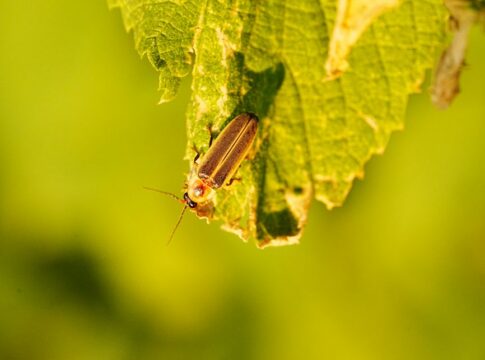
Why Fireflies Glow Yellow: The Chemical Reaction Inside
By Trivia Daily, Staff Writer — Published August 6, 2026
Table of Contents
- Key Takeaways
- Why Fireflies Glow Yellow: The Bioluminescent Chemistry
- The Color Spectrum: Why Some Fireflies Aren’t Yellow
- The Flash Control Mechanism
- Beyond Romance: Other Uses of Firefly Light
- From Firefly to Laboratory: Medical Applications
- Frequently Asked Questions
On warm summer evenings, fireflies light up backyards and meadows with their distinctive yellow-green glow, creating one of nature’s most enchanting displays. But this mesmerizing bioluminescence isn’t magic—it’s the result of a surprisingly efficient chemical reaction happening inside the insect’s abdomen. What makes fireflies glow yellow is a precise interaction between a molecule called luciferin, an enzyme called luciferase, oxygen, and a cellular energy source. This fascinating process produces light with almost no heat, making it one of the most efficient light sources in the natural world.
The firefly’s glow has captivated scientists and nature lovers for centuries, sparking curiosity about how such a small creature can produce such visible light. The answer reveals amazing trivia about biochemistry, evolution, and the hidden wonders of insects we often take for granted.
Key Takeaways
- Fireflies produce light through a chemical reaction involving luciferin, luciferase, oxygen, and ATP in specialized cells called photocytes.
- The reaction is incredibly efficient, converting nearly 100% of chemical energy into light with virtually no wasted heat.
- Different firefly species produce slightly different colors ranging from yellow-green to orange, determined by the structure of their luciferase enzyme.
- Fireflies can control their flashing by regulating oxygen flow to the light-producing cells.
- The glow serves primarily as a mating signal, with each species having its own unique flash pattern.
- Scientists have adapted firefly luciferase for medical research, using it to detect diseases and track cellular processes.
Why Fireflies Glow Yellow: The Bioluminescent Chemistry
The firefly’s light organ contains specialized cells called photocytes, packed with the chemical ingredients needed for bioluminescence. When a firefly decides to flash, its nervous system triggers a release of nitric oxide, which allows oxygen to flood into these cells. The oxygen then reacts with luciferin—a light-emitting molecule—in the presence of the enzyme luciferase and ATP, the energy currency of cells.
This reaction oxidizes luciferin, creating an excited state molecule called oxyluciferin. As oxyluciferin returns to its ground state, it releases energy in the form of a photon of light. The wavelength of this light typically falls in the yellow-green range, around 560 nanometers, which is why most fireflies appear to glow yellow to our eyes.
What makes this reaction truly remarkable is its efficiency. While a standard incandescent light bulb converts only about 10% of energy into light (wasting the rest as heat), fireflies achieve nearly 100% efficiency. Scientists call this “cold light” because it generates almost no heat whatsoever. You could hold a glowing firefly without feeling any warmth from its light organ.
The Color Spectrum: Why Some Fireflies Aren’t Yellow
Not all fireflies glow the same shade of yellow. Different species produce light ranging from yellow-green to amber to orange. This variation comes down to the structure of their luciferase enzyme. Tiny differences in the enzyme’s amino acid sequence alter how it interacts with luciferin, slightly changing the wavelength of light produced.
The most common color is yellow-green because this wavelength travels well through air and is easily visible to other fireflies in dim conditions. Some species that live in humid environments or dense forests produce more orange or red light, which penetrates better through moisture and vegetation. This color diversity helps different firefly species recognize their own kind during mating season.
| Light Color | Wavelength Range | Common Environment |
|---|---|---|
| Yellow-Green | 550-570 nm | Open fields, meadows |
| Yellow | 570-590 nm | Gardens, woodland edges |
| Orange | 590-610 nm | Humid forests, wetlands |
The Flash Control Mechanism
Fireflies don’t glow continuously—they flash in precise patterns. Each species has its own distinctive rhythm, duration, and number of flashes, functioning as a bioluminescent morse code. But how does a firefly turn its light on and off so precisely?
The answer lies in oxygen control. The light-producing cells are surrounded by tracheoles, tiny tubes that deliver oxygen throughout the insect’s body. When the firefly wants to flash, it releases nitric oxide, which signals the tracheoles to deliver oxygen to the photocytes. The chemical reaction begins immediately, producing light. When the nitric oxide signal stops, oxygen delivery ceases, and the light goes out.
This on-off switching happens remarkably fast, allowing fireflies to create flashes lasting just fractions of a second or sustained glows of several seconds, depending on the message they’re sending. Males typically flash while flying, advertising their presence to females watching from vegetation below. Females respond with their own species-specific flash pattern if they’re interested.
Beyond Romance: Other Uses of Firefly Light
While mating is the primary purpose of firefly bioluminescence, some species use their glow for other purposes. Firefly larvae, which live in soil and leaf litter, also produce light. Scientists believe this may serve as a warning signal to predators, advertising that the larvae taste bad due to defensive chemicals in their bodies.
Some adult fireflies also use their glow defensively. Certain species in the genus Photuris are known as “femme fatale fireflies” because females mimic the flash patterns of other species. When males of those species approach expecting a mate, the Photuris female captures and eats them, acquiring defensive chemicals the prey species contains.
From Firefly to Laboratory: Medical Applications
The firefly’s efficient light-production system has become an invaluable tool in scientific research. Researchers have isolated and replicated firefly luciferase, using it as a biological marker in countless experiments. When scientists insert the gene for luciferase into cells, those cells glow when they produce ATP, allowing researchers to track cellular activity, detect the presence of specific molecules, or monitor disease progression.
This technique has applications in cancer research, drug development, and infectious disease detection. Medical researchers can use luciferase to watch in real-time as cancer cells respond to treatments or as bacteria multiply in response to antibiotics. The firefly’s simple chemical reaction has illuminated countless discoveries in human health.
Frequently Asked Questions
Do all fireflies glow yellow?
Most fireflies produce yellow-green light, but some species glow orange or amber depending on the structure of their luciferase enzyme. The color variation helps different species recognize their own kind during mating.
Can fireflies control when they light up?
Yes, fireflies have precise control over their flashing through regulation of oxygen delivery to their light-producing cells. They use this control to create species-specific flash patterns for communication.
Why doesn’t firefly light produce heat?
The bioluminescent reaction in fireflies is nearly 100% efficient at converting chemical energy directly into light, with virtually no energy wasted as heat. This makes it one of the most efficient light sources known.
Are firefly populations declining?
Many firefly populations are decreasing due to habitat loss, light pollution that interferes with their mating signals, and pesticide use. Conservation efforts focus on preserving dark habitats and reducing artificial lighting in firefly areas.
The next time you see fireflies dancing through the summer darkness, you’re witnessing one of nature’s most elegant chemical reactions—a light show powered by molecules that have been refined by millions of years of evolution. That yellow glow represents not just beauty, but biochemical brilliance that continues to inspire and inform human innovation.