
Why Popcorn Kernels Pop: The Science Behind the Burst
By Trivia Daily, Staff Writer — Published August 4, 2026
Table of Contents
- Key Takeaways
- The Anatomy of Popcorn Kernels Science
- The Explosion in Slow Motion
- Why Some Kernels Refuse to Pop
- The Unique Biology of Popping Corn
- Interesting Physics and Chemistry Facts
- Frequently Asked Questions
Few snacks announce themselves quite like popcorn. That sudden crack, the burst of steam, the transformation from hard kernel to fluffy white cloud—it’s a miniature explosion happening right in your kitchen. But what makes popcorn kernels science so remarkable isn’t just the spectacle. It’s the precise combination of anatomy, pressure, and heat that turns a humble seed into one of humanity’s oldest and most beloved treats.
Every kernel is a tiny pressure cooker waiting to happen. Discover the surprising physics that make this everyday wonder possible, and you’ll never look at movie night the same way again.
Key Takeaways
- Popcorn kernels contain about 14% moisture trapped inside a hard, airtight shell that acts as a natural pressure vessel.
- When heated to around 356°F (180°C), the water inside turns to steam and builds pressure up to about 135 pounds per square inch.
- The hull ruptures suddenly, causing the starchy interior to explode outward and gelatinize into the familiar white foam structure.
- Only one variety of corn—Zea mays everta—has the right hull thickness and starch composition to pop reliably.
- A popcorn kernel can leap up to three feet in the air when it pops, turning inside-out in a fraction of a second.
- Unpopped kernels, called “old maids,” usually fail because of hull cracks that let steam escape prematurely.
The Anatomy of Popcorn Kernels Science
Not all corn is created equal. While sweet corn, field corn, and dozens of other varieties exist, only popcorn possesses the structural features necessary for that signature pop. The secret lies in the hull—the hard outer shell that botanists call the pericarp. In popcorn, this hull is exceptionally strong and moisture-resistant, creating an airtight seal around the kernel’s contents.
Inside that protective shell sits the endosperm, a starchy mass that stores energy for the plant embryo. Crucially, this starch contains water—typically around 14% by weight. That percentage matters tremendously. Too little moisture, and there’s not enough steam to build pressure. Too much, and the kernel becomes tough or fails to pop properly. Popcorn farmers and processors carefully control moisture levels to ensure optimal popping performance.
The kernel’s small, dense structure concentrates this water in a tiny volume. When you apply heat, you’re essentially creating a miniature steam engine with nowhere for the pressure to escape.
What Happens When You Heat a Kernel
As temperature rises, the water molecules inside begin moving faster and faster. Around 212°F (100°C)—water’s normal boiling point—they’d ordinarily turn to steam and escape. But the hull prevents that escape, forcing the water to remain liquid even as temperatures climb well beyond the boiling point. This superheated water exists in a state of extreme pressure, pushing against the hull from every direction.
Scientists have measured the pressure inside a heating kernel, and it’s impressive. By the time the kernel reaches its breaking point—roughly 356°F (180°C)—internal pressure has built to approximately 135 pounds per square inch. That’s nine times normal atmospheric pressure, compressed into a space smaller than your fingernail.
Then comes the rupture. The hull can’t withstand the force any longer, and it fails suddenly. In a fraction of a second, the superheated water flashes to steam, expanding to about 40 times its liquid volume. The starchy endosperm, softened by heat and moisture, explodes outward.
The Explosion in Slow Motion
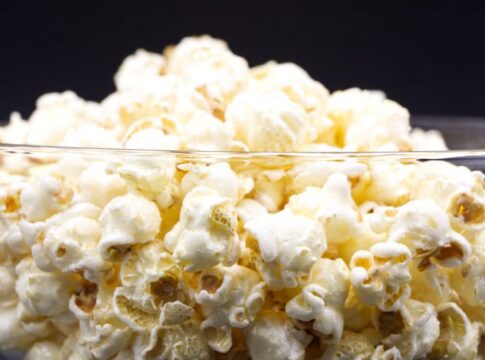
High-speed photography has revealed exactly what happens during a pop. The kernel doesn’t simply burst—it turns itself inside out. The gelatinized starch rapidly expands and cools, forming the foam structure we recognize as popped corn. The entire process, from first crack to fully expanded fluff, takes less than one-tenth of a second.
The force of the explosion propels the kernel into the air. Most popcorn launches itself between one and three feet upward, spinning as it pops. This jumping behavior is so characteristic that some languages have colorful names for popcorn that reference the leaping motion.
| Popping Stage | Temperature | What’s Happening |
|---|---|---|
| Initial heating | Room temp to 212°F | Water molecules gain energy; hull stays sealed |
| Pressure building | 212°F to 356°F | Superheated water; pressure reaches 135 PSI |
| Rupture point | ~356°F | Hull fails; steam expands 40x instantly |
| Expansion | Rapid cooling | Starch gelatinizes and solidifies into foam |
Why Some Kernels Refuse to Pop
Every batch of popcorn leaves behind a few stubborn “old maids”—the industry term for unpopped kernels. These failures usually stem from hull damage. Even microscopic cracks allow steam to leak out gradually as the kernel heats, preventing the pressure buildup necessary for a proper pop.
Moisture content also plays a role. Kernels that have dried out below about 11% water content simply can’t generate enough steam. Conversely, kernels with too much moisture may pop poorly or become tough and chewy. Commercial popcorn producers store their product carefully to maintain that ideal 14% moisture level.
Age matters too. Over time, even properly stored kernels can lose moisture through their hulls. Fresher popcorn generally pops more reliably and produces larger, fluffier results than old stock.
The Unique Biology of Popping Corn
Archaeologists have found popcorn remnants in Peru dating back at least 6,700 years, making it one of the oldest snack foods in the Americas. Indigenous peoples throughout North and South America cultivated popcorn long before European contact, selecting for varieties that popped most reliably.
That selective breeding created Zea mays everta, distinct from other corn subspecies. Its hull is about 20% thicker than regular corn, with a unique crystalline structure that resists fracturing until pressure becomes extreme. The starch composition differs too—popcorn has a higher ratio of hard to soft starch, which contributes to its characteristic texture after popping.
Modern popcorn comes in two main shapes: butterfly (or snowflake) and mushroom. Butterfly popcorn has irregular wings and a light, crispy texture—it’s what you typically get at movie theaters. Mushroom popcorn pops into a more compact, ball-like shape that’s sturdier and better for coating with caramel or chocolate. The shape depends primarily on the variety of popcorn and how rapidly it pops.
Interesting Physics and Chemistry Facts
The popping sound itself comes from the hull rupture and the sudden release of pressurized steam—not from the expansion of the starch, as many people assume. Researchers have recorded these sounds and found they occur at frequencies between 2,000 and 8,000 hertz, well within human hearing range.
Popped corn expands to 40 or 50 times its original volume, but weighs almost exactly the same as it did before popping (minus the tiny amount of moisture that escapes as steam). This makes it one of the most efficient snacks by volume—a small amount of kernels produces a large bowl of food.
The white fluffy part you eat is essentially a starch foam, similar in structure to some packing materials. The cell walls have gelatinized and then set into a rigid structure full of air pockets. This explains why popcorn is so light and crunchy—you’re mostly eating air held in place by thin starch walls.
Frequently Asked Questions
Can you pop regular corn kernels?
No, regular sweet corn or field corn won’t pop because their hulls aren’t strong enough to build sufficient pressure. They’ll simply heat up, char, or split without the explosive transformation that popcorn undergoes.
Why does microwave popcorn sometimes burn before all kernels pop?
Microwaves heat unevenly, and once some kernels pop, they absorb more microwave energy than the remaining hard kernels. This creates hot spots that can scorch the popped corn before the stragglers reach popping temperature.
Does freezing popcorn help it pop better?
No, this is a persistent myth. Freezing doesn’t improve moisture retention or hull integrity. Proper storage in an airtight container at room temperature preserves popcorn quality far better than freezing.
What’s the world record for the largest popcorn kernel?
While individual kernel size records aren’t officially tracked, the largest varieties of popcorn kernels are typically only about 50% larger than standard kernels—size doesn’t significantly affect popping quality or expansion rate.
The next time you hear that telltale crack and pop, remember: you’re witnessing a perfect storm of botany, thermodynamics, and pressure engineering that took thousands of years of plant breeding to perfect. That humble kernel contains the same explosive potential whether it’s popping over an open fire or in a modern microwave—a testament to the amazing physics hiding in the most ordinary moments of daily life.