
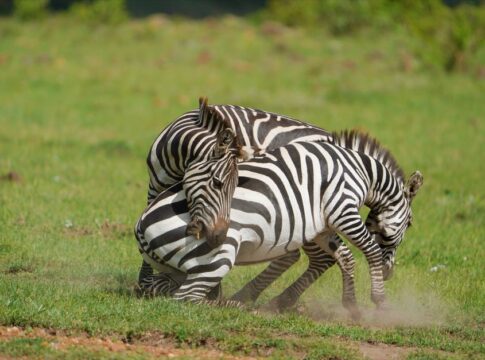
Why Zebras Have Stripes: The Surprising Biology Revealed
By Trivia Daily, Staff Writer — Published August 1, 2026
Table of Contents
- Key Takeaways
- The Fascinating Biology Behind Zebras Stripes
- How Stripes Confuse Biting Flies
- Debunking Common Myths About Zebra Stripes
- Geographic Patterns Tell the Story
- The Unique Identity of Every Zebra
- Frequently Asked Questions
For centuries, naturalists have puzzled over the zebra’s iconic black-and-white coat. The question seems simple enough: why do zebras have stripes? Yet the answer involves fascinating zebras stripes biology that scientists debated for over a hundred years. While many assumed the pattern helped with camouflage or social bonding, researchers have discovered the truth is far more unexpected—and it involves some of nature’s smallest pests.
These distinctive patterns aren’t just for show. Recent studies have finally cracked the code, revealing that zebra stripes serve a crucial survival function that has nothing to do with hiding from predators. The real reason is both surprising and ingenious.
Key Takeaways
- Zebra stripes primarily function as a defense against biting flies, particularly horseflies and tsetse flies that spread disease
- The stripes confuse the visual systems of flies, making it difficult for them to land successfully on the zebra’s coat
- Camouflage theories have been largely debunked—lions can easily see zebras, and the stripes don’t blend into grassland environments
- Each zebra’s stripe pattern is unique, like a fingerprint, with no two individuals sharing identical markings
- Temperature regulation was another popular theory, but experimental evidence shows minimal cooling effects from the stripe pattern
- Zebras living in regions with more disease-carrying flies tend to have more prominent striping patterns
The Fascinating Biology Behind Zebras Stripes
Scientists have proposed numerous theories over the years. Charles Darwin himself speculated about zebra stripes, though he couldn’t settle on a definitive explanation. Some researchers suggested the stripes created optical illusions that confused predators when zebras ran in herds. Others thought the patterns helped zebras recognize each other or regulated body temperature by creating air currents across the skin.
The breakthrough came from careful observation and experimentation. Researchers noticed something interesting: zebras spend far less time swatting at flies compared to other African herbivores like horses and antelopes. This observation led to a series of studies that would finally solve the mystery.
When scientists dressed horses in striped coats and observed fly behavior, the results were remarkable. Flies approached striped and non-striped horses at similar rates, but something changed at the last moment. As flies got close to striped surfaces, they failed to decelerate properly. They either missed the landing entirely or bumped into the surface and flew away. The stripes were disrupting the flies’ ability to land.
How Stripes Confuse Biting Flies
The mechanism behind this defense is rooted in insect vision. Flies rely on visual cues to judge distance and speed when landing. The high-contrast stripes interfere with their motion detection systems. Think of it like trying to land on a surface covered in optical illusions—your depth perception gets scrambled.
This matters tremendously for zebra survival. Horseflies and tsetse flies don’t just irritate; they transmit serious diseases. Tsetse flies carry trypanosomiasis, commonly known as sleeping sickness, which can be fatal. Horseflies can transmit equine infectious anemia and other blood-borne diseases. By preventing successful landings, zebra stripes reduce disease transmission and blood loss from bites.
The stripe width appears optimized for this purpose. They’re narrow enough to confuse fly vision but wide enough to be metabolically efficient to produce. Evolution has fine-tuned this pattern over millions of years.
Debunking Common Myths About Zebra Stripes
The camouflage theory sounds plausible at first. Perhaps stripes break up the zebra’s outline in tall grass? Not quite. Lions hunt primarily at dawn and dusk when lighting conditions are poor, but they have excellent night vision. Studies show that from a lion’s perspective, zebras don’t blend into the background any better than solid-colored prey animals.
The “motion dazzle” hypothesis suggested that when zebras run in groups, their stripes create a confusing visual effect that makes it hard for predators to single out individuals. While this sounds compelling, experimental evidence doesn’t support it. Predators successfully target individual zebras despite the stripe patterns.
Temperature regulation seemed promising too. Could black and white stripes create convection currents that cool the animal? Researchers tested this with temperature sensors and found the cooling effect, if present at all, is negligible. Zebras don’t have significantly different body temperatures compared to similarly-sized animals without stripes.
Geographic Patterns Tell the Story
One of the most convincing pieces of evidence comes from comparing different zebra populations. The three zebra species—plains zebras, mountain zebras, and Grevy’s zebras—show varying stripe patterns. Even within species, populations in different regions display different stripe intensities.
Here’s the revealing pattern: zebras living in areas with higher densities of disease-carrying flies have bolder, more extensive striping. In regions with fewer biting flies, zebra stripes tend to be less prominent or even fade on certain body parts. This geographic correlation strongly supports the fly-deterrent hypothesis.
| Zebra Species | Stripe Characteristics | Primary Habitat |
|---|---|---|
| Plains Zebra | Broad stripes, some with shadow stripes | Eastern and southern African grasslands |
| Grevy’s Zebra | Narrow, closely-spaced stripes | Semi-arid scrublands of Kenya and Ethiopia |
| Mountain Zebra | Vertical stripes with distinctive grid pattern on rump | Mountainous regions of southwestern Africa |
The Unique Identity of Every Zebra
Beyond their fly-deterrent function, zebra stripes serve as individual identifiers. No two zebras share identical stripe patterns. Scientists studying wild populations use these patterns to track individuals, much like fingerprinting humans. Foals may use their mother’s unique pattern to stay close in the herd, though this social function appears secondary to the anti-fly benefits.
The stripes form during fetal development through a process involving pigment cells called melanocytes. The exact developmental mechanisms that create such precise patterns remain an active area of research, involving complex interactions between genes and cellular signals.
Frequently Asked Questions
Are zebras white with black stripes or black with white stripes?
Zebras are black with white stripes. Embryological evidence shows that the animal’s background color is black, and white stripes are added as inhibition of melanin production in certain areas. The skin underneath zebra fur is black.
Do zebra stripes really keep flies away?
Yes, scientific experiments have confirmed that stripes significantly reduce successful fly landings. Flies approach striped surfaces but fail to land properly because the pattern disrupts their visual motion detection systems, causing them to abort landings or crash into the surface.
Can predators see zebra stripes clearly?
Lions and other predators can see zebra stripes clearly and have no difficulty distinguishing zebras from their surroundings. The stripes do not provide effective camouflage against the tawny grasslands where zebras live.
Why don’t other animals have stripes if they work so well?
The stripe defense appears most beneficial for animals that cannot seek shelter from flies and live in regions with high densities of disease-carrying biting flies. Other animals may have different defenses like thick skin, tail swishing, or behavioral adaptations that work better for their specific ecology.
The next time you see a zebra, you’re looking at millions of years of evolutionary problem-solving in action. What appears to be simple decoration is actually sophisticated biological engineering—a wearable fly repellent that’s been protecting these remarkable animals long before humans ever wondered why they looked so striking.