
7 Surprising Facts About How Snowflakes Form Patterns
By Trivia Daily, Staff Writer — Published October 26, 2026
Table of Contents
- Key Takeaways
- The Science Behind Snowflake Formation
- Why Temperature Controls Snowflake Shapes
- 1. Snowflakes Can Contain Hundreds of Individual Crystals
- 2. Identical Twin Snowflakes Have Been Created
- 3. Humidity Determines How Elaborate the Patterns Become
- 4. Snowflakes Have 35 Official Classification Types
- 5. Snowflakes Grow Faster at Their Tips Than Their Centers
- 6. Snowflakes Make Sounds When They Fall
- 7. Snowflake Symmetry Isn’t Always Perfect
- Frequently Asked Questions
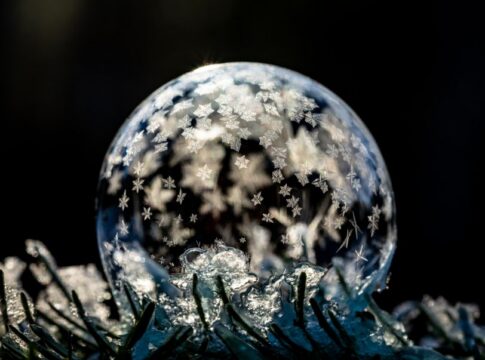
Every winter, trillions of snowflakes drift from the sky, each one a miniature ice sculpture with its own unique design. But how do snowflakes form patterns that are both mathematically precise and endlessly varied? The answer lies in an amazing dance between temperature, humidity, and the fundamental laws of physics. These tiny ice crystals reveal surprising truths about the natural world that continue to fascinate scientists and curious minds alike.
From the classic six-sided symmetry to the myth that no two snowflakes are ever identical, the science behind these frozen wonders is packed with interesting trivia. Discover the hidden mechanisms that transform simple water vapor into nature’s most intricate artwork, and explore why these delicate structures have captivated researchers for centuries.
Key Takeaways
- Snowflakes always form six-sided patterns due to the hexagonal structure of water molecules when they freeze.
- Temperature determines whether snowflakes grow as thin plates, chunky columns, or elaborate branched stars.
- A single snowflake can contain up to 200 ice crystals fused together during its journey through clouds.
- Identical snowflakes have been created in laboratory conditions, challenging the popular notion that every flake is unique.
- Snowflakes form patterns by growing fastest where humidity is highest, creating symmetrical but unpredictable designs.
- The “snowflake” shape most people imagine represents just one of 35 officially classified types.
The Science Behind Snowflake Formation
When water vapor freezes in clouds, it doesn’t create random shapes. The molecular structure of water dictates the architecture. Each water molecule bonds with others at a 120-degree angle, naturally forming hexagons. This is why snowflakes form patterns with six sides or six branches, never five or eight.
The process begins when water vapor condenses around a microscopic particle—dust, pollen, or even bacteria—floating in subfreezing clouds. As more water molecules attach to this nucleus, they align according to their chemical bonds, building outward in six directions simultaneously. The snowflake grows as it tumbles through varying temperature and humidity zones, with each environmental shift leaving its mark on the crystal’s structure.
What makes this process truly remarkable is that all six arms experience nearly identical conditions as the snowflake rotates through the cloud. This explains why the branches develop in such striking symmetry, even though the overall pattern can be wildly complex. The snowflake essentially records its atmospheric journey in ice.
Why Temperature Controls Snowflake Shapes
Temperature acts as the master sculptor of snowflake geometry. Scientists have mapped out precise temperature ranges that produce specific crystal types, and the variation is dramatic. Between 27°F and 23°F, snowflakes grow as thin hexagonal plates. Drop the temperature a few more degrees, and they switch to hollow columns. Warmer subfreezing temperatures, around 28°F to 32°F, create those classic branched stellar dendrites that grace holiday cards.
This temperature sensitivity occurs because ice molecules attach to a growing crystal at different rates depending on thermal conditions. Warmer temperatures favor growth along the flat faces of the hexagon, producing plates. Colder temperatures accelerate growth at the corners and edges, creating branches and needles. The transition happens in distinct bands, creating what researchers call the Nakaya diagram—a temperature map of snowflake morphology named after the Japanese physicist who documented these patterns in the 1930s.
1. Snowflakes Can Contain Hundreds of Individual Crystals
The delicate snowflakes that land on your mitten are often not single crystals at all. Many are aggregates—clusters of individual ice crystals that collided and stuck together during their descent. A single large snowflake can incorporate 200 or more separate crystals, each with its own growth history. This happens most readily when temperatures hover near freezing, where the crystal surfaces become slightly sticky. Some of the largest snowflakes ever documented measured several inches across, composed of countless smaller crystals fused into lacy conglomerates. These composite structures explain why some snowfalls produce large, fluffy flakes while other storms deliver fine, powdery snow.
2. Identical Twin Snowflakes Have Been Created
The popular saying that no two snowflakes are alike isn’t quite accurate. Scientists have produced nearly identical snowflakes under controlled laboratory conditions by carefully regulating temperature and humidity. In 1988, a researcher at the National Center for Atmospheric Research captured two natural snowflakes from the same storm that appeared virtually identical under microscopic examination. While the odds of finding duplicate snowflakes in nature remain astronomically small due to the countless variables involved in their formation, the absolute uniqueness of every flake is more poetic than scientific fact. Simple snowflakes with minimal branching are far more likely to have twins than the elaborate stellar dendrites we typically picture.
3. Humidity Determines How Elaborate the Patterns Become
A snowflake’s complexity depends heavily on water vapor availability. In conditions of high humidity, snowflakes develop intricate branches with delicate side arms and ornate details. Low humidity produces simpler, more compact crystals with minimal decoration. This happens because crystal growth requires a steady supply of water molecules. In humid air, the tips of growing branches encounter abundant vapor and elongate rapidly, creating those stunning dendritic patterns. Dry conditions starve the crystal of building material, resulting in simpler hexagonal plates or short columns. The most photographed and celebrated snowflakes—those with spectacular branching patterns—form only when humidity levels are just right, making them relative rarities among the spectrum of snowflake types.
4. Snowflakes Have 35 Official Classification Types
The six-pointed star is just one member of a much larger family. Scientists recognize 35 distinct morphological types of ice crystals and snowflakes, ranging from simple hexagonal plates to complex combinations of columns, plates, and dendrites. The classification system includes needles, hollow columns, capped columns, spatial dendrites, and irregular forms. Each type forms under specific atmospheric conditions. Triangular crystals can appear under certain circumstances. Twelve-branched snowflakes occasionally form when two crystals grow together in specific orientations. This diversity reflects the sensitivity of ice crystal formation to minute changes in temperature and humidity, creating a catalog of forms far beyond the stereotypical snowflake shape most people envision.
5. Snowflakes Grow Faster at Their Tips Than Their Centers
The branching pattern of classic snowflakes emerges from a quirk of crystal physics. When a hexagonal ice crystal begins to grow, any tiny bump or irregularity on its surface juts slightly further into the surrounding water vapor. This protruding tip encounters fresh, vapor-rich air more readily than the flatter central regions. As water molecules attach preferentially to these tips, the bumps grow into branches, which develop their own tips, spawning secondary branches. This feedback loop—called diffusion-limited aggregation—creates the fractal-like patterns seen in dendritic snowflakes. The arms race outward while the center fills in more slowly, producing those delicate, fernlike structures. The process is self-reinforcing: the more a branch grows, the better positioned it becomes to capture additional water vapor.
6. Snowflakes Make Sounds When They Fall
Fresh snow creates acoustic effects that go beyond the familiar crunch underfoot. When snowflakes fall in calm conditions, they actually absorb sound waves, creating the characteristic muffled quiet of a heavy snowfall. The complex structure of snowflakes traps air in countless tiny pockets, and this network of air spaces dampens sound by preventing sound waves from reflecting efficiently. A blanket of fresh snow can reduce environmental noise significantly. Scientists have measured this effect and found that the intricate geometry of dendritic snowflakes makes them particularly effective sound absorbers. This is why a landscape after fresh snowfall seems eerily silent—the snow is literally soaking up the ambient noise.
7. Snowflake Symmetry Isn’t Always Perfect
While snowflakes are famous for their six-fold symmetry, perfect specimens are actually uncommon. Most snowflakes show some degree of asymmetry due to slight differences in the microenvironments each arm experiences during growth. A tiny shift in temperature or a momentary change in humidity as the crystal tumbles through the air can cause one branch to develop differently from its neighbors. Collisions with other crystals, uneven ice distribution, and mechanical stress during the fall all introduce irregularities. The most symmetrical snowflakes form during steady atmospheric conditions with minimal turbulence—a relatively rare occurrence in the chaotic environment of a storm cloud. Scientists estimate that truly symmetrical snowflakes represent a small fraction of all ice crystals that fall.
Frequently Asked Questions
Why are all snowflakes six-sided?
The hexagonal shape comes from the molecular structure of ice. Water molecules bond at 120-degree angles, naturally creating six-sided symmetry as the crystal grows. This geometric constraint is fundamental to how water freezes.
Can snowflakes form with eight or twelve points?
True snowflakes always have six-fold symmetry or multiples thereof. Twelve-branched snowflakes occur when two six-sided crystals fuse together at specific angles. Eight-pointed ice crystals don’t form naturally due to water’s molecular geometry.
What makes some snowflakes look like needles instead of stars?
Temperature determines the shape. Needle-shaped crystals form at specific temperature ranges around 21°F to 25°F, where ice grows preferentially along one axis rather than developing broad, flat branches.
Do snowflakes form in the same way on other planets?
Other planets can have different types of “snow” made from frozen carbon dioxide, methane, or nitrogen, each with its own crystal structure. Water ice snowflakes with hexagonal symmetry are specific to water’s unique molecular properties.
The next time snowflakes drift past your window, you’re witnessing a physics demonstration written in ice—a visible reminder that nature’s simplest building blocks can create patterns of breathtaking complexity. Each crystal is both a work of art and a frozen record of its journey through the clouds.