
Why Does Aluminum Foil Have a Shiny and Dull Side
By Trivia Daily, Staff Writer — Published October 24, 2026
Table of Contents
- Key Takeaways
- The Rolling Process Behind Aluminum Foil Shiny Surfaces
- Does the Shiny Side Actually Matter When Cooking
- The Science of Aluminum’s Reflective Properties
- Comparing Aluminum Foil Types and Uses
- Common Myths About Aluminum Foil Debunked
- Frequently Asked Questions
Every time you tear off a sheet of aluminum foil, you’re holding a product of industrial engineering that reveals its manufacturing secrets right on its surface. The shiny and dull sides aren’t a design choice or a functional difference—they’re an accidental byproduct of how the foil is made. This everyday kitchen staple carries a surprising story that most people never notice, even though they’ve handled it thousands of times.
The difference between the two sides comes down to a process called rolling, where aluminum is pressed thinner and thinner until it reaches that impossibly thin state we use to wrap leftovers. Understanding why aluminum foil has these two distinct finishes reveals fascinating facts about manufacturing efficiency and the properties of metal itself.
Key Takeaways
- The shiny and dull sides of aluminum foil are created during the final rolling process, not by intentional design.
- Manufacturers roll two layers of foil together during the final pass, causing one side to contact polished steel rollers (shiny) and the other to contact another sheet of foil (dull).
- Both sides perform identically for cooking, wrapping, and heat reflection—the difference is purely cosmetic.
- Aluminum foil is typically between 0.00024 and 0.0059 inches thick, so thin that rolling a single sheet would cause it to tear.
- The reflectivity difference between sides is minimal, with both reflecting approximately 88% of radiant heat.
- This manufacturing method has remained essentially unchanged since aluminum foil became commercially available in the early 20th century.
The Rolling Process Behind Aluminum Foil Shiny Surfaces
Aluminum foil begins its life as a thick slab of pure aluminum or aluminum alloy. Through a series of rolling operations, this slab gets progressively thinner. Massive industrial rollers squeeze the metal repeatedly, reducing its thickness while extending its length. The metal can withstand this treatment because aluminum is remarkably malleable—it can be shaped and stretched without breaking.
Here’s where the interesting part happens. When aluminum reaches a certain thinness during manufacturing, it becomes too delicate to roll alone. A single sheet would tear under the pressure of the industrial rollers. The solution? Manufacturers stack two sheets together and roll them simultaneously in what’s called the final pass. This doubling technique allows the foil to achieve its characteristic thinness without ripping apart.
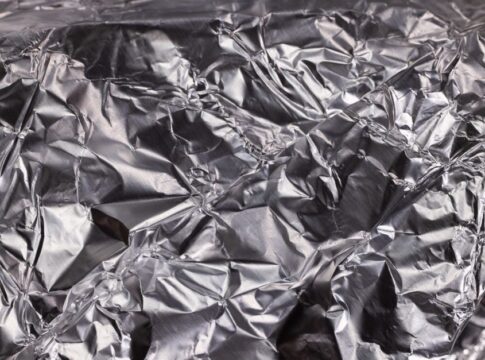
The side of each sheet that contacts the polished steel rollers comes out mirror-smooth and shiny. The sides that face each other—foil touching foil—emerge with a matte, dull finish. When the two sheets are separated after rolling, each one has a shiny side and a dull side. It’s not intentional decoration. It’s pure mechanical necessity.
Does the Shiny Side Actually Matter When Cooking
Despite persistent kitchen myths, the shiny and dull sides perform identically. Your casserole doesn’t care which side faces inward. The reflectivity difference is so minimal that it makes no practical difference in cooking times, heat retention, or food quality.
Some cooks insist the shiny side should face inward to reflect heat back toward the food, or outward to reflect heat away. Others claim the dull side conducts heat better. These beliefs persist across generations, passed down like family recipes. But they’re wrong. Scientific testing shows both sides reflect radiant heat at nearly the same rate and conduct thermal energy identically.
The confusion likely stems from the visible difference. Humans naturally assume that things that look different must act different. Our eyes tell us the shiny side seems more reflective, so we imagine it must perform differently. But aluminum’s thermal properties don’t change based on surface finish when the difference is this slight.
The Science of Aluminum’s Reflective Properties
Aluminum ranks among the most reflective metals for both light and heat. This property makes it invaluable not just in kitchens but in insulation, spacecraft design, and solar reflectors. The metal’s atomic structure allows it to bounce back electromagnetic radiation efficiently, whether that’s visible light or infrared heat.
Both sides of aluminum foil reflect approximately 88% of radiant heat. The tiny difference in surface texture between shiny and dull creates such a small variation in reflectivity that it falls within the margin of error for most measurements. When you’re roasting vegetables or covering a baking dish, factors like oven temperature, cooking time, and food placement matter enormously more than which foil side faces which direction.
What does affect foil’s performance is thickness. Heavy-duty foil provides better insulation and structural support than regular foil, but again, the shiny-versus-dull question remains irrelevant. The extra thickness gives you more aluminum atoms to work with, creating a more substantial barrier to heat transfer.
Comparing Aluminum Foil Types and Uses
| Foil Type | Typical Thickness | Best Uses | Shiny vs. Dull Matter? |
|---|---|---|---|
| Standard | 0.00063 inches | Wrapping food, covering dishes | No |
| Heavy-Duty | 0.00094 inches | Grilling, lining pans, packets | No |
| Extra Heavy-Duty | 0.0015 inches | High-heat applications, industrial | No |
| Non-Stick | Varies (coated) | Baking, sticky foods | No (coating on one side only) |
Common Myths About Aluminum Foil Debunked
Beyond the shiny-side debate, aluminum foil attracts numerous misconceptions. Some people believe you shouldn’t use foil with acidic foods because it will leach dangerous amounts of aluminum into your meal. While acidic foods can cause minimal aluminum transfer, the amounts are far below levels considered harmful by health authorities. Your body naturally processes small amounts of aluminum from various sources daily.
Another myth claims that aluminum foil blocks radio waves and can be used to shield electronics or create makeshift barriers. While aluminum does have some electromagnetic shielding properties, a simple sheet of kitchen foil doesn’t create an effective barrier for most frequencies. The foil would need to completely encase an object with no gaps to provide meaningful shielding.
Some also believe recycled aluminum foil is lower quality than new foil. In reality, aluminum recycling is remarkably efficient. Recycled aluminum maintains the same properties as newly smelted aluminum, and most aluminum foil contains significant recycled content. The metal can be recycled indefinitely without degradation.
Frequently Asked Questions
Should I cook with the shiny or dull side of aluminum foil facing up?
It doesn’t matter. Both sides perform identically because the reflectivity and heat conduction differences are negligible. Use whichever side is more convenient.
Why does aluminum foil sometimes stick to food?
Foil sticks when moisture or fats create a bond between the metal and food surface during cooking. Non-stick aluminum foil, which has a special coating, prevents this issue. The shiny versus dull side doesn’t affect sticking.
Can you recycle aluminum foil with food residue on it?
Most recycling programs prefer clean foil, but small amounts of residue are usually acceptable. Heavily soiled foil should be composted or discarded, as contamination can interfere with the recycling process.
Is aluminum foil safe to use in the microwave?
No. Aluminum foil can cause sparks and potentially damage your microwave or start a fire because metal reflects microwaves rather than absorbing them. Always use microwave-safe containers instead.
Next time you unroll aluminum foil, you’ll know you’re witnessing manufacturing efficiency in action. Those two different finishes aren’t there to confuse cooks or spark kitchen debates—they’re simply evidence of how impossibly thin we’ve learned to make useful materials. The real marvel isn’t which side shines brighter, but that we can roll metal thin enough to see light through it while keeping it strong enough to protect tomorrow’s lunch.