
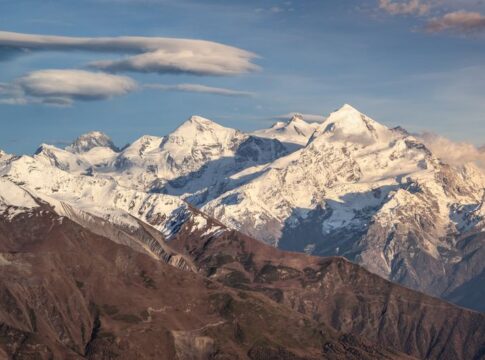
Why Gravity Is Weaker on Mountains: The Physics Explained
By Trivia Daily, Science Desk — Published July 26, 2026
Table of Contents
- Key Takeaways
- The Distance Factor: Why Altitude Weakens Gravity
- The Mass Below: Mountains Add Weight Too
- Earth’s Bulge: Why Latitude Matters More Than You’d Think
- Measuring the Invisible: How Scientists Detect Gravity Changes
- Gravity Variations Around the World
- Frequently Asked Questions
Standing atop Mount Everest, you’d weigh slightly less than you do at sea level. Not because you’ve burned calories climbing, but because gravity itself is weaker up there. This isn’t science fiction—it’s physics in action. The phenomenon of gravity weaker mountains has fascinated researchers for centuries, revealing fundamental truths about how mass, distance, and gravitational force interact. Every meter you climb reduces the pull Earth exerts on your body, though the difference is so small you’d never notice without precision instruments.
The scientific explanation combines Newton’s law of universal gravitation with the simple geometry of spheres. Earth’s gravity weakens as you move farther from its center, and mountaintops place you thousands of meters farther away than sea level does. But that’s not the whole story. The mass beneath your feet changes too, and local geology can create surprising gravitational variations that geophysicists use to map hidden structures deep underground.
Key Takeaways
- Gravity decreases with altitude because you’re farther from Earth’s center of mass—the source of gravitational pull.
- At the summit of Mount Everest (8,849 meters), gravity is approximately 0.28% weaker than at sea level.
- Newton’s inverse square law governs this relationship: gravitational force decreases with the square of the distance from Earth’s center.
- Mountain mass beneath you also affects local gravity, sometimes creating stronger gravity despite higher elevation.
- Precision gravity measurements help scientists discover underground mineral deposits, magma chambers, and geological structures.
- Your weight would decrease by roughly 0.5% climbing from sea level to the peak of a typical tall mountain.
The Distance Factor: Why Altitude Weakens Gravity
Earth’s gravitational pull originates from its entire mass, concentrated at the planet’s center approximately 6,371 kilometers below sea level. When you climb a mountain, you increase your distance from this center of mass. Newton’s law of universal gravitation states that gravitational force is inversely proportional to the square of the distance between two objects. Double the distance, and gravity becomes one-quarter as strong.
The math is straightforward. At sea level, you’re 6,371 kilometers from Earth’s center. Climb to Everest’s summit, and you’re now 6,379.849 kilometers away—a tiny fractional increase. But even this small change matters. The gravitational acceleration at sea level is approximately 9.81 meters per second squared. At Everest’s peak, it drops to about 9.78 meters per second squared.
For a person weighing 70 kilograms at sea level, this translates to a weight reduction of roughly 200 grams at Everest’s summit. Sensitive scientific instruments called gravimeters can detect these minute variations, which geophysicists use in exploration and research. The discovery that gravity varies with location revolutionized our understanding of Earth’s structure and composition.
The Mass Below: Mountains Add Weight Too
Here’s where the physics gets interesting. Mountains aren’t hollow. The massive rock formations beneath your feet exert their own gravitational pull upward, partially counteracting the weakening effect of increased altitude. This creates a tug-of-war between two competing factors: distance from Earth’s center (which weakens gravity) and the mountain’s mass (which strengthens it locally).
The net effect depends on the mountain’s density and structure. For most mountains, the distance effect wins, and gravity remains weaker at the summit than at sea level. But the mountain’s mass reduces how much weaker it becomes. Without that mass, gravity at high elevations would be even weaker than measurements show.
Geologists use these gravitational anomalies as diagnostic tools. Dense rock formations create stronger-than-expected gravity readings, while underground caverns or less-dense sediments create weaker readings. This technique, called gravimetric surveying, has helped locate oil deposits, map volcanic plumbing systems, and even detect hidden archaeological structures without digging.
Earth’s Bulge: Why Latitude Matters More Than You’d Think
Earth isn’t a perfect sphere—it’s an oblate spheroid, bulging at the equator and flattened at the poles. This shape creates gravitational variations far more dramatic than mountain climbing produces. The equatorial bulge means you’re about 21 kilometers farther from Earth’s center at the equator than at the poles, even at sea level.
Combine this with Earth’s rotation, which creates centrifugal force that partially counteracts gravity at the equator, and you get a significant difference. Gravity at the North Pole is roughly 0.5% stronger than at the equator—nearly twice the effect of climbing Everest. A 70-kilogram person would weigh about 350 grams more at the poles than at the equator, assuming identical elevations.
This variation affects everything from Olympic records (jumping events are slightly easier at high-latitude, high-altitude locations) to satellite orbits. Scientists must account for these gravitational irregularities when calculating spacecraft trajectories and predicting ocean tides.
Measuring the Invisible: How Scientists Detect Gravity Changes
Modern gravimeters can detect gravitational changes as small as one part in a billion—equivalent to noticing the gravitational pull of a person standing 10 meters away. These instruments use various principles: some measure how far a precisely calibrated spring stretches under gravity’s pull, while others track the motion of free-falling objects inside vacuum chambers.
Superconducting gravimeters, the most sensitive type, levitate a supercooled sphere using magnetic fields and measure microscopic changes in its position. These devices are so precise they can detect groundwater depletion, tectonic plate movements, and even atmospheric pressure changes through their gravitational effects.
Satellite-based gravity mapping has revolutionized Earth science. Missions like GRACE (Gravity Recovery and Climate Experiment) measured tiny variations in Earth’s gravitational field from orbit, revealing ice sheet melting, aquifer depletion, and mantle convection patterns. The data shows gravity isn’t just weaker on mountains—it varies constantly across Earth’s surface in ways that tell us about deep geological processes and climate change impacts.
Gravity Variations Around the World
| Location | Elevation (meters) | Gravitational Acceleration (m/s²) | Relative Difference |
|---|---|---|---|
| Dead Sea (lowest land point) | -430 | ~9.816 | +0.06% |
| Sea Level (45° latitude) | 0 | 9.806 | Baseline |
| Denver, Colorado | 1,609 | ~9.796 | -0.10% |
| Mount Everest Summit | 8,849 | ~9.78 | -0.28% |
| North Pole (sea level) | 0 | 9.832 | +0.27% |
Frequently Asked Questions
Would you age faster on a mountain due to weaker gravity?
Yes, but the effect is infinitesimally small. Einstein’s general relativity predicts time runs slightly faster where gravity is weaker, so clocks on mountaintops tick microseconds faster than those at sea level over many years. Atomic clocks can measure this difference, confirming relativity’s predictions.
Is gravity the same on all mountains of equal height?
No. Local geology, the mountain’s mass, nearby terrain, and latitude all create variations. A 3,000-meter peak in the Himalayas might have slightly different gravity than a 3,000-meter peak in the Andes due to differences in crustal density and structure beneath each mountain.
Does weaker gravity on mountains affect athletic performance?
Slightly, though altitude’s effect on oxygen availability is far more significant. Weaker gravity makes you marginally lighter, which could theoretically help in jumping or throwing events, but the reduced air resistance at altitude (from thinner air) has a much larger impact on performance.
Can you escape Earth’s gravity by climbing high enough?
No. Gravity extends infinitely outward, though it weakens with distance. Even astronauts on the International Space Station, orbiting 400 kilometers up, experience about 90% of Earth’s surface gravity—they float because they’re in constant freefall, not because gravity disappeared.
Every step up a mountain staircase is a tiny experiment in fundamental physics, demonstrating how mass and distance shape the invisible forces governing our universe. The precision with which scientists can now measure these minute gravitational variations has transformed them from curiosities into powerful tools for understanding everything beneath our feet and beyond our atmosphere.