
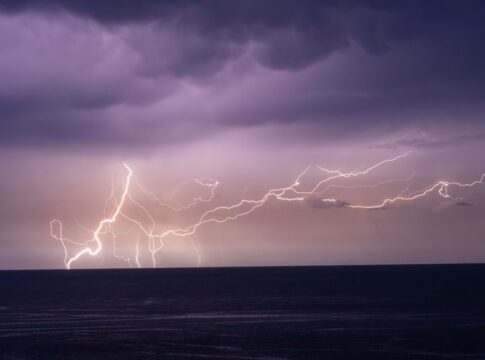
Did You Know Lightning Strikes Earth 100 Times Per Second
By Trivia Daily, Science Desk — Published November 11, 2026
Table of Contents
- Key Takeaways
- How Lightning Strikes Earth So Frequently
- The Global Distribution of Lightning Activity
- The Chemistry and Biology of Lightning
- Measuring and Predicting Lightning
- Frequently Asked Questions
Every second of every day, roughly 100 bolts of lightning strike somewhere on Earth. That’s about 8.6 million strikes daily, or more than three billion per year. This relentless electrical barrage makes lightning one of the planet’s most spectacular and continuous physics demonstrations, a natural phenomenon that has fascinated scientists and sky-watchers for centuries. The discovery that lightning strikes earth with such frequency came from decades of research combining ground-based detection networks and satellite observations, revealing just how electrically active our atmosphere truly is.
Lightning isn’t just beautiful—it’s scientifically essential. Each bolt reaches temperatures of roughly 30,000 Kelvin, five times hotter than the surface of the Sun. The energy released triggers chemical reactions in the atmosphere, including the production of nitrogen compounds that fertilize soil. Understanding this electrical phenomenon requires knowledge from multiple scientific disciplines: the physics of electrical discharge, the chemistry of atmospheric gases, and even the biology of how living organisms respond to electromagnetic pulses.
Key Takeaways
- Lightning strikes Earth approximately 100 times every second, totaling around 8.6 million strikes daily and over three billion annually.
- Each lightning bolt can reach temperatures of about 30,000 Kelvin—five times hotter than the Sun’s surface—and contains enough energy to power a 100-watt light bulb for more than three months.
- About 75% of all lightning strikes occur over tropical regions, with the Democratic Republic of Congo experiencing the highest concentration of lightning activity on the planet.
- Lightning produces nitrogen oxides through atmospheric chemistry reactions, which eventually fall to Earth and fertilize soil, playing a role in the nitrogen cycle essential for plant biology.
- The speed of a lightning bolt varies, but the return stroke—the bright flash we see—travels at roughly one-third the speed of light.
- Scientific research using satellite technology and ground-based detection networks has mapped global lightning patterns, advancing our understanding of severe weather prediction.
How Lightning Strikes Earth So Frequently
The sheer frequency of lightning strikes earth becomes less mysterious when you consider that roughly 2,000 thunderstorms are active across the globe at any given moment. These storms concentrate in equatorial regions where warm, moist air rises rapidly, creating the perfect conditions for electrical buildup. The physics behind each strike involves the separation of electrical charges within storm clouds—ice crystals and water droplets collide, transferring electrons and creating regions of positive and negative charge.
When the electrical potential difference grows large enough, it overcomes the insulating properties of air. A stepped leader—an invisible channel of ionized air—extends downward from the cloud in a zigzag pattern. Once this channel connects with the ground (or with a positively charged streamer rising from the surface), the main discharge occurs. This return stroke carries the brilliant flash we recognize as lightning, traveling upward at tremendous speed.
Ground-based lightning detection networks operated by organizations like the National Oceanic and Atmospheric Administration monitor these strikes continuously. More recently, satellite instruments have provided global coverage, confirming that lightning activity peaks over land in the afternoon and early evening when solar heating maximizes atmospheric instability.
The Global Distribution of Lightning Activity
Lightning doesn’t strike randomly across Earth’s surface. Scientific mapping reveals distinct patterns tied to geography, climate, and atmospheric conditions. Tropical regions dominate global lightning statistics, accounting for roughly three-quarters of all strikes. Lake Maracaibo in Venezuela holds the record for the highest concentration of lightning activity, with storms occurring up to 260 nights per year in some areas.
| Region | Annual Lightning Density | Primary Factor |
|---|---|---|
| Central Africa (Congo Basin) | Very High | Year-round convection, moisture |
| Lake Maracaibo, Venezuela | Extreme | Mountain-valley circulation, humidity |
| Tropical Asia (India, Southeast Asia) | High | Monsoon systems, warm temperatures |
| North America (Great Plains) | Moderate to High | Severe convective storms, frontal systems |
| Polar Regions | Very Low | Cold temperatures, limited convection |
Oceans experience far less lightning than land masses, despite covering most of Earth’s surface. The reason lies in thermodynamics: land heats and cools more rapidly than water, creating stronger updrafts necessary for thunderstorm development. This discovery emerged from research comparing satellite lightning data with surface temperature measurements.
The Chemistry and Biology of Lightning
Beyond its spectacular physics, lightning drives important chemical reactions in Earth’s atmosphere. The extreme temperatures within a lightning channel break apart nitrogen and oxygen molecules, allowing them to recombine into nitrogen oxides. These compounds eventually dissolve in rainwater, forming dilute nitric acid that delivers nitrogen to soil—a natural fertilization process that predates human agriculture by billions of years.
Scientists estimate that lightning contributes several million tons of usable nitrogen to Earth’s ecosystems annually. This chemistry connects atmospheric electricity to the biology of plant growth, since nitrogen is essential for producing proteins and DNA. Before humans learned to synthesize fertilizers industrially, lightning-fixed nitrogen played an even more critical role in sustaining plant life.
Some researchers have conducted experiments suggesting that lightning may have contributed to the origin of life itself. Laboratory simulations show that electrical discharges through primitive atmospheric mixtures can produce amino acids and other organic compounds. While the exact conditions of early Earth remain debated, these experiments demonstrate how physics and chemistry could have collaborated to create the building blocks of biology.
Measuring and Predicting Lightning
Modern lightning detection relies on networks of sensors that detect the electromagnetic pulses generated by each strike. These systems can pinpoint strike locations within a few hundred meters and distinguish between cloud-to-ground and cloud-to-cloud discharges. The data feeds into weather forecasting models and provides real-time alerts for aviation, outdoor events, and electrical utilities.
Satellites equipped with optical sensors and radio-frequency detectors have revolutionized global lightning research. NASA‘s Lightning Imaging Sensor and the more recent Geostationary Lightning Mapper provide continuous coverage, capturing strikes that ground-based networks miss. This technology has revealed previously unknown patterns, including how lightning activity relates to hurricane intensity and how it varies with climate cycles.
The physics of lightning prediction remains challenging. While meteorologists can forecast thunderstorm probability with reasonable accuracy, predicting exactly when and where individual strikes will occur is nearly impossible. The chaotic nature of atmospheric electricity means that tiny variations in temperature, humidity, or wind can dramatically alter lightning behavior—a classic example of complexity in natural systems.
Frequently Asked Questions
Can lightning strike the same place twice?
Absolutely. Tall structures like the Empire State Building are struck dozens of times annually because they provide a shorter path for electrical discharge. The idea that lightning never strikes twice is a myth with no scientific basis.
Is it safe to be in a car during a lightning storm?
Yes, enclosed metal vehicles provide excellent protection through a principle called a Faraday cage—the metal shell conducts electricity around the outside, protecting occupants inside. However, convertibles and vehicles with fiberglass bodies offer less protection.
What causes the thunder that follows lightning?
Thunder is the sound of rapidly expanding air. Lightning heats the air channel to extreme temperatures almost instantaneously, causing explosive expansion that creates a shock wave we hear as thunder. Light travels much faster than sound, which is why you see the flash before hearing the rumble.
How much energy is in a typical lightning bolt?
A single lightning strike contains roughly one billion joules of energy, though only about 250 kilowatt-hours is usable electricity. While that could power a home for weeks, capturing and storing lightning energy remains impractical due to the brief, unpredictable nature of strikes.
The next time storm clouds gather, remember that you’re witnessing one small part of a global electrical circuit that never sleeps. Somewhere on Earth right now, lightning is striking—and it will strike again in less than a second.