
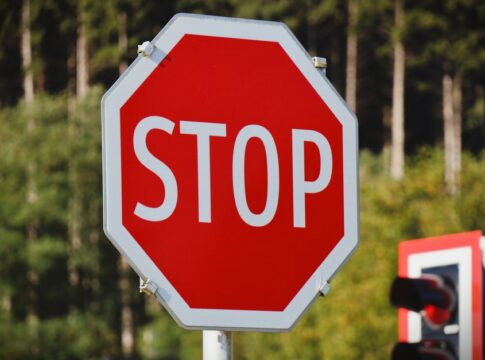
The Truth About Why Stop Signs Are Octagonal Shaped
By Triv Central, Staff Writer — Published November 9, 2026
Table of Contents
- Key Takeaways
- The Truth Stop Signs Tell About Early Traffic Chaos
- Why Eight Sides Won Over Other Shapes
- The Surprising Color Evolution
- International Adoption and Variations
- Modern Manufacturing and Reflectivity Standards
- Frequently Asked Questions
Every driver recognizes the bright red octagon instantly, even from a distance. But have you ever wondered why stop signs have eight sides instead of being round, square, or triangular? The truth about stop signs reveals a fascinating piece of engineering psychology and traffic safety history. This distinctive shape wasn’t chosen randomly—it’s the result of deliberate design decisions made nearly a century ago to save lives on increasingly crowded roads.
The octagonal shape serves a purpose far beyond aesthetics. It creates instant recognition, even when the sign is partially obscured by snow, dirt, or vegetation. More surprisingly, the eight-sided design works even when viewed from behind, allowing drivers to recognize intersections controlled by stop signs from multiple angles.
Key Takeaways
- Stop signs became octagonal in 1922 to create a unique, instantly recognizable shape that stands out from all other traffic signs.
- The eight-sided design allows drivers to identify stop signs even from the rear, helping them anticipate cross-traffic situations.
- Before standardization, stop signs varied wildly in color (yellow, white) and shape (round, square) across different cities and states.
- The octagon has more sides than any other standard traffic sign shape, making it impossible to confuse with regulatory or warning signs.
- Modern stop signs must meet precise specifications: exactly 30 inches across for standard roads, 36 inches for multi-lane highways.
- The distinctive shape was chosen before the red color—early octagonal stop signs were actually yellow with black lettering.
The Truth Stop Signs Tell About Early Traffic Chaos
In the early 1900s, American roads were a confusing mess of inconsistent signage. Cities and states created their own traffic control systems with no coordination. Detroit might use a yellow square. Cleveland preferred white circles. Some communities painted “STOP” directly on telephone poles.
This chaos became dangerous as automobiles proliferated and drivers began traveling between cities. A driver trained on one city’s signs could easily miss critical warnings in another jurisdiction. Traffic fatalities climbed. Something had to change.
The American Association of State Highway Officials (now the American Association of State Highway and Transportation Officials) stepped in during the 1920s to create uniform standards. They assigned specific shapes to different types of signs: circles for railroad crossings, diamonds for warnings, rectangles for regulations. The stop sign needed something more dramatic—a shape that would command immediate attention and couldn’t be mistaken for anything else.
Why Eight Sides Won Over Other Shapes
The octagon wasn’t the only candidate. Traffic engineers considered various options, each with advantages and drawbacks. But the eight-sided shape offered unique benefits that other geometries couldn’t match.
First, it’s complex enough to be distinctive but simple enough to manufacture consistently. A circle requires precise curves. An octagon can be cut with straight edges, making production easier with 1920s technology. Second, it has the most sides of any standard traffic sign, creating a hierarchy of urgency. The more sides, the more important the message. Yield signs, with three sides, rank below stop signs in the priority system.
Third, and perhaps most clever: the octagonal shape looks similar from multiple angles. Unlike a triangle or rectangle, which appear dramatically different when viewed from various perspectives, an octagon maintains its distinctive profile even when seen at oblique angles or from behind. This means drivers approaching an intersection can recognize that cross-traffic faces a stop sign, even though they’re viewing the back of that sign.
The Surprising Color Evolution
Most people assume stop signs have always been red. They haven’t. The original octagonal stop signs, introduced in 1924, were yellow with black letters. Red pigments of that era faded quickly under sunlight and weather exposure, making them unreliable for permanent outdoor signage.
Yellow provided better visibility and durability with available materials. This remained standard until the 1950s, when fade-resistant red enamel paints became available. The switch to red happened gradually—some yellow stop signs remained in use into the 1970s in rural areas.
Red carries stronger psychological associations with danger and prohibition across cultures. Studies have shown that drivers respond more quickly to red signals than yellow ones. The combination of the unique octagonal shape and the urgent red color creates what traffic engineers call “redundant coding”—multiple features working together to ensure the message gets through.
International Adoption and Variations
The octagonal stop sign has become nearly universal, but not every country uses identical designs. Most nations following the Vienna Convention on Road Signs and Signals use the red octagon, though some place the word “STOP” in their local language inside the shape.
A few countries add subtle variations. Japan uses an inverted red triangle for stop signs instead of an octagon, though they’re considering switching to align with international standards. Some European nations experimented with different approaches before ultimately adopting the octagonal standard for consistency with global traffic patterns.
| Sign Shape | Number of Sides | Typical Use | Priority Level |
|---|---|---|---|
| Octagon | 8 | Stop | Highest |
| Triangle (inverted) | 3 | Yield | High |
| Diamond | 4 | Warning | Medium |
| Rectangle (vertical) | 4 | Regulatory | Variable |
| Pentagon | 5 | School crossing | High |
Modern Manufacturing and Reflectivity Standards
Today’s stop signs bear little resemblance to their 1920s ancestors beyond shape and color. Modern signs use highly engineered retroreflective sheeting that bounces headlight beams directly back to drivers, making signs visible from hundreds of feet away in darkness.
The Federal Highway Administration maintains strict specifications. The red must meet precise color coordinates measured by spectrophotometry. The white letters must achieve specific contrast ratios. The sheeting must maintain reflectivity for at least seven years under normal weather conditions. Signs that fail to meet these standards must be replaced, which is why road crews regularly inspect and swap out aging signs.
Some municipalities now experiment with LED-enhanced stop signs that illuminate in low-visibility conditions, though these remain controversial. Critics argue that over-engineering stop signs may reduce driver attention to standard signs, creating safety problems elsewhere.
Frequently Asked Questions
Why don’t stop signs use other shapes like hexagons or decagons?
The octagon was chosen because it offers the optimal balance between distinctiveness and manufacturability. It has enough sides to be unique among traffic signs while remaining simple enough to produce consistently with straight cuts, unlike more complex polygons that would be harder to fabricate and inspect for quality.
Are there any square or round stop signs still legally in use?
No. Federal standards require all stop signs on public roads to be octagonal. While a few antique non-octagonal stop signs exist in private collections or on private property, any stop sign controlling traffic on public roads must meet current octagonal specifications or face replacement.
Can you get a ticket for rolling through a stop sign even if you can’t see it clearly?
Yes, though visibility can be a defense in court. Drivers are expected to recognize stop signs by shape alone, even when text is obscured. However, if vegetation or damage makes a sign genuinely invisible, judges may dismiss tickets, and municipalities have legal obligations to maintain clear signage.
Why do some countries write “STOP” in English even though it’s not their language?
Many non-English-speaking countries use “STOP” because it’s become an internationally recognized traffic term, similar to how “OK” is understood globally. Some nations prefer this approach to using their native word, believing the universal “STOP” helps international travelers navigate safely.
The next time you brake at that familiar red octagon, you’re participating in a century of carefully designed traffic psychology. That simple eight-sided shape represents countless hours of engineering thought, all compressed into a split-second recognition that happens dozens of times during your daily drive. It’s a small reminder that even the most ordinary objects around us often hide fascinating stories of human ingenuity.