
The Truth About Why Mazes Were Built in Ancient Gardens
By Trivia Daily, Staff Writer — Published November 7, 2026
Table of Contents
- Key Takeaways
- The Truth About Mazes Built for Spiritual Journeys
- Medieval Labyrinths: Walking Pilgrimages on Cathedral Floors
- Renaissance Gardens: When Mazes Became Status Symbols
- Famous Historic Mazes and Their Purposes
- The Psychology Behind Maze Walking
- From Sacred to Secular: The Evolution Continues
- Frequently Asked Questions
Walk through any historic European estate and you might stumble upon an elaborate hedge maze, its green walls towering overhead and paths twisting in confusing patterns. These garden mazes weren’t just whimsical decorations or entertainment for bored aristocrats. The truth about why mazes were built in ancient gardens reveals a fascinating blend of spiritual symbolism, philosophical meditation, and social display that stretches back thousands of years. What began as sacred pathways evolved into status symbols, proving grounds for courtship, and eventually the puzzle-like attractions we recognize today.
Ancient civilizations created labyrinths and mazes for reasons that might surprise modern visitors who see them merely as fun diversions. The oldest known labyrinth designs appear in Greek mythology and ancient Egyptian tombs, serving purposes far removed from simple amusement.
Key Takeaways
- Ancient mazes originated as spiritual and meditative pathways, not entertainment puzzles, with the oldest designs dating back over 4,000 years.
- The famous Cretan labyrinth from Greek mythology symbolized a journey to the center of oneself, representing transformation and rebirth.
- Medieval Christian churches incorporated labyrinth designs into their floors as substitutes for pilgrimages to the Holy Land.
- Renaissance garden mazes served as status symbols for wealthy families, demonstrating their resources and sophisticated taste.
- The hedge maze at Hampton Court Palace, planted around 1690, remains one of the oldest surviving puzzle mazes in the world.
- Modern neuroscience research suggests walking labyrinths can reduce anxiety and promote meditative states similar to mindfulness practices.
The Truth About Mazes Built for Spiritual Journeys
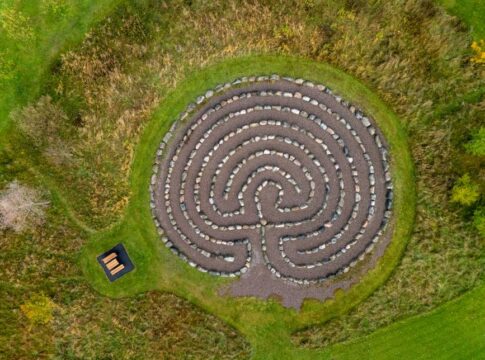
The earliest labyrinths weren’t designed to confuse visitors. Ancient cultures created single-path labyrinths—technically not mazes at all—as metaphors for life’s journey. These unicursal designs had no wrong turns or dead ends. You simply followed the winding path to the center and back out again.
Greek mythology tells of the labyrinth beneath King Minos’s palace in Crete, built to contain the Minotaur. Archaeological evidence shows labyrinth symbols carved into stone tablets and pottery throughout the Mediterranean region dating to 1200 BCE and earlier. These weren’t maps of actual buildings. They represented spiritual concepts: the journey inward to confront one’s inner beast, transformation, and eventual emergence into enlightenment.
Egyptian tombs feature labyrinthine passages that served both practical and symbolic functions. The complex corridors protected royal burials from thieves while representing the deceased’s journey through the underworld. Herodotus, the ancient Greek historian, described an enormous Egyptian structure he called “the Labyrinth” near Lake Moeris, claiming it surpassed even the pyramids in wonder.
Medieval Labyrinths: Walking Pilgrimages on Cathedral Floors
During the Middle Ages, European churches incorporated labyrinth designs directly into their stone floors. The most famous example sits in Chartres Cathedral in France, installed around 1200 CE. This circular pattern spans roughly 42 feet in diameter, and its path measures about 860 feet when fully walked.
These church labyrinths served as symbolic pilgrimages. When war, poverty, or health prevented believers from traveling to Jerusalem, they could walk the labyrinth on their knees as a substitute journey. The center represented reaching the Holy City. Priests used these patterns for contemplative prayer and penance.
The spiritual function differed entirely from the puzzle mazes that would emerge centuries later. No choices confronted the walker. No possibility of getting lost existed. The path simply wound back and forth, creating a meditative rhythm that quieted the mind and focused attention inward.
Renaissance Gardens: When Mazes Became Status Symbols
Everything changed during the Renaissance when wealthy Italian and French families began constructing elaborate garden mazes with multiple paths, dead ends, and genuine confusion. These weren’t spiritual tools. They were expensive displays of wealth and sophisticated taste.
Creating a proper hedge maze required enormous resources. Gardeners planted thousands of shrubs—typically boxwood, yew, or hornbeam—and maintained them for years before the maze reached functional height. The design demonstrated mathematical and geometric knowledge. The ongoing maintenance required skilled labor. Essentially, only the richest families could afford such elaborate garden features.
These mazes also served social functions. Young couples could “accidentally” get lost together, providing rare moments of relative privacy in highly supervised societies. Garden parties featured maze races and competitions. The puzzle element transformed the ancient spiritual labyrinth into entertainment.
Famous Historic Mazes and Their Purposes
| Maze Location | Approximate Date | Primary Purpose |
|---|---|---|
| Chartres Cathedral, France | 1200 CE | Spiritual meditation and symbolic pilgrimage |
| Villa Pisani, Italy | 1720 | Entertainment and aristocratic display |
| Hampton Court Palace, England | 1690 | Royal garden feature and amusement |
| Rosamond’s Bower, England | 12th century (legendary) | Alleged secret meeting place |
The Psychology Behind Maze Walking
Modern research reveals interesting facts about how mazes affect human psychology. Walking a labyrinth activates different brain patterns than solving a puzzle maze. The single-path labyrinth promotes relaxation and meditative states, similar to repetitive practices like walking meditation or saying rosary prayers.
Puzzle mazes, by contrast, engage problem-solving regions of the brain. They trigger mild stress responses—just enough to be stimulating rather than overwhelming for most people. This explains why maze walking feels satisfying when you finally reach the center or exit. Your brain releases small amounts of dopamine as a reward for solving the spatial puzzle.
Some hospitals and wellness centers have reintroduced labyrinth walking as a therapeutic tool. The practice may help reduce anxiety, lower blood pressure, and improve focus. Ancient builders couldn’t have known the neuroscience, but they understood the calming effect through observation and experience.
From Sacred to Secular: The Evolution Continues
Today’s corn mazes, mirror mazes at amusement parks, and elaborate hedge mazes at tourist destinations descend from these ancient traditions. The spiritual symbolism has largely faded from popular consciousness, though some churches and meditation centers maintain walking labyrinths for contemplative purposes.
The interesting truth is that both traditions—spiritual labyrinths and entertainment mazes—continue to coexist. You can find finger labyrinths in hospital waiting rooms and massive corn mazes covering acres of farmland. Each serves different human needs: one for contemplation, the other for playful challenge.
Frequently Asked Questions
What is the difference between a labyrinth and a maze?
A labyrinth has a single path leading to the center with no dead ends or choices, while a maze contains multiple paths, wrong turns, and dead ends designed to confuse. Labyrinths are for meditation; mazes are puzzles.
Where is the oldest surviving garden maze?
The hedge maze at Hampton Court Palace near London, planted around 1690, is among the oldest surviving puzzle mazes. However, labyrinth designs carved in stone date back over 4,000 years.
Why did medieval churches put labyrinths on their floors?
Church labyrinths served as symbolic pilgrimages to Jerusalem for believers who couldn’t make the actual journey. Walking the path on one’s knees represented penance and spiritual devotion.
Do walking labyrinths have actual health benefits?
Research suggests labyrinth walking can reduce stress, lower anxiety, and promote meditative states similar to mindfulness practices. Some medical facilities incorporate them into wellness programs.
Next time you encounter a garden maze or labyrinth, consider the layers of human intention woven into those paths. Whether carved in cathedral stone or clipped from living hedges, these winding ways connect us to ancestors who understood that sometimes the journey itself—not the destination—holds the deepest meaning. The ancient designers knew something we’re only rediscovering: getting purposefully lost can help us find ourselves.