
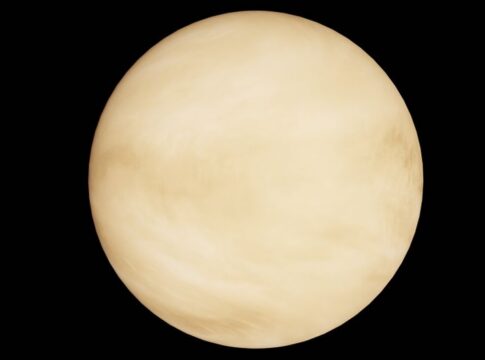
Did You Know Venus Rotates Backwards Compared to Earth
By Trivia Daily, Science Desk — Published November 6, 2026
Table of Contents
- Key Takeaways
- Why Venus Rotates Backwards: The Leading Scientific Theory
- The Slowest Spinner in the Solar System
- Comparing Planetary Rotations in Our Solar System
- The Discovery That Changed Our Understanding
- Venus’s Atmosphere: Faster Than the Planet Itself
- Frequently Asked Questions
When you look up at the night sky and spot Venus—our closest planetary neighbor—you’re gazing at one of the solar system’s most peculiar worlds. While nearly every planet in our cosmic neighborhood spins in the same direction, Venus rotates backwards compared to Earth and most other planets. This retrograde rotation means the Sun rises in the west and sets in the east on Venus, the complete opposite of what we experience here at home. Even more remarkably, a single day on Venus lasts longer than its entire year.
This strange behavior has puzzled scientists for decades and sparked fascinating research into planetary formation and the violent history of our solar system. Understanding why Venus rotates backwards requires diving into physics, celestial mechanics, and the dramatic collisions that shaped the planets billions of years ago.
Key Takeaways
- Venus rotates backwards (retrograde) compared to Earth and most other planets in our solar system, making it one of only two planets with this unusual spin direction.
- A day on Venus (one complete rotation) takes about 243 Earth days, while its year (one orbit around the Sun) takes only 225 Earth days—meaning a Venusian day is longer than its year.
- Scientists believe a massive collision with another planetary body early in Venus’s history likely caused its backward rotation, though the exact mechanism remains an active area of research.
- Venus rotates so slowly that its dense atmosphere actually rotates faster than the planet itself, creating super-rotating winds that circle the planet every four Earth days.
- Only Venus and Uranus have retrograde rotations in our solar system, though Uranus’s extreme tilt makes its rotation pattern even more unusual.
- The discovery of Venus’s backward rotation came from radar observations conducted by astronomers in the 1960s, as the planet’s thick cloud cover makes direct observation of its surface impossible from Earth.
Why Venus Rotates Backwards: The Leading Scientific Theory
The most widely accepted explanation involves a catastrophic impact. Early in the solar system’s history—roughly four billion years ago—planetary formation was a chaotic, violent process. Large proto-planets and massive asteroids regularly collided with one another. Scientists theorize that Venus suffered at least one enormous collision with a planetary body, possibly as large as Earth’s moon or even bigger. This impact delivered enough energy to dramatically alter Venus’s spin.
The physics behind this are straightforward yet dramatic. When a massive object strikes a planet at the right angle and velocity, it transfers angular momentum. Depending on the collision’s direction and force, this transfer can slow a planet’s rotation, speed it up, tilt it on its axis, or even reverse its spin entirely. Venus likely experienced multiple significant impacts during the solar system’s turbulent youth, with the cumulative effect being its current backward rotation.
Some research suggests tidal forces from the Sun combined with Venus’s thick atmosphere may have contributed to slowing and eventually reversing its rotation over billions of years. The dense Venusian atmosphere creates significant gravitational interactions with the Sun, producing tidal bulges that could have gradually altered the planet’s spin. This process would have taken enormous stretches of time, but Venus has had over four billion years for such changes to occur.
The Slowest Spinner in the Solar System
Venus holds another remarkable record: it’s the slowest-rotating planet we know. Its rotation is so leisurely that Venus completes an orbit around the Sun before finishing a single rotation on its axis. Imagine living on a world where a single day-night cycle spans more than an entire year. The Sun would creep across the sky at an almost imperceptible pace, taking months to move from horizon to horizon.
This extreme slowness creates unusual conditions. The long days mean that the side facing the Sun bakes for months at a time, while the night side experiences extended darkness. However, Venus’s incredibly dense atmosphere—about 90 times thicker than Earth’s—distributes heat so efficiently that there’s surprisingly little temperature difference between the day and night sides. The entire planet maintains a scorching surface temperature of around 900 degrees Fahrenheit, hot enough to melt lead.
Comparing Planetary Rotations in Our Solar System
| Planet | Rotation Direction | Length of Day | Rotation Speed |
|---|---|---|---|
| Mercury | Prograde (normal) | 59 Earth days | Slow |
| Venus | Retrograde (backward) | 243 Earth days | Extremely slow |
| Earth | Prograde (normal) | 24 hours | Moderate |
| Mars | Prograde (normal) | 24.6 hours | Moderate |
| Jupiter | Prograde (normal) | 10 hours | Very fast |
| Uranus | Retrograde (backward) | 17 hours | Fast |
The Discovery That Changed Our Understanding
For centuries, astronomers couldn’t determine Venus’s rotation at all. The planet is perpetually shrouded in thick clouds of sulfuric acid that completely obscure its surface. Telescope observations revealed nothing about how fast or in which direction Venus spun. The mystery persisted until the space age brought new technology.
In the 1960s, scientists began bouncing radar signals off Venus from Earth-based radio telescopes. These radar observations could penetrate the clouds and reveal details about the planet’s surface and rotation. The data showed something unexpected: Venus was rotating backward, and incredibly slowly. NASA‘s later missions to Venus, including the Magellan spacecraft in the 1990s, confirmed these findings and mapped the Venusian surface in detail using radar imaging.
Venus’s Atmosphere: Faster Than the Planet Itself
Here’s where things get even stranger. While Venus’s solid surface rotates once every 243 Earth days, its upper atmosphere races around the planet in just four Earth days. This phenomenon, called super-rotation, means the atmospheric winds travel roughly 60 times faster than the planet’s surface rotates. Scientists are still working to fully understand the chemistry and physics driving these extraordinary winds.
The super-rotating atmosphere transports heat from the day side to the night side with remarkable efficiency. This atmospheric circulation, combined with the greenhouse effect from Venus’s carbon dioxide-rich atmosphere, maintains uniform temperatures across the entire planet. The experiment of nature occurring on Venus provides valuable insights into atmospheric dynamics that help scientists better understand weather patterns on Earth and other worlds.
Frequently Asked Questions
Does Venus really rotate backwards or is it just tilted upside down?
Venus truly rotates in the opposite direction compared to Earth, not just upside down. Its axial tilt is only about 3 degrees, nearly upright, but its rotation direction is retrograde—clockwise when viewed from above the solar system’s north pole, while Earth and most planets rotate counterclockwise.
How long would a day feel like if you could stand on Venus?
If you could survive Venus’s hellish conditions, you’d experience sunlight for about four Earth months, followed by darkness for another four months. The Sun would rise in the west, crawl across the sky incredibly slowly, and set in the east after roughly 117 Earth days of daylight.
Are there any other planets that rotate backwards like Venus?
Uranus also has retrograde rotation, though it’s even more unusual because the planet is tilted 98 degrees on its side, essentially rolling around the Sun. Venus and Uranus are the only two planets in our solar system with this backward rotation pattern.
Could Venus’s backward rotation ever reverse again?
Over billions of years, tidal forces from the Sun continue to affect Venus’s rotation, though the changes are extremely gradual. Some scientists theorize Venus’s rotation could eventually slow to zero and possibly reverse again, but this would take timescales far longer than the current age of the solar system.
Venus reminds us that planets don’t always follow the rules we expect. Its backward spin, slower-than-a-year day, and super-rotating atmosphere make it one of the most scientifically intriguing worlds in our cosmic backyard. Every discovery about this mysterious planet raises new questions about how worlds form, evolve, and sometimes march to their own peculiar rhythms.