
Why Does Liquid Nitrogen Freeze Objects Instantly
By Trivia Daily, Science Desk — Published November 4, 2026
Table of Contents
- Key Takeaways
- The Physics Behind Instant Liquid Nitrogen Freeze
- Why Nitrogen Makes Such an Effective Freezing Agent
- The Chemistry of Extreme Cold
- Comparing Cryogenic Liquids
- Safety and the Leidenfrost Effect
- Frequently Asked Questions
Drop a flower into liquid nitrogen and watch it transform into a brittle sculpture in seconds. The petals, once soft and supple, shatter like glass at the slightest touch. This dramatic transformation happens because liquid nitrogen exists at an extraordinarily cold temperature—approximately negative 196 degrees Celsius (negative 321 degrees Fahrenheit). When objects encounter this extreme cold, heat energy rushes out of them so rapidly that they freeze almost instantaneously. The science behind why liquid nitrogen freeze processes work so quickly involves fundamental principles of thermodynamics and the behavior of matter at extreme temperatures.
The physics of this phenomenon reveals something profound about heat transfer and molecular motion. Nitrogen becomes liquid only when cooled far below the temperatures we experience in everyday life, and maintaining this state requires careful handling in specialized containers.
Key Takeaways
- Liquid nitrogen boils at negative 196 degrees Celsius, creating a temperature difference of over 200 degrees with room-temperature objects.
- The extreme temperature gradient causes rapid heat transfer through conduction, pulling thermal energy from objects at extraordinary rates.
- Water inside objects freezes so quickly that ice crystals can rupture cell walls, which is why frozen flowers become brittle and shatter.
- The boiling effect you see when pouring liquid nitrogen is actually the nitrogen rapidly evaporating back into gas as it absorbs heat.
- Liquid nitrogen is commonly used in cryogenic research, food preservation, and medical procedures because of its ability to freeze biological samples quickly.
- The Leidenfrost effect can temporarily protect objects from instant freezing if a vapor barrier forms between the liquid and the surface.
The Physics Behind Instant Liquid Nitrogen Freeze
Temperature measures the average kinetic energy of molecules—how fast they’re vibrating and moving. At room temperature, molecules in most materials bounce around vigorously. When these materials contact liquid nitrogen, heat energy flows from the warmer object to the colder liquid following the second law of thermodynamics.
The rate of this heat transfer depends on the temperature difference. With liquid nitrogen sitting at negative 196 degrees Celsius and a typical object at 20 degrees Celsius, you have a temperature gradient of about 216 degrees. This massive difference drives heat energy out of the object at incredible speed.
As molecules in the object lose energy, they slow down dramatically. In liquids like water, this causes the molecules to lock into rigid crystalline structures—ice. The process happens so fast that the entire object can solidify in seconds rather than the minutes or hours freezing would take in a conventional freezer.
Liquid nitrogen itself provides another clue to the speed of this process. It boils vigorously when exposed to room-temperature air or objects. This boiling represents nitrogen absorbing heat energy and converting from liquid back to gas. The phase change from liquid to gas requires substantial energy, which the nitrogen pulls directly from whatever it touches.
Why Nitrogen Makes Such an Effective Freezing Agent
Nitrogen comprises about 78 percent of Earth’s atmosphere in its gaseous form. Under normal atmospheric pressure, nitrogen only becomes liquid when cooled below negative 196 degrees Celsius. This extreme cold makes it ideal for rapid freezing applications in chemistry and biology research.
Several properties make liquid nitrogen particularly effective:
- Inert nature—nitrogen doesn’t react chemically with most substances, so it freezes objects without altering their chemical composition
- Abundant and relatively inexpensive compared to other cryogenic liquids
- Evaporates completely into harmless atmospheric gas, leaving no residue
- Low viscosity allows it to flow easily and contact surfaces thoroughly
- High heat of vaporization means it can absorb substantial thermal energy during boiling
Scientists and researchers use liquid nitrogen for flash-freezing biological samples because rapid freezing minimizes ice crystal formation that would otherwise damage delicate cellular structures. When freezing happens slowly, water molecules have time to form large ice crystals that puncture cell membranes. Fast freezing creates smaller crystals that cause less structural damage.
The Chemistry of Extreme Cold
Chemical reactions slow down dramatically at cryogenic temperatures. The Arrhenius equation describes how reaction rates depend on temperature—most chemical processes roughly double in speed for every 10-degree Celsius increase in temperature. Running this relationship in reverse, extreme cold brings molecular activity nearly to a standstill.
This principle has practical applications. Food preservation through flash-freezing maintains texture and nutritional content better than slow freezing. Biological samples stored in liquid nitrogen can remain viable for decades because chemical degradation essentially stops. Medical applications include cryotherapy treatments and preservation of tissues, cells, and reproductive materials.
The physical changes objects undergo in liquid nitrogen can be startling. Rubber becomes brittle. Bananas turn hard enough to hammer nails. These transformations occur because materials change their mechanical properties at different temperatures. Rubber’s flexibility comes from long polymer chains that can move and slide past each other. At cryogenic temperatures, these chains lose mobility and the material becomes rigid and glass-like.
Comparing Cryogenic Liquids
| Cryogenic Liquid | Boiling Point | Common Applications |
|---|---|---|
| Liquid Nitrogen | -196°C (-321°F) | Food freezing, medical preservation, cooling superconductors |
| Liquid Helium | -269°C (-452°F) | MRI machines, quantum physics research, space telescope cooling |
| Liquid Oxygen | -183°C (-297°F) | Rocket fuel oxidizer, medical oxygen supply |
| Liquid Hydrogen | -253°C (-423°F) | Rocket fuel, experimental physics research |
Safety and the Leidenfrost Effect
Despite its extreme cold, liquid nitrogen doesn’t always freeze objects instantly on contact. The Leidenfrost effect creates a curious exception. When liquid nitrogen hits a much warmer surface, it can boil so rapidly that a layer of nitrogen gas forms between the liquid and the surface. This vapor barrier actually insulates the object temporarily, slowing heat transfer.
You can observe this when small amounts of liquid nitrogen dance across a warm floor rather than immediately spreading and freezing everything. The droplets hover on their own vapor cushion. This same effect explains why you can briefly dip a wet finger into liquid nitrogen without injury—the water vaporizes and creates a protective barrier. However, this is extremely dangerous and should never be attempted, as prolonged contact causes severe frostbite and tissue damage.
Proper handling requires insulated gloves, face protection, and well-ventilated spaces. As liquid nitrogen evaporates, it displaces oxygen in enclosed areas, creating asphyxiation hazards. Containers must allow gas to escape, as sealed vessels can explode from pressure buildup.
Frequently Asked Questions
How fast does liquid nitrogen actually freeze objects?
Small objects with high surface area, like flowers or leaves, freeze solid in just a few seconds. Larger objects take longer depending on their mass and thermal conductivity, but the surface freezes almost immediately upon contact. The freezing happens hundreds of times faster than in a conventional freezer.
Can liquid nitrogen freeze anything instantly?
Liquid nitrogen can freeze most common materials very quickly, but some substances require even lower temperatures. Helium, for example, remains liquid even at liquid nitrogen temperatures and requires liquid helium (negative 269 degrees Celsius) to freeze. Materials with very low freezing points resist solidification in liquid nitrogen.
Why does liquid nitrogen create fog when poured out?
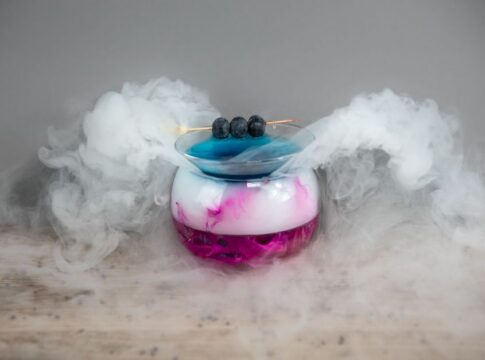
The fog isn’t actually nitrogen—it’s water vapor from the surrounding air condensing into tiny droplets. The extreme cold of the nitrogen chills nearby air below the dew point, causing moisture to condense visibly. This is the same process that creates clouds and fog in nature.
Is liquid nitrogen used in everyday products?
Yes, liquid nitrogen flash-freezing is used in food production for items like frozen fruits, vegetables, and ice cream. Some restaurants use it for dramatic presentations and to create ultra-smooth frozen desserts. Dermatologists use it to remove warts and skin lesions through cryotherapy. It’s also essential for preserving biological samples in research laboratories and medical facilities.
The next time you see liquid nitrogen demonstrations, you’re witnessing fundamental physics in action—the relentless flow of heat from warm to cold, molecular motion grinding to near-stillness, and matter transforming states in the blink of an eye. It’s a reminder that extreme conditions reveal the hidden rules governing everything around us.