
Why Do Airplanes Dim Cabin Lights Before Night Landing
By Trivia Daily, Staff Writer — Published November 16, 2026
Table of Contents
- Key Takeaways
- The Science Behind Airplanes Cabin Lights and Eye Adaptation
- What Flight Attendants Are Really Doing During Descent
- The Connection to Emergency Evacuations
- Other Safety Procedures That Work Together
- Variations in Airline Procedures
- Frequently Asked Questions
Anyone who has flown at night has experienced it: the cabin lights suddenly dim as the plane begins its descent, leaving passengers in near-darkness. Some travelers assume it’s to help them sleep, while others think it’s purely for ambiance. The truth is far more practical and fascinating. Dimming airplanes cabin lights before landing is a carefully designed safety measure that could make all the difference in an emergency evacuation.
This simple procedure prepares passengers’ eyes for the darkness outside and helps crew members spot potential hazards on the ground. What seems like a minor inconvenience is actually a critical step in aviation safety protocol used by airlines worldwide.
Key Takeaways
- Cabin lights are dimmed before night landings to allow passengers’ eyes to adjust to darkness, which can take 20 to 30 minutes for complete adaptation.
- In an emergency evacuation at night, pre-adapted eyes help passengers see exits, obstacles, and escape routes much more quickly.
- Flight attendants also dim lights to better see outside the aircraft, allowing them to spot fires, obstructions, or other hazards on the runway.
- The same principle applies when cabin window shades must be raised during takeoff and landing—crew need unobstructed views in and out.
- This safety procedure is mandated by aviation authorities and has been standard practice for decades across commercial airlines.
- The human eye’s adjustment from bright light to darkness involves both pupil dilation and chemical changes in photoreceptor cells.
The Science Behind Airplanes Cabin Lights and Eye Adaptation
Human eyes need time to adjust when transitioning from bright environments to dark ones. This process, called dark adaptation, involves two main mechanisms. First, the pupils dilate to allow more light to enter. That happens relatively quickly, within seconds. But the more significant change occurs at the cellular level in the retina.
The retina contains two types of photoreceptor cells: cones and rods. Cones handle color vision and work best in bright light. Rods are responsible for vision in low-light conditions. When you move from a brightly lit cabin to darkness, your eyes must switch from cone-dominant to rod-dominant vision. This chemical process takes time—about 20 to 30 minutes for complete adaptation.
By dimming the cabin lights several minutes before landing, airlines give passengers a head start on this adaptation process. If an emergency evacuation becomes necessary immediately after landing, passengers won’t be stumbling blind into the darkness. Their eyes will already be partially adjusted, allowing them to see obstacles, locate exits, and move more safely away from the aircraft.
What Flight Attendants Are Really Doing During Descent
The dimmed lights serve another critical purpose: they help flight attendants perform their safety duties more effectively. When the cabin is dark, crew members can see outside the aircraft windows much more clearly. They’re not just admiring the view.
Flight attendants are trained to scan the area outside the plane during landing. They look for fires, fuel leaks, emergency vehicles, or obstructions on the runway. If the cabin were brightly lit, reflections on the windows would make it nearly impossible to see outside clearly. The dimmed interior eliminates these reflections, giving crew members an unobstructed view of potential hazards.
This is the same reason flight attendants ask passengers to raise window shades during takeoff and landing. More eyes scanning the exterior means a better chance of spotting problems quickly. In the critical moments after an incident, every second counts. A flight attendant who immediately notices a fire on one side of the aircraft can direct passengers to evacuate through the opposite exits, potentially saving lives.
The Connection to Emergency Evacuations
Aviation safety standards require that aircraft be evacuated within 90 seconds in an emergency. That’s an incredibly tight timeframe, especially considering that a wide-body aircraft might carry 300 or more passengers. Every factor that could slow down an evacuation must be minimized.
Imagine a scenario where a plane lands at night with the cabin fully illuminated. Everything seems fine until the aircraft comes to a stop and an emergency evacuation is ordered. Passengers suddenly exit into complete darkness. Their eyes, fully adapted to bright cabin lighting, would be virtually useless for the first several minutes. They couldn’t see the ground, ditches, debris, or other hazards. Injuries during evacuation could be as dangerous as whatever prompted the evacuation in the first place.
With dimmed cabin lights during descent, passengers’ eyes are already transitioning to darkness. When they exit the aircraft, they can see well enough to move quickly and safely. This simple precaution removes one significant obstacle from an already dangerous situation.
Other Safety Procedures That Work Together
Dimming cabin lights is just one part of a comprehensive safety system used during the most critical phases of flight. Takeoff and landing account for a disproportionate number of aviation incidents, which is why multiple precautions converge during these periods.
Several related procedures work in concert with dimmed lighting:
- Passengers must return seats to the upright position, ensuring clear pathways to exits and preventing injuries from sudden stops
- Tray tables must be stowed to avoid blocking passengers in their seats during an evacuation
- Overhead bins must be securely closed to prevent contents from falling during turbulence or impact
- Electronic devices must be stowed or secured to keep hands free and aisles clear
- Window shades must be open to allow maximum visibility both inside and outside the aircraft
Each of these seemingly minor requirements addresses a specific safety concern identified through decades of aviation experience and accident investigation. None exists arbitrarily.
Variations in Airline Procedures
While the basic principle of dimming lights before night landings is universal, airlines implement it with slight variations. Some carriers dim lights gradually during descent, while others make a more dramatic transition. The timing can also vary, with some airlines dimming lights 10 minutes before landing and others waiting until final approach.
The specific brightness level also differs. Some airlines reduce cabin lighting to about 10 to 20 percent of normal levels, while others go even darker. The goal is consistent across all carriers: provide enough light for passengers to remain comfortable and see immediate surroundings, while still allowing significant eye adaptation to darkness.
Long-haul flights that arrive at dawn present an interesting variation. As natural sunlight begins filling the cabin during descent, the dimming procedure becomes less critical. However, many airlines still follow the protocol during the pre-dawn hours, when darkness still dominates outside the aircraft.
Frequently Asked Questions
Why don’t planes dim cabin lights for daytime landings?
Daytime landings don’t require dimmed cabin lights because passengers’ eyes don’t need to adapt to darkness. The exterior environment is already well-lit, so emergency evacuation visibility isn’t compromised. The safety procedure specifically addresses the challenges of nighttime operations.
Can I keep my reading light on during landing?
Most airlines allow individual reading lights to remain on during landing, as they provide focused illumination that doesn’t significantly interfere with overall eye adaptation. However, flight attendants may ask you to turn them off if they’re causing excessive glare on windows or disrupting safety observations.
Do cargo planes follow the same lighting procedures?
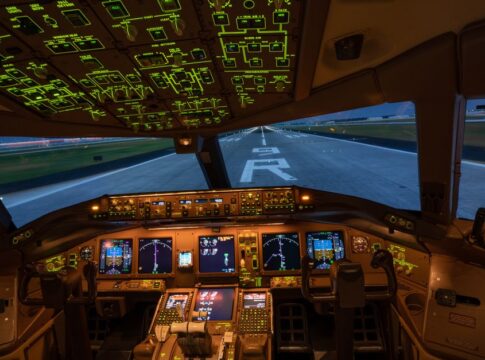
Cargo aircraft with minimal or no passenger accommodations have different lighting requirements, but the flight deck still follows similar principles. Cockpit lighting is adjusted before night landings to help pilots’ eyes adapt and maintain clear visibility of instruments, runway lights, and the surrounding environment.
How long does it take for eyes to fully adjust to darkness?
Complete dark adaptation takes approximately 20 to 30 minutes, though significant improvement occurs within the first few minutes. The dimming procedure during descent provides partial adaptation, which is sufficient to meaningfully improve evacuation safety compared to no adaptation at all.
Next time the cabin lights dim during your evening descent, you’ll know it’s not about creating mood lighting for arrival. It’s a precisely calculated safety measure backed by decades of aviation science, designed to protect you in those critical moments when every second of visibility could matter. The next time you fly at night, take a moment to appreciate how this small adjustment reflects the extraordinary attention to detail that makes modern air travel remarkably safe.