
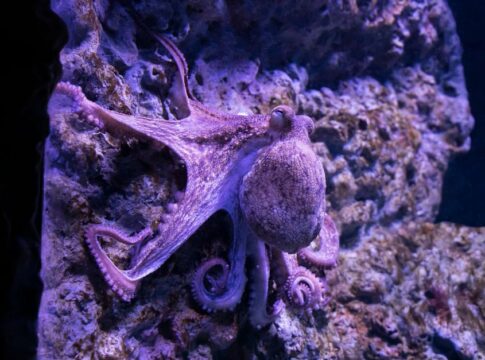
7 Surprising Facts About Octopus Intelligence and Memory
By Trivia Daily, Staff Writer — Published November 20, 2026
Table of Contents
- Key Takeaways
- Understanding Octopus Intelligence and Memory Through Brain Structure
- The Seven Most Remarkable Facts About Octopus Cognition
- Comparing Octopus Intelligence Across Species
- How Octopus Memory Systems Work
- Why Octopus Intelligence Matters for Science
- Frequently Asked Questions
Octopuses are among the ocean’s most remarkable problem-solvers, yet their intelligence operates in ways fundamentally different from our own. These eight-armed creatures possess abilities that challenge our understanding of what it means to be smart. Exploring octopus intelligence and memory reveals a world where neurons are distributed throughout the body, learning happens without a centralized brain structure like ours, and cognitive abilities evolved along an entirely separate path from vertebrates. The facts about these cephalopods will make you reconsider what intelligence really means.
Scientists have spent decades studying these fascinating animals, uncovering surprising truths about their cognitive capabilities. What makes octopus intelligence particularly interesting is that it developed independently from mammalian or bird intelligence, offering a glimpse into an alien form of consciousness right here on Earth.
Key Takeaways
- Two-thirds of an octopus’s neurons are located in its arms, not its brain, allowing for distributed intelligence
- Octopuses can solve complex puzzles, open childproof containers, and use tools despite having no social learning structure
- These animals demonstrate short-term and long-term memory capabilities, remembering solutions to problems for months
- Each octopus arm can taste, touch, and make decisions semi-independently from the central brain
- Octopuses are the only invertebrates known to use tools deliberately in their natural environment
- Despite their intelligence, octopuses live only one to five years, making their cognitive development remarkably rapid
Understanding Octopus Intelligence and Memory Through Brain Structure
The octopus brain contains approximately 500 million neurons—a number comparable to a dog’s brain. But here’s where things get truly interesting: only about 180 million of those neurons reside in the central brain. The remaining two-thirds are distributed throughout the eight arms. This decentralized nervous system creates a form of intelligence unlike anything found in vertebrates.
Each arm operates with significant autonomy. Scientists have observed that severed octopus arms continue to react to stimuli and even attempt to bring food toward where the mouth would be. This isn’t mere reflex. The arms process information and make decisions independently, though they remain coordinated with the central brain when attached. Think of it as having eight mini-brains working in concert with one central processor.
This distributed intelligence allows octopuses to multitask in ways humans cannot. One arm might explore a crevice for food while another manipulates an object and a third remains vigilant for predators. The central brain doesn’t micromanage every movement—it sets broad objectives while the arms handle tactical execution.
The Seven Most Remarkable Facts About Octopus Cognition
1. Octopuses Demonstrate Both Short-Term and Long-Term Memory
Research has shown that octopuses possess both short-term and long-term memory systems. In laboratory settings, they remember solutions to mazes and puzzles for months after initially solving them. When presented with the same challenge again, they complete it faster, demonstrating retention and learning. They also exhibit spatial memory, remembering the locations of their dens and hunting grounds. Some species have been observed returning to favorable hunting spots at specific times, suggesting they track both location and temporal patterns—a sophisticated cognitive feat.
2. They Solve Problems Without Social Learning
Most intelligent animals learn from their parents or social groups. Octopuses don’t. They’re solitary creatures from birth, with no parental care after hatching. Yet they still develop problem-solving abilities independently. In experiments, octopuses figure out how to open various containers—including childproof pill bottles and twist-top jars—through trial and error. They’ll observe a container, test different approaches, and eventually discover the solution. This ability to learn without social instruction or extended development periods makes their intelligence especially remarkable.
3. Each Arm Contains Autonomous Taste and Touch Sensors
An octopus doesn’t just feel with its arms—it tastes with them. Specialized chemoreceptors cover the suckers, allowing the animal to taste everything it touches. This sensory fusion means an octopus arm exploring a dark crevice simultaneously gathers tactile and chemical information. The arm can identify food, texture, and shape without visual input or central brain processing. This creates a form of perception entirely foreign to human experience, where touch and taste blend into a single sense distributed across the body.
4. Octopuses Are the Only Invertebrates Known to Use Tools
Tool use was once considered a hallmark of advanced vertebrate intelligence. Octopuses shattered that assumption. Several species have been documented using tools in the wild. The coconut octopus, for example, collects discarded coconut shells and carries them across the ocean floor, later assembling them into protective shelters. This behavior requires planning, foresight, and understanding of future needs—cognitive abilities once thought exclusive to primates, dolphins, and certain birds. They also use rocks to barricade den entrances and manipulate objects to create better hiding spots.
5. They Learn by Observation Despite Lacking Mirror Neurons
Mirror neurons, which facilitate observational learning in mammals, don’t exist in octopuses. Yet they still learn by watching. In experiments, octopuses observe other octopuses solving puzzles, then apply those solutions themselves—despite having no evolutionary mechanism for this type of learning. Scientists remain puzzled about how this works. The octopus brain must process observational information through entirely different neural pathways than vertebrates use, representing a convergent evolution of cognitive ability through completely distinct biological mechanisms.
6. Their Intelligence Evolved Independently From Vertebrate Intelligence
The last common ancestor between octopuses and humans lived roughly 600 million years ago—a primitive worm-like creature with minimal neural complexity. Octopus intelligence evolved completely separately from the vertebrate lineage. This makes them the closest thing we have to meeting an intelligent alien. Their cognitive abilities developed under different evolutionary pressures, using different biological structures, yet arrived at similar outcomes: problem-solving, memory, learning, and tool use. Studying octopus intelligence helps scientists understand which cognitive features are universal necessities of intelligence and which are accidents of our particular evolutionary history.
7. They Achieve Remarkable Intelligence With Extremely Short Lifespans
Most octopus species live only one to two years. Larger species, like the giant Pacific octopus, may reach five years. Compare this to similarly intelligent animals: parrots live 50-80 years, dolphins live 40-50 years, and elephants live 60-70 years. Octopuses compress their cognitive development into a fraction of that time. They hatch fully independent, develop problem-solving abilities within months, and reach full cognitive capacity within their first year. This rapid development suggests their intelligence is more hardwired than learned, requiring less environmental input than mammalian or avian intelligence. It also means each octopus essentially reinvents the wheel, unable to pass knowledge to the next generation.
Comparing Octopus Intelligence Across Species
| Species | Average Lifespan | Notable Cognitive Abilities |
|---|---|---|
| Giant Pacific Octopus | 3-5 years | Complex problem-solving, maze navigation, individual personality traits |
| Common Octopus | 1-2 years | Tool use, observational learning, memory retention |
| Coconut Octopus | 1-2 years | Tool assembly, planning, carrying objects for future use |
| Day Octopus | 1 year | Rapid camouflage decisions, spatial memory, hunting strategy |
How Octopus Memory Systems Work
Memory in octopuses appears to function through both central and peripheral systems. The vertical lobe in the octopus brain—analogous to the hippocampus in mammals—plays a crucial role in learning and memory formation. When this structure is damaged, octopuses lose the ability to form new long-term memories while retaining older ones, similar to certain types of amnesia in humans.
But memory doesn’t reside solely in the brain. The arm ganglia also store information. An octopus arm “remembers” textures and movements, creating muscle memory distributed throughout the body. This dual memory system—central and peripheral—allows for both conscious recall and automatic responses. The central brain remembers where food was found yesterday. The arms remember how to manipulate a shell or navigate a familiar crevice.
Research suggests octopuses may even have something resembling episodic memory—the ability to recall specific past events. In experiments, they’ve demonstrated recognition of individual humans, treating some people differently than others based on past interactions. This requires remembering not just facts but experiences, a sophisticated form of memory once thought unique to vertebrates.
Why Octopus Intelligence Matters for Science
Studying octopus cognition offers unique insights into the nature of intelligence itself. Because their intelligence evolved independently, it reveals which cognitive features are universal requirements for complex thought and which are peculiarities of our own evolutionary path. Every similarity between octopus and human intelligence represents a convergent solution to the same problem—evidence that certain cognitive strategies work so well that evolution discovers them repeatedly.
The differences are equally instructive. Octopuses prove that advanced cognition doesn’t require a centralized brain, long lifespans, or social learning. Intelligence can emerge from distributed neural networks, develop rapidly without parental teaching, and exist in creatures that will never meet their offspring. These findings challenge assumptions about consciousness, cognition, and what forms intelligence might take on other planets.
Frequently Asked Questions
Can octopuses recognize individual human faces?
Yes, research has demonstrated that octopuses can distinguish between individual humans and remember past interactions with them. They often treat people who have fed them differently from those who have not, suggesting both visual recognition and memory of specific individuals.
Do octopuses have a dominant arm like humans have a dominant hand?
Studies have shown that octopuses do exhibit arm preferences, but these preferences are less consistent than human handedness. An octopus might favor a particular arm for certain tasks while using different arms for others, and preferences can change based on context.
How do scientists measure octopus intelligence?
Researchers use problem-solving tests, maze navigation, observational learning experiments, and tool-use documentation. Scientists also study memory retention by presenting puzzles, waiting weeks or months, then re-presenting the same challenge to measure recall and learning efficiency.
Why don’t octopuses pass knowledge to their offspring?
Female octopuses die shortly after their eggs hatch, and males typically die soon after mating. The young emerge fully independent with no parental care, making knowledge transfer impossible. This biological constraint means each generation must rediscover solutions independently.
The more we learn about octopus intelligence and memory, the more we realize how little we truly understand about consciousness itself. These creatures force us to expand our definitions and recognize that Earth hosts not one form of intelligence, but many—each shaped by different evolutionary pressures into something beautifully, strangely unique.