
The Truth About Chameleons: They Don’t Change for Camouflage
By Trivia Daily, Staff Writer — Published September 10, 2026
Table of Contents
- Key Takeaways
- The Truth About Chameleons Change: What’s Really Happening
- The Science Behind the Spectacle
- Busting the Camouflage Myth
- Color-Changing Champions: A Comparison
- Not All Chameleons Are Created Equal
- Frequently Asked Questions
For decades, the chameleon has been the poster child for nature’s masters of disguise. Cartoons, nature documentaries, and even scientific illustrations have reinforced a simple narrative: chameleons change color to blend into their surroundings. It’s one of those facts everyone “knows.” Except it isn’t true. The truth about chameleons and why they change color is far more interesting and surprising than the camouflage myth suggests. These fascinating reptiles are actually communicating, regulating their body temperature, and displaying their moods through their remarkable color-shifting abilities.
Scientists have known for years that chameleons don’t primarily use their color-changing talent to hide from predators. Instead, their spectacular transformations serve as a complex visual language. When you discover the real reasons behind this amazing adaptation, the chameleon becomes even more captivating than the myth ever suggested.
Key Takeaways
- Chameleons change color primarily for communication and mood display, not camouflage.
- Males use bright colors to attract mates and warn off rivals during territorial disputes.
- Color changes also help regulate body temperature, with darker shades absorbing more heat.
- The color transformation happens through specialized cells called chromatophores in their skin.
- Darker colors often signal aggression or stress, while lighter tones indicate submission or relaxation.
- Only about half of the roughly 200 chameleon species are proficient color-changers.
The Truth About Chameleons Change: What’s Really Happening
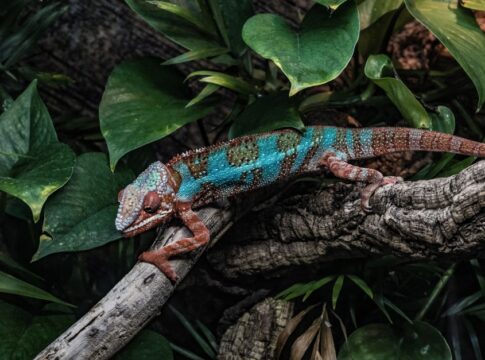
When a chameleon shifts from green to yellow, or suddenly displays vibrant blues and reds, it’s not trying to match a nearby flower or leaf. The lizard is talking. Color change in chameleons functions like a mood ring crossed with a neon billboard. A male chameleon encountering a rival will often explode into brilliant, contrasting colors—a visual shout declaring territory and dominance. Dark, intense patterns communicate aggression and readiness to fight. Conversely, a defeated or submissive chameleon will pale, adopting muted tones that signal surrender.
Female chameleons also participate in this chromatic conversation. A receptive female might display specific color patterns to signal her availability to males. After mating, or when pregnant, she’ll often shift to darker colors with distinctive markings that essentially tell males to back off. This isn’t subtle suggestion—it’s clear biological communication that prevents unwanted attention and potential stress.
Temperature regulation adds another layer to the color-changing puzzle. Chameleons are ectothermic, meaning they rely on external heat sources to regulate body temperature. A cold chameleon will darken its skin to absorb more solar radiation and warm up faster. Once comfortably warm, the same animal might lighten its coloration to reflect excess heat. This thermoregulatory function works alongside the social signaling, making the chameleon’s skin a multifunctional organ of remarkable sophistication.
The Science Behind the Spectacle
The mechanism enabling these transformations involves specialized pigment-containing cells called chromatophores layered within the chameleon’s skin. Unlike squid or octopuses that change color by expanding or contracting pigment sacs, chameleons use a more complex system involving nanocrystals. Researchers have discovered that beneath the pigment-containing cells lies a layer of cells containing tiny guanine crystals arranged in a lattice pattern.
When a chameleon experiences emotional or environmental triggers, its nervous system signals these cells to relax or tense. This changes the spacing between the nanocrystals, which in turn affects how light reflects off them. Tightly packed crystals reflect shorter wavelengths like blue, while relaxed spacing reflects longer wavelengths like red and yellow. The interplay between these reflective layers and the pigmented layers above creates the stunning color combinations chameleons display.
This discovery, published by researchers studying panther chameleons, revealed that color change involves active photonic manipulation—essentially the chameleon is functioning as a living, breathing optical device. The precision and speed of these changes demonstrate an evolutionary achievement that goes far beyond simple camouflage.
Busting the Camouflage Myth
So where did the camouflage misconception come from? Chameleons do naturally possess colors that often blend reasonably well with their forest or desert habitats. Many species are predominantly green or brown, matching the vegetation where they live. This background coloration does provide some concealment from predators. But this is passive camouflage—the chameleon’s default state—not an active disguise strategy.
The myth likely persisted because it makes intuitive sense and creates a tidy narrative. People observed color-changing lizards in leafy environments and drew the obvious, if incorrect, conclusion. The real story requires understanding animal behavior, cellular biology, and social dynamics—topics less accessible than the simple camouflage explanation that spread through popular culture.
Actual camouflage specialists in the animal kingdom, like cuttlefish and octopuses, can genuinely match complex backgrounds with remarkable accuracy. They possess sophisticated vision and pattern-recognition abilities that allow them to mimic their surroundings in real-time. Chameleons lack this capability. Their color repertoire is impressive but limited to their species-specific palette, and they don’t analyze their background to match it.
Color-Changing Champions: A Comparison
| Species | Color Range | Primary Purpose | Speed of Change |
|---|---|---|---|
| Panther Chameleon | Greens, reds, blues, yellows | Social signaling, temperature | 20 seconds to several minutes |
| Veiled Chameleon | Greens, yellows, browns | Mood display, thermoregulation | Minutes |
| Common Cuttlefish | Full spectrum, patterns | True camouflage, hunting | Milliseconds |
| Octopus | Full spectrum, textures | Camouflage, communication | Under 1 second |
Not All Chameleons Are Created Equal
The chameleon family includes roughly 200 species, and not all are talented color-shifters. Some smaller species display only modest color changes, shifting between subtle variations of brown and green. The most dramatic transformations belong to larger species like the panther chameleon and Parson’s chameleon, which can display vivid, almost neon colors.
Geographic location influences these abilities too. Chameleons from Madagascar tend to be the most colorful, possibly due to the island’s unique evolutionary pressures and diverse habitats. African species show considerable variation, with some forest dwellers exhibiting brilliant colors while others remain relatively drab. The smallest chameleon species, some measuring barely an inch long, show minimal color change compared to their larger cousins.
Frequently Asked Questions
Can chameleons see all the colors they produce?
Yes, chameleons have excellent color vision and can see ultraviolet light that humans cannot detect. Their visual capabilities likely exceed our own in the color spectrum, which makes sense given that color communication is central to their social behavior.
Do chameleons change color when they sleep?
Chameleons typically display paler, more muted colors during sleep as their bodies relax and metabolic activity decreases. They’re not actively signaling during rest, so the vivid display colors fade to more neutral tones.
What happens if you put a chameleon on a checkerboard?
The chameleon won’t turn into a checkerboard pattern. It will display colors based on its mood, temperature, and stress level at that moment—likely showing stress-related darker colors from being handled and placed in an unfamiliar situation, not attempting to match the pattern beneath it.
Are there other animals that change color for communication rather than camouflage?
Yes, many animals use color change primarily for communication. Cuttlefish and squid use it for both camouflage and signaling. Some fish species change color during mating rituals or territorial disputes. Anole lizards can shift colors based on mood and temperature, similar to chameleons.
The next time you see a chameleon in a documentary shifting through a rainbow of colors, remember you’re watching a conversation, not a disappearing act. These remarkable reptiles remind us that nature’s most famous “facts” sometimes turn out to be our most cherished misconceptions. The real story, as usual, proves far more complex and wonderful than the myth.