
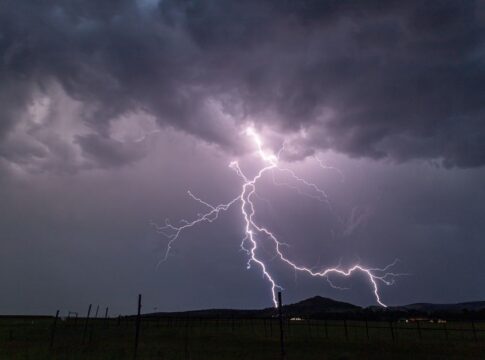
9 Surprising Facts About How Lightning Forms in Clouds
By Trivia Daily, Staff Writer — Published September 12, 2026
Table of Contents
- Key Takeaways
- How Lightning Forms in Clouds: The Basic Process
- The Role of Temperature in Lightning Formation
- Different Types of Lightning Strikes
- 9 Surprising Facts About Lightning Formation
- Frequently Asked Questions
Lightning strikes Earth roughly 100 times every second, yet most people have no idea how this spectacular natural phenomenon actually begins. The process of how lightning forms in clouds involves a complex dance of ice crystals, water droplets, and electrical charges that scientists are still working to fully understand. What starts as gentle air currents inside a storm cloud ends in a bolt powerful enough to heat the air to temperatures five times hotter than the surface of the sun.
These electrical giants don’t just appear randomly. They’re the product of specific atmospheric conditions, particle collisions, and charge separations that transform ordinary thunderclouds into nature’s most impressive light show. The facts behind lightning formation reveal a world of surprising science hiding in plain sight above our heads.
Key Takeaways
- Lightning forms when ice crystals and water droplets collide inside clouds, creating electrical charge separation through a process scientists are still researching.
- A typical lightning bolt carries about 300 million volts and can heat the surrounding air to approximately 50,000 degrees Fahrenheit in milliseconds.
- Most lightning never reaches the ground—roughly 75% of all lightning strikes occur entirely within clouds or between clouds.
- The stepped leader, an invisible channel of electricity, descends from the cloud before the visible lightning bolt shoots upward from the ground.
- Thunderstorms must reach heights where temperatures drop below freezing for lightning to form, which is why lightning is rare in very cold climates.
- Scientists use specialized aircraft and high-speed cameras to study lightning formation, but many aspects of the process remain mysterious.
How Lightning Forms in Clouds: The Basic Process
The journey toward a lightning strike begins with the development of a cumulonimbus cloud, the towering thundercloud that can reach heights of 50,000 feet or more. Inside these massive structures, powerful updrafts and downdrafts create turbulent conditions where water droplets and ice particles constantly collide. These collisions are the key to understanding how lightning forms in clouds.
When ice crystals and supercooled water droplets bump into each other, they exchange electrons. Lighter ice crystals, carried upward by air currents, tend to become positively charged, while heavier particles like graupel (soft hail) fall toward the bottom of the cloud and accumulate negative charge. This separation creates an electric field within the cloud that grows stronger as the storm intensifies. When the difference in charge becomes great enough to overcome air’s natural resistance to electrical flow, lightning discharges to balance the system.
The Role of Temperature in Lightning Formation
Temperature plays a crucial role in lightning development. The charge separation process works most efficiently in the mixed-phase region of a cloud, where temperatures range from about 5 to minus 40 degrees Fahrenheit. In this zone, ice and liquid water coexist, creating ideal conditions for the particle collisions that generate electrical charges.
This temperature requirement explains why lightning is relatively uncommon in extremely cold regions like the Arctic and Antarctic, despite the presence of clouds. The air is simply too cold to support the vigorous updrafts and mixed-phase conditions necessary for strong charge separation. Tropical and temperate regions, with their combination of warmth, moisture, and atmospheric instability, produce the vast majority of the world’s lightning strikes.
Different Types of Lightning Strikes
Not all lightning follows the same path, and understanding the varieties helps illustrate the complexity of cloud electrification. The different types emerge from the varying charge distributions within and around thunderstorms.
| Lightning Type | Path | Frequency |
|---|---|---|
| Intracloud | Within a single cloud | ~50-60% of all lightning |
| Cloud-to-ground | From cloud to Earth’s surface | ~25% of all lightning |
| Cloud-to-cloud | Between separate clouds | ~15-20% of all lightning |
| Ground-to-cloud | Upward from tall structures | Rare, less than 5% |
9 Surprising Facts About Lightning Formation
1. Lightning Travels Upward More Than Downward
Despite appearances, the bright flash we see as lightning actually travels from the ground up to the cloud, not the other way around. What happens first is an invisible “stepped leader” of negative charge descends from the cloud in a branching pattern, creating an ionized channel. When it gets close to the ground, positive charges rush upward from the surface to meet it. The brilliant flash we observe is this return stroke racing upward at roughly one-third the speed of light, following the path the stepped leader created.
2. Ice Is Essential for Lightning Formation
Warm, all-liquid clouds rarely produce lightning, no matter how turbulent they become. The presence of ice particles in the upper reaches of thunderclouds is essential for the charge separation process. Research indicates that the collision between ice crystals and graupel (soft hail pellets) in the presence of supercooled water droplets creates the most effective charge transfer. This is why thunderstorms need to tower high into the atmosphere where temperatures plunge well below freezing.
3. A Single Lightning Bolt Can Strike Multiple Times in Seconds
What appears to be a single flash is often multiple strokes traveling along the same channel in rapid succession. A typical lightning event consists of three to four individual strokes, each lasting less than a millisecond, separated by intervals of about 40 milliseconds. This rapid flickering is what creates the characteristic flicker of a lightning bolt. Some lightning strikes have been recorded with more than 20 separate strokes, all following the same ionized path.
4. Scientists Still Debate Exactly How Lightning Initiates
While researchers understand the general charge separation process, the precise mechanism that triggers the initial breakdown of air to start a lightning strike remains somewhat mysterious. The electric fields measured in thunderclouds are often weaker than what laboratory experiments suggest should be needed to initiate a discharge. Some scientists theorize that cosmic rays from space might provide the extra kick needed to start the process, while others point to localized regions of enhanced electric field strength.
5. Volcanic Eruptions Create Their Own Lightning
Volcanic lightning demonstrates that ice isn’t absolutely necessary for lightning formation under extreme conditions. When volcanoes erupt, they eject massive amounts of ash, rock fragments, and gases into the atmosphere. These particles collide violently in the eruption plume, generating static electricity through a process similar to, but distinct from, thunderstorm lightning. The charge separation occurs through friction between ash particles rather than ice crystal collisions, creating spectacular electrical displays in volcanic plumes.
6. Lightning Can Travel More Than 10 Miles From a Storm
Bolt from the blue lightning strikes can occur when positive charges near the top of a thunderstorm send out a horizontal lightning channel that extends far beyond the storm’s rain shaft before turning downward to strike the ground. These strikes can happen under clear skies more than 10 miles from the parent thunderstorm, catching people completely by surprise. They’re particularly dangerous because they strike areas where people don’t perceive any immediate threat.
7. The Sound of Thunder Reveals Lightning’s Distance
Thunder is created when lightning’s extreme heat causes explosive expansion of the air along the lightning channel. Because light travels much faster than sound, you see the flash before hearing the boom. You can estimate your distance from a lightning strike by counting the seconds between flash and thunder, then dividing by five—this gives you the approximate distance in miles. This works because sound travels roughly one mile every five seconds through air at typical temperatures.
8. Positive Lightning Strikes Are Rare but Extremely Powerful
Most lightning carries negative charge from cloud to ground, but about 5-10% of strikes are positive, originating from the positively charged upper regions of the storm. These positive strikes are typically much more powerful than their negative counterparts, carrying up to ten times more current and lasting longer. They’re also more likely to start fires because of their intensity and duration. Positive lightning tends to occur later in a storm’s life cycle or from the anvil portion of the cloud.
9. Ball Lightning Remains One of Nature’s Great Mysteries
Witnesses have reported seeing glowing spheres of light, sometimes the size of a basketball, that float through the air during thunderstorms and persist for several seconds. These ball lightning events have been documented for centuries, but scientists have struggled to explain or reproduce them. Recent theories suggest they might be plasma balls created by lightning strikes on soil, which vaporize silicon and create glowing orbs, but definitive proof remains elusive. Ball lightning stands as a reminder that even common phenomena like thunderstorms still hold secrets.
Frequently Asked Questions
Can lightning form without a cloud?
Lightning requires charge separation, which typically occurs in clouds, but it can form in volcanic eruptions, large forest fires, and even nuclear explosions where particles collide violently enough to generate static electricity. True cloudless lightning is essentially impossible because the charge separation mechanism needs suspended particles.
Why does lightning follow a zigzag path?
The stepped leader searches for the path of least resistance as it descends from the cloud, moving in roughly 50-meter segments. Air isn’t uniformly conductive, so the lightning channel branches and zigzags as it seeks out pockets of ionized air and moisture that conduct electricity more easily than the surrounding atmosphere.
How hot does lightning actually get?
Lightning heats the air in its channel to approximately 50,000 degrees Fahrenheit—about five times hotter than the surface of the sun. This extreme temperature is reached in microseconds and causes the explosive expansion of air that we hear as thunder.
Can lightning strike the same place twice?
Absolutely. Tall structures like skyscrapers and communication towers are struck repeatedly, sometimes dozens of times per year. The Empire State Building in New York is struck an average of 20-25 times annually. Any elevated point that offers a shorter path to ground is likely to be struck multiple times.
The next time storm clouds gather overhead, remember that you’re witnessing one of Earth’s most powerful ongoing experiments in atmospheric electricity. Each flash represents millions of particle collisions, precise charge separations, and the explosive release of energy that scientists are still working to fully decode—a reminder that even the most familiar phenomena can harbor extraordinary complexity.