Why Do Honeybees Dance to Communicate Hive Locations
By Trivia Daily, Staff Writer — Published September 14, 2026
Table of Contents
- Key Takeaways
- The Waggle Dance Decoded: How Honeybees Dance Communicate Location Data
- Why Dancing Beats Other Communication Methods
- The Sensory Challenge of Dancing in Darkness
- Comparing Bee Dance Types
- Beyond Food: Other Uses for the Dance Language
- Frequently Asked Questions
Inside the shadowy interior of a beehive, thousands of honeybees perform one of nature’s most remarkable communication systems. When a forager bee discovers a patch of flowers bursting with nectar, she doesn’t simply return to the hive and hope her sisters stumble upon the same treasure. Instead, she launches into an intricate dance that conveys the exact distance, direction, and quality of the food source. This honeybees dance communicate system represents one of the most sophisticated examples of non-human language in the animal kingdom, a discovery that earned Austrian ethologist Karl von Frisch the Nobel Prize in 1973.
The waggle dance isn’t just interesting trivia—it’s a complete information package encoded in movement, angle, and duration. Through this amazing behavior, bees share GPS-like coordinates without words, maps, or technology. Let’s explore the surprising facts behind this everyday wonder happening in hives around the world.
Key Takeaways
- Honeybees use two primary dances: the round dance for nearby food sources (within about 50 meters) and the waggle dance for distant locations.
- The angle of the waggle run relative to vertical indicates the direction of food relative to the sun’s position.
- The duration of the waggle portion tells other bees how far to fly—roughly one second of waggling equals one kilometer of distance.
- Bees perform their dances on the vertical honeycomb in complete darkness, with attending bees touching the dancer to decode the message.
- The vigor and repetition of the dance communicates food quality, with better nectar sources earning more enthusiastic performances.
- This communication system allows colonies to efficiently allocate thousands of foragers to the most productive food sources.
The Waggle Dance Decoded: How Honeybees Dance Communicate Location Data
The waggle dance follows a figure-eight pattern. A forager bee walks in a straight line while waggling her abdomen side to side, then circles back to the starting point, alternating the direction of her return loop. The straight “waggle run” contains the critical information.
Direction is communicated through angle. If the bee waggles straight up the vertical comb, the food lies in the direction of the sun. A waggle run pointing 40 degrees to the right of vertical means the flowers are 40 degrees to the right of the sun’s current position. As the sun moves across the sky, dancing bees continuously adjust their angles to account for its changing position—demonstrating an internal clock and astronomical awareness that continues to fascinate researchers.
Distance is encoded in time. The longer a bee waggles during the straight run, the farther away the food source. While the exact correlation varies slightly between honeybee subspecies, the general rule holds: more waggling means more flying. A quick waggle might indicate flowers just 100 meters away, while an extended waggle dance could direct workers to a meadow several kilometers distant.
The round dance, by contrast, signals nearby food. When resources lie close to the hive, the returning forager simply circles in alternating directions without the waggle run. This tells her nestmates to search the immediate vicinity without providing specific directional information—apparently precision navigation isn’t necessary when the destination is practically next door.
Why Dancing Beats Other Communication Methods
You might wonder why bees evolved such an elaborate system instead of simpler alternatives. The answer reveals the genius of natural selection. Pheromone trails, used successfully by ants, wouldn’t work for flying insects covering three-dimensional space. Leading recruits directly to food sources would be time-consuming and inefficient when a single forager needs to mobilize dozens or hundreds of workers.
The dance language solves a colony-level optimization problem. A hive of 40,000 to 60,000 bees must coordinate foraging across a landscape where flower patches bloom and fade unpredictably. By sharing precise location data, successful foragers enable their colony to concentrate effort on the richest resources while ignoring mediocre options.
The system includes quality control. Bees discovering exceptional nectar sources dance longer and more vigorously than those finding merely adequate flowers. They repeat their dances more times, recruiting more followers. This creates a flexible, real-time voting system where the colony automatically allocates labor to the most profitable opportunities.
The Sensory Challenge of Dancing in Darkness
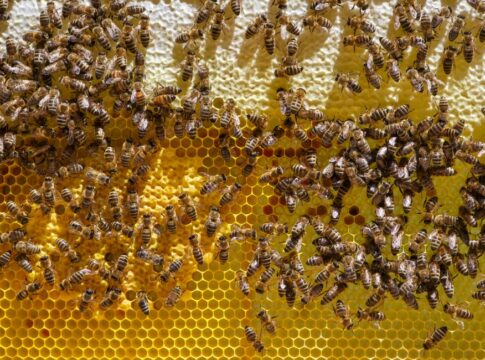
Honeybees perform their informational dances on vertical honeycomb surfaces in the pitch-black interior of the hive. Follower bees can’t see the performance—they perceive it through touch and vibration. They crowd around the dancer, antennae extended, detecting the waggle movements and air currents created by her wings.
Sound plays a role too. During the waggle run, bees produce vibrations at specific frequencies by moving their flight muscles, creating audible buzzing that follower bees detect through their legs and antennae. This multi-sensory communication ensures the message gets through despite the challenging environment.
The vertical orientation of the dance floor creates an interesting challenge. Bees transpose the horizontal landscape onto a vertical surface, using gravity as a reference point in place of visual landmarks. Up represents the sun’s direction, and angles to either side represent corresponding angles in the horizontal plane outside the hive. It’s a remarkable feat of spatial translation.
Comparing Bee Dance Types
| Dance Type | Distance Indicated | Pattern | Information Conveyed |
|---|---|---|---|
| Round Dance | 0–50 meters | Circular, alternating directions | Food nearby; search locally |
| Waggle Dance | 50+ meters | Figure-eight with waggle run | Precise distance and direction |
| Tremble Dance | N/A | Shaking movements | Need more receiver bees to process nectar |
Beyond Food: Other Uses for the Dance Language
Honeybees don’t limit their dance communication to nectar sources. When a colony swarms—splitting to form a new hive—scout bees search for suitable nest sites. They return to the swarm cluster and dance to advertise potential homes, with the same directional and distance encoding used for food sources.
Multiple scouts may dance for different locations simultaneously, creating a democratic decision-making process. The swarm eventually chooses the site that generates the most dancing support, typically the cavity offering the best combination of size, entrance characteristics, and protection from the elements. This collective intelligence often leads to surprisingly optimal choices.
Water sources also inspire dancing when colonies need hydration during hot weather. Foragers who locate reliable water supplies perform dances similar to those for nectar, helping their sisters find drinking spots to cool the hive through evaporative cooling.
Frequently Asked Questions
Can bees communicate about danger using their dances?
No, the waggle dance specifically communicates resource locations. Bees use different signals for danger, including alarm pheromones and specific buzzing patterns, but these aren’t part of the dance language system.
Do all bee species perform waggle dances?
No, the sophisticated waggle dance is primarily performed by honeybees in the genus Apis. Bumblebees and most solitary bee species don’t use this communication method, though some related species have simpler versions.
How accurate is the information conveyed through bee dances?
Remarkably accurate. Studies have shown that bees following dance instructions typically arrive within a few meters of the advertised location, even when the food source is a kilometer or more away.
Can honeybees dance to communicate about artificial feeders?
Yes, bees readily dance to share the location of sugar-water feeders set up by researchers or beekeepers, treating them exactly like natural nectar sources and adjusting their enthusiasm based on sugar concentration.
The next time you see a bee visiting flowers in your garden, consider the invisible network of communication that brought her there. Somewhere in a nearby hive, a sister may have danced the directions in total darkness, translating sunlight and distance into movement and vibration. This ancient language, refined over millions of years, continues to orchestrate the pollination that sustains ecosystems and agriculture worldwide—a small dance with enormous consequences.