
7 Surprising Facts About How Rainbows Form in the Sky
By Trivia Daily, Staff Writer — Published September 13, 2026
Table of Contents
- Key Takeaways
- Understanding How Rainbows Form: The Basic Mechanics
- The Seven Surprising Facts
- The Science Behind Rainbow Colors
- Comparing Rainbow Phenomena
- Frequently Asked Questions
Most people have gazed up at a rainbow and felt a sense of wonder, but few understand the intricate dance of light and water that creates this natural spectacle. The way rainbows form involves precise angles, millions of water droplets acting as tiny prisms, and even a touch of illusion that tricks our eyes. These colorful arcs aren’t just beautiful—they’re demonstrations of physics happening in real time, revealing surprising truths about light, perception, and the atmosphere above us.
From double rainbows to the reason you’ll never find that pot of gold, the science behind these phenomena is filled with fascinating details that challenge common assumptions. Let’s explore the remarkable facts that explain how these optical wonders appear in our skies.
Key Takeaways
- Rainbows form when sunlight refracts, reflects, and disperses through millions of water droplets at a specific 42-degree angle from your line of sight.
- Every person sees their own unique rainbow because the phenomenon depends entirely on the observer’s position relative to the sun and rain.
- Rainbows are actually full circles, but we typically only see arcs because the ground blocks the lower half from view.
- The order of colors in a rainbow—red on top, violet on bottom—is determined by how different wavelengths of light bend at different angles.
- Double rainbows occur when light reflects twice inside water droplets, reversing the color sequence in the secondary arc.
- You can never physically reach a rainbow because it’s an optical phenomenon that moves as you move, always maintaining that critical viewing angle.
Understanding How Rainbows Form: The Basic Mechanics
The process begins when white sunlight enters a spherical water droplet suspended in the atmosphere. As light crosses from air into water, it slows down and bends—a phenomenon physicists call refraction. But here’s where it gets interesting: different wavelengths of light bend at slightly different angles. Red light bends the least, while violet light bends the most, causing the white light to split into its component colors.
Once inside the droplet, light bounces off the back interior surface like a mirror. This internal reflection sends the light back toward the front of the droplet. As it exits, the light refracts again, bending once more and spreading the colors even further apart. The entire process happens in countless droplets simultaneously, each one sending a specific color back to your eye depending on its position. The droplets that are roughly 42 degrees from the line between your eye and the shadow of your head send red light to you, while those at about 40 degrees send violet light.
The Seven Surprising Facts
1. You’re Always at the Center of Your Own Rainbow
Here’s a mind-bending truth: no two people ever see exactly the same rainbow. Because rainbows depend on the precise angle between the sun, water droplets, and your eyes, each observer occupies the center of their own personal optical display. If you stand next to a friend admiring a rainbow, you’re each seeing light reflected from different sets of water droplets. Move a few steps to the side, and you’re viewing an entirely new rainbow formed by a new collection of droplets. This is why rainbows appear to follow you as you walk—you’re constantly repositioning yourself at the center of a fresh optical phenomenon.
2. Rainbows Are Actually Complete Circles
The familiar arc shape is merely the visible portion of a full circular rainbow. The horizon blocks the lower half from ground-level observers, creating the impression of an arch. Pilots and passengers in aircraft, however, can sometimes witness circular rainbows when conditions are right—looking down at rain below with the sun behind them. These glory rings demonstrate that the 42-degree angle forms a cone of light around the antisolar point, creating a perfect circle. From mountaintops or tall buildings with mist in the valley below, lucky observers occasionally glimpse more of this circular reality.
3. The Red Band Always Appears on Top for a Specific Reason
The consistent color sequence—red, orange, yellow, green, blue, indigo, violet from top to bottom—isn’t random. It’s dictated by the physics of refraction. Red light, with its longer wavelength, bends less dramatically when entering and exiting water droplets, so it reaches your eyes from droplets at a higher angle (roughly 42 degrees from the antisolar point). Violet light, with its shorter wavelength, bends more sharply and comes from droplets at a lower angle (about 40 degrees). This two-degree spread creates the colored bands we observe, with red always crowning the arc and violet forming the inner edge.
4. Double Rainbows Reveal Light’s Hidden Journey
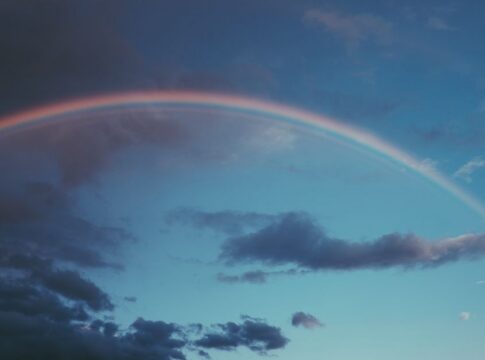
When you spot a fainter secondary rainbow above the primary arc, you’re witnessing light that has bounced twice inside water droplets instead of once. This additional reflection reverses the color sequence—violet appears on top in the secondary rainbow, with red on the bottom. The second reflection also disperses light over a wider area, making the secondary rainbow dimmer and broader than the primary. The dark band between the two rainbows, called Alexander’s band, occurs because no light exits the droplets at those angles. This region appears noticeably darker than the sky outside the double rainbow.
5. Rainbows Require Precise Conditions That Rarely Align
For a rainbow to appear, several factors must converge simultaneously. The sun must be behind you and relatively low in the sky—no higher than 42 degrees above the horizon, which is why rainbows are more common in early morning or late afternoon. Rain, mist, or spray must be present in front of you, and the sun must be shining through breaks in the clouds to illuminate those droplets. This explains why rainbows often appear as storms are clearing, when sunlight breaks through while rain still falls from retreating clouds. The larger the droplets, the more vivid the colors appear, which is why rainbows from heavy rain showers often display more intense hues than those formed in fine mist.
6. Moonbows Exist But Remain Mostly Invisible to Human Eyes
Rainbows can form from moonlight using the same optical principles as solar rainbows, but they’re exceedingly rare and difficult to observe. The moon reflects far less light than the sun—about 400,000 times dimmer—so moonbows typically appear faint and colorless to human eyes. Our retinas contain two types of light receptors: cones that detect color and rods that function in low light. In the dim illumination of a moonbow, only our rods activate, creating a ghostly white or pale arc. Long-exposure photography, however, reveals that moonbows contain the full spectrum of colors. The best chances to see one occur during a full moon on clear nights with rain or waterfalls present.
7. You Can Never Reach the End of a Rainbow
The pot of gold remains forever out of reach because rainbows aren’t physical objects with locations—they’re optical phenomena that exist only in the interaction between light, water, and an observer. As you move toward where a rainbow appears to touch the ground, the required 42-degree viewing angle shifts, and the rainbow “moves” to maintain that geometric relationship. It’s similar to how your shadow always stays opposite the sun no matter where you walk. The rainbow is essentially a projection of light onto your retina, not a structure in space. Two observers in different locations see rainbows in different positions, which is impossible for a physical object but perfectly normal for an optical effect that depends on viewing angle.
The Science Behind Rainbow Colors
The spectrum of colors in a rainbow corresponds to the visible portion of electromagnetic radiation, with wavelengths ranging from about 700 nanometers for red light to 380 nanometers for violet. When Isaac Newton first demonstrated that white light contains all colors by passing it through a prism in the 1660s, he identified seven distinct hues, though the human eye actually perceives a continuous gradient. The traditional seven colors—red, orange, yellow, green, blue, indigo, and violet—may have been chosen partly for symbolic reasons, as Newton was influenced by the belief that there should be seven colors to match the seven notes of the musical scale.
The intensity of each color band depends on the size of the water droplets. Larger droplets, around one millimeter in diameter, produce the most vibrant rainbows with distinct color separation. Smaller droplets create hazier rainbows with overlapping colors, while extremely fine mist can produce fogbows—pale, nearly white arcs with only faint color hints at the edges.
Comparing Rainbow Phenomena
| Phenomenon | Number of Internal Reflections | Viewing Angle | Color Order |
|---|---|---|---|
| Primary Rainbow | One | 40-42 degrees | Red (top) to Violet (bottom) |
| Secondary Rainbow | Two | 50-53 degrees | Violet (top) to Red (bottom) |
| Tertiary Rainbow | Three | Around 40 degrees from sun | Red (top) to Violet (bottom) |
| Fogbow | One | 40-42 degrees | Mostly white with faint edges |
Frequently Asked Questions
Can rainbows appear at night?
Yes, moonbows can form at night when bright moonlight refracts through water droplets, but they appear mostly white to the human eye due to low light conditions that activate only our rod photoreceptors rather than color-detecting cones.
Why do some rainbows look more vivid than others?
Rainbow intensity depends on droplet size and sunlight brightness. Larger water droplets around one millimeter in diameter produce the most vibrant, well-defined color bands, while smaller droplets create paler, hazier rainbows with less distinct color separation.
How rare are triple rainbows?
Triple rainbows are extremely rare because they require three internal reflections within water droplets and appear on the same side of the sky as the sun, making them difficult to observe against bright sky backgrounds. Only a handful have been photographed.
Can you see a rainbow from space?
Astronauts cannot see rainbows from space in the traditional sense because rainbows require an atmosphere with water droplets and a specific viewing geometry relative to the sun. However, circular glories and similar optical effects can occur in spacecraft windows under certain conditions.
The next time rain and sunshine share the sky, take a moment to appreciate the precise physics unfolding above you. Every rainbow is a fleeting demonstration of light’s behavior, visible only because millions of droplets happen to be suspended at just the right angles, refracting and reflecting photons into your waiting eyes. That personal light show, centered on you and you alone, will never be seen by anyone else in quite the same way—a reminder that even common wonders hold unique magic for each observer.