
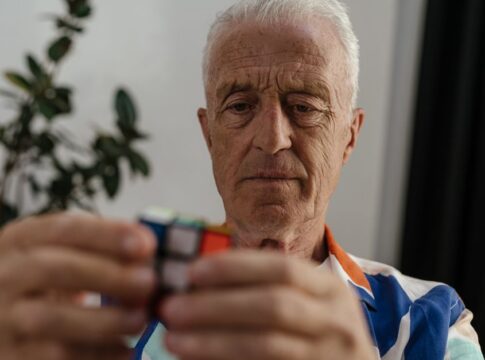
Why Some People Can Solve Rubik’s Cubes Blindfolded
By Trivia Daily, Staff Writer — Published August 6, 2026
Table of Contents
- Key Takeaways
- How People Solve Rubik’s Cubes Blindfolded: The Method Revealed
- The Surprising Science Behind Spatial Memory
- Record-Breaking Facts and Competition Standards
- Common Myths About Blindfolded Solving
- Why People Pursue This Unusual Skill
- Frequently Asked Questions
Watching someone solve a Rubik’s Cube blindfolded seems like witnessing magic. Yet thousands of people around the world can perform this astonishing feat, and the explanation has less to do with superhuman abilities and more to do with clever memory techniques and dedicated practice. When people solve Rubik’s Cubes without looking, they’re demonstrating one of the most impressive applications of spatial memory and algorithmic thinking the human brain can achieve.
The secret lies in a fascinating combination of memorization systems, pattern recognition, and methodical problem-solving. Blindfolded solving isn’t about seeing with your mind’s eye in real-time—it’s about converting the cube’s scrambled state into a sequence of moves that can be executed from memory alone.
Key Takeaways
- Blindfolded Rubik’s Cube solving relies on memorizing the cube’s initial state before the blindfold goes on, not solving it by feel.
- Speedcubers use letter-pair memory systems to convert cube positions into memorable sequences, often creating vivid mental stories.
- The world record for blindfolded solving stands at under 15 seconds, including memorization time.
- Multiple blindfolded solving involves memorizing and solving several cubes in succession—the record exceeds 50 cubes.
- Anyone can learn blindfolded solving with practice; it doesn’t require exceptional innate spatial reasoning.
- The technique strengthens working memory and demonstrates the brain’s remarkable capacity for sequential information processing.
How People Solve Rubik’s Cubes Blindfolded: The Method Revealed
The process begins with inspection. Solvers examine the scrambled cube for several minutes, translating what they see into a memorized sequence. They’re not memorizing the position of all 26 visible pieces—that would overwhelm working memory. Instead, they use algorithms that solve the cube piece by piece, determining which pieces need to move where and in what order.
Most blindfolded solvers employ the Old Pochmann method or the more advanced M2/R2 technique. These approaches break the cube into edges and corners, then cycle through swapping pieces into their correct positions. Each piece gets assigned a letter, and solvers memorize pairs of letters representing swaps. A scrambled cube might translate into something like “AB CD EF GH” for corners and a separate sequence for edges.
Here’s where memory palaces and vivid imagery enter the picture. Rather than memorizing abstract letter pairs, experienced solvers convert them into memorable images or stories. The letters “DM” might become “dentist” and “mountain,” which the solver visualizes in an absurd, memorable scenario. This technique, borrowed from memory competition strategies, transforms dry data into something the brain retains effortlessly.
Once memorization is complete, the blindfold goes on. Solvers then execute their predetermined algorithm sequences, trusting their memory completely. They can’t peek to check progress. One wrong turn means the entire solve fails, which is why accuracy matters more than speed during the execution phase.
The Surprising Science Behind Spatial Memory
Blindfolded cube solving showcases the brain’s working memory system—the mental workspace that holds information temporarily while we manipulate it. Research in cognitive psychology has shown that working memory capacity varies among individuals but can be expanded through deliberate practice and mnemonic strategies.
The hippocampus, crucial for memory formation, becomes highly active during these tasks. Studies of memory athletes have revealed that their brains don’t differ structurally from average people; instead, they’ve trained specific neural pathways through repeated practice. The same principle applies to blindfolded cubers.
Interestingly, blindfolded solving doesn’t rely heavily on spatial visualization in the way you might expect. Solvers aren’t mentally rotating a 3D cube in their mind’s eye throughout the solve. They’re following a linear sequence of memorized instructions, more akin to following a recipe than mentally manipulating objects in space.
Record-Breaking Facts and Competition Standards
The World Cube Association governs official Rubik’s Cube competitions, including blindfolded events. These competitions follow strict rules: solvers inspect the cube, put on a blindfold, and then solve. Timing includes both memorization and execution phases.
| Event Type | Description | Approximate World Record |
|---|---|---|
| 3x3x3 Blindfolded | Standard cube, single solve | Under 15 seconds |
| 4x4x4 Blindfolded | Larger cube with more complexity | Under 90 seconds |
| 5x5x5 Blindfolded | Even larger cube | Under 3 minutes |
| Multi-Blind | Multiple cubes solved in one attempt | Over 50 cubes |
Multi-blind events push memory to extraordinary limits. Competitors memorize numerous cubes—sometimes spending over an hour on memorization alone—then solve them all blindfolded in succession. A successful solve requires remembering hundreds of letter pairs and executing thousands of moves without error.
Common Myths About Blindfolded Solving
Many people assume blindfolded solvers possess photographic memory. This isn’t accurate. Eidetic memory, the technical term for what’s popularly called photographic memory, is exceedingly rare and doesn’t function the way most people imagine. Blindfolded cubers use learned mnemonic techniques available to anyone willing to practice.
Another misconception holds that solvers are feeling their way through the puzzle, using tactile feedback to guide their moves. While touch confirms they’re gripping the correct layer, solvers aren’t using texture or bumps to identify piece positions. The cube feels identical on all sides. Everything comes from pre-memorized sequences.
Some believe you need exceptional mathematical ability or genius-level intelligence. The reality? Blindfolded solving is a skill, not an innate talent. Online communities are filled with average people who’ve learned the technique through YouTube tutorials and dedicated practice. The barrier is patience and practice time, not IQ.
Why People Pursue This Unusual Skill
The blindfolded cubing community thrives on the satisfaction of achieving something that seems impossible. There’s a meditative quality to the memorization phase—a deep focus that blocks out distractions. The execution phase requires trust in your preparation and mental discipline.
Cognitive benefits extend beyond the cube itself. Regular practitioners report improvements in concentration, working memory capacity, and confidence in their learning abilities. The skill demonstrates that seemingly superhuman feats often break down into learnable techniques when properly understood.
Competition provides another draw. The World Cube Association sanctions hundreds of competitions annually where blindfolded events attract dedicated communities. Competitors form friendships, share techniques, and push each other toward faster times and more ambitious multi-blind attempts.
Frequently Asked Questions
How long does it take to learn blindfolded Rubik’s Cube solving?
Most dedicated learners achieve their first successful blindfolded solve within a few weeks to a few months of practice. Mastering the memorization techniques and algorithms requires regular practice sessions, but the basic method can be understood in a matter of days.
Do blindfolded solvers memorize every position on the cube?
No, they memorize a sequence of piece swaps rather than absolute positions. Using letter-pair systems and algorithms, they convert the scrambled state into a linear sequence of moves, which is far more memory-efficient than trying to remember where all 20 moveable pieces are located.
Can blindfolded solving improve your regular solving speed?
Blindfolded practice improves algorithm execution accuracy and reinforces understanding of how pieces move, but it doesn’t directly translate to faster sighted solving times. The techniques and goals differ significantly between the two disciplines.
What’s the difference between blindfolded solving and solving with eyes closed?
Blindfolded solving requires memorizing the cube’s initial state before covering your eyes, then executing a solution from memory. Solving with eyes closed while continuously feeling the cube would be nearly impossible, as there’s no tactile way to identify which color each piece displays.
The next time you see someone solve a Rubik’s Cube blindfolded, you’ll know you’re witnessing not supernatural ability but the remarkable result of human memory techniques refined through practice. It’s a reminder that our brains are capable of far more than we typically demand of them—and that what looks like magic is often just method, patience, and dedication made visible.