
Why Honey Never Spoils: The Ancient Preservation Mystery
By Trivia Daily, Staff Writer — Published August 7, 2026
Table of Contents
- Key Takeaways
- Why Honey Never Spoils: The Science of Sweet Preservation
- The Honeybee’s Role in Creating an Eternal Food
- Archaeological Evidence: Honey Through the Ages
- Common Misconceptions About Honey Storage
- How Honey Compares to Other Natural Preservatives
- Frequently Asked Questions
Archaeologists working in Egyptian tombs have uncovered jars of honey over 3,000 years old — and the contents were still perfectly edible. This astonishing discovery reveals one of nature’s most remarkable trivia facts: honey never spoils. While nearly every food we know eventually rots, ferments, or grows mold, honey remains shelf-stable indefinitely. The secret behind this amazing preservation isn’t magic, but rather a fascinating combination of chemistry, biology, and the incredible work of honeybees.
Understanding why honey defies the normal rules of food decay opens a window into both ancient history and modern science. From the tomb of King Tut to your kitchen pantry, this golden substance has remained unchanged for millennia, making it perhaps the only food with truly eternal shelf life.
Key Takeaways
- Honey contains extremely low moisture content (around 17-18%), creating an environment where bacteria and microorganisms cannot survive or reproduce.
- The naturally acidic pH of honey (between 3 and 4.5) inhibits the growth of most pathogens that cause food spoilage.
- Bees add an enzyme called glucose oxidase that produces hydrogen peroxide, giving honey natural antibacterial properties.
- Archaeologists have found edible honey in Egyptian tombs dating back over 3,000 years, proving its indefinite shelf life.
- Properly sealed honey can crystallize over time but never truly spoils — gentle heating restores its liquid state without affecting quality.
- The hygroscopic nature of honey means it pulls moisture from its surroundings rather than absorbing it, preventing bacterial growth.
Why Honey Never Spoils: The Science of Sweet Preservation
The remarkable longevity of honey stems from a perfect storm of chemical and physical properties. Each element works in concert to create an environment so hostile to microorganisms that they simply cannot survive. The first and most critical factor is water content. Bacteria, molds, and other spoilage organisms need water to grow and reproduce. Honey typically contains only 17-18% water, far below the roughly 60% moisture content found in most fruits or the 85% in milk.
This low moisture level alone would discourage most microbes. But honey takes things further through its hygroscopic properties — it actively pulls moisture from anything it contacts, including bacteria cells. When a bacterium lands in honey, the substance literally draws water out of the cell through osmosis, causing it to dehydrate and die. Think of it as molecular-level mummification happening in real time.
The acidic nature of honey provides another layer of protection. With a pH hovering between 3 and 4.5, honey creates an environment too acidic for most harmful organisms. This acidity comes from gluconic acid, which forms when bees add the enzyme glucose oxidase to nectar. This same enzyme produces small amounts of hydrogen peroxide when honey is diluted — the same antiseptic you might use on a cut. Ancient and modern cultures alike have used honey to dress wounds for precisely this reason.
The Honeybee’s Role in Creating an Eternal Food
Bees don’t just collect nectar and store it. They transform it through an intricate process that makes preservation possible. Worker bees consume nectar and store it in a special honey stomach, separate from their digestive stomach. During this storage, enzymes begin breaking down the complex sugars in nectar into simpler sugars like glucose and fructose.
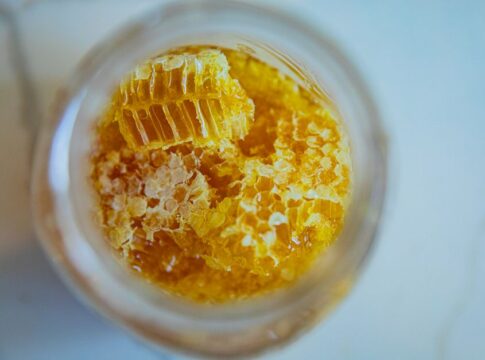
Back at the hive, bees deposit this modified nectar into honeycomb cells. Then comes the crucial step: evaporation. Bees fan their wings vigorously over the open cells, creating airflow that evaporates excess water from the nectar. They continue this process until the water content drops to that magic 17-18% threshold. Only then do they seal the cell with a wax cap, preserving the honey in an airtight environment.
The wax capping serves as the final preservation mechanism. By preventing air and moisture from entering, bees create a sealed system where the honey’s low water content and acidic properties can work indefinitely. This natural packaging has proven so effective that it has outlasted ancient civilizations themselves.
Archaeological Evidence: Honey Through the Ages
The most compelling evidence for honey’s eternal shelf life comes not from laboratories but from archaeological sites. When Howard Carter opened King Tutankhamun’s tomb in 1922, his team discovered sealed jars of honey among the treasures. The honey, approximately 3,000 years old, remained unspoiled and theoretically edible — though understandably, no one volunteered to taste-test it.
Egyptian tombs aren’t the only source of ancient honey. Archaeologists have found preserved honey in Georgian tombs dating back roughly 5,500 years. These discoveries aren’t flukes or rare preservation accidents. They represent the normal state of properly stored honey across millennia. The same jar of honey you buy today could, in theory, sit unopened for thousands of years and remain perfectly safe to eat.
Ancient cultures recognized honey’s preservative powers and used them for more than just food storage. The Egyptians, Persians, and other civilizations used honey in embalming processes and as a medium for preserving fruits, meats, and even human organs. Historical texts describe submerging bodies in honey to preserve them for transport — a practice that modern science confirms would work due to honey’s antimicrobial properties.
Common Misconceptions About Honey Storage
Many people panic when their honey crystallizes, assuming it has gone bad. Crystallization is actually a natural process that indicates pure, unprocessed honey. The glucose in honey naturally separates from water and forms crystals over time, especially in cooler temperatures. This doesn’t mean the honey has spoiled — it simply means the physical state has changed.
Restoring crystallized honey to liquid form requires nothing more than gentle heat. Placing the jar in warm water (not boiling, which can destroy beneficial enzymes and alter flavor) will dissolve the crystals without damaging the honey. Some beekeepers and honey enthusiasts actually prefer crystallized honey for spreading on toast or biscuits, as it has a creamier texture and doesn’t drip.
Another myth suggests that refrigerating honey preserves it better. The opposite is true. Refrigeration accelerates crystallization and provides no preservation benefit since honey is already shelf-stable at room temperature. Store honey in a sealed container at room temperature, away from direct sunlight, and it will remain liquid longer while maintaining all its properties.
How Honey Compares to Other Natural Preservatives
| Substance | Typical Shelf Life | Primary Preservation Method |
|---|---|---|
| Honey | Indefinite | Low moisture, acidity, hydrogen peroxide |
| Salt | Indefinite | Hygroscopic, inhibits bacterial growth |
| Sugar | Indefinite (if dry) | Hygroscopic when concentrated |
| Vinegar | Indefinite (quality may decline) | High acidity |
| Dried beans | 30 years (if properly stored) | Low moisture content |
Frequently Asked Questions
Can honey actually go bad or expire?
Pure, properly stored honey never expires or spoils. The expiration dates on commercial honey jars are regulatory requirements, not indicators of actual shelf life. Honey may crystallize or darken over time, but these changes don’t affect safety or edibility.
Why does some honey crystallize faster than others?
The crystallization rate depends on the ratio of glucose to fructose in the honey, which varies by floral source. Honey with higher glucose content (like clover or alfalfa honey) crystallizes faster than high-fructose varieties like acacia or tupelo honey.
Is raw honey more likely to spoil than processed honey?
Neither raw nor processed honey spoils, but raw honey may crystallize faster because it contains pollen particles and other natural materials that provide nucleation points for crystal formation. Both types remain safe to eat indefinitely when properly stored.
What happens if water gets into honey?
If enough water dilutes the honey above roughly 19% moisture content, it can begin to ferment as wild yeasts become active. This is how mead (honey wine) is made intentionally, but in storage honey, it indicates contamination that could affect quality and taste.
The next time you drizzle honey into your tea or spread it on toast, consider that you’re enjoying a food essentially unchanged since ancient times. This golden substance connects us to Egyptian pharaohs, medieval beekeepers, and the tireless work of millions of bees — all preserved in a single, eternal spoonful.