
Why Do Zebra Stripe Patterns Confuse the Human Eye
By Trivia Daily, Staff Writer — Published November 15, 2026
Table of Contents
- Key Takeaways
- The Science Behind Zebra Stripe Patterns and Visual Confusion
- Motion Dazzle: Nature’s Speed Illusion
- How Stripe Width Maximizes Confusion
- The Herd Effect: When Confusion Multiplies
- Why Your Eyes Can’t Quite Focus
- Frequently Asked Questions
Stare at a zebra long enough, and your eyes begin to play tricks on you. The bold black-and-white stripes seem to shimmer and vibrate, creating an optical phenomenon that has puzzled observers for centuries. These zebra stripe patterns don’t just confuse predators in the wild—they genuinely mess with human perception too. Scientists have discovered surprising facts about how these remarkable patterns exploit fundamental quirks in the way our visual system processes information, turning a simple animal coat into nature’s own optical illusion.
The effect becomes even more interesting when zebras move in groups. What appears clear when viewing a single animal transforms into a dizzying swirl of lines when a herd gallops together, making it nearly impossible to track individual animals or judge their speed and direction accurately.
Key Takeaways
- Zebra stripes create a visual effect called “motion dazzle” that makes it difficult for observers to accurately judge the animal’s speed and trajectory.
- The high-contrast patterns trigger a phenomenon known as the “wagon-wheel effect,” where moving stripes can appear to slow down, stop, or even reverse direction.
- Human eyes experience “flicker fusion” when viewing zebra stripes, as our visual system struggles to process the rapid alternation of black and white patterns.
- Research has shown that the confusion isn’t just psychological—it’s rooted in how neurons in the visual cortex respond to high-contrast edges.
- The stripe width on zebras falls into a specific range that maximizes visual confusion for most mammals, including humans.
- When zebras stand together, their stripes align and break up the outline of individual animals, a camouflage technique called “disruptive coloration.”
The Science Behind Zebra Stripe Patterns and Visual Confusion
Our brains process visual information through specialized neurons that detect edges, contrast, and motion. Zebra stripes exploit these systems in fascinating ways. The stark black-and-white contrast creates what neuroscientists call “edge overload”—too many high-contrast boundaries for the visual system to process efficiently. When a zebra moves, these edges shift rapidly, overwhelming the motion-detection circuits in our visual cortex.
The effect intensifies with movement. Human eyes track moving objects by predicting their trajectory based on visual cues. Stripes disrupt this prediction mechanism. The vertical orientation of most zebra stripes conflicts with the horizontal motion of a running animal, sending mixed signals to the brain’s motion-processing regions. This creates a lag in perception—by the time your brain resolves where the zebra was, it’s already somewhere else.
The phenomenon becomes even more pronounced at certain distances. When viewed from afar, individual stripes begin to blend together, creating a shimmering gray appearance. Up close, the high contrast is almost painful to look at for extended periods. This “sweet spot” of maximum confusion occurs at middle distances, precisely the range where predators would attempt to single out prey from a herd.
Motion Dazzle: Nature’s Speed Illusion
Motion dazzle represents one of the most intriguing aspects of how zebra stripe patterns confuse observers. This effect makes it genuinely difficult to judge how fast a striped object is moving. Research conducted by scientists using computer simulations and human test subjects has demonstrated that people consistently misjudge the speed of striped patterns compared to solid-colored ones.
The confusion stems from how our visual system samples motion. Rather than continuously tracking movement, our eyes take rapid “snapshots” and our brain fills in the gaps. Stripes create ambiguity in this process. When a vertical stripe moves horizontally, the brain must match the stripe’s position in one snapshot to its new position in the next. With multiple identical stripes, this matching becomes nearly impossible—any given white stripe could correspond to several different white stripes in the previous frame.
This ambiguity extends to direction as well. The wagon-wheel effect, familiar to anyone who has watched wheels appear to spin backward in movies, occurs naturally when viewing moving zebra stripes. The periodic pattern of the stripes creates temporal aliasing, where the brain’s sampling rate interacts with the stripe frequency to produce illusory motion.
How Stripe Width Maximizes Confusion
Not all stripes confuse the eye equally. Zebras possess stripes that fall within a specific width range—typically between four and six centimeters—that maximizes visual disruption for most mammalian observers. This isn’t coincidental. Evolution has fine-tuned these dimensions over millions of years.
Stripes that are too wide fail to create sufficient edge density to overwhelm the visual system. Stripes that are too narrow blend together into gray at typical viewing distances, losing their disruptive effect. The actual width on zebras hits the optimal zone where individual stripes remain visible but numerous enough to create confusion.
| Stripe Characteristic | Effect on Human Perception | Optimal Range |
|---|---|---|
| Stripe Width | Maximum confusion at middle distances | 4-6 centimeters |
| Contrast Ratio | Edge overload in visual cortex | Near 100% (black to white) |
| Stripe Orientation | Conflicts with horizontal motion | Vertical to diagonal |
| Pattern Regularity | Creates motion ambiguity | Semi-regular spacing |
The Herd Effect: When Confusion Multiplies
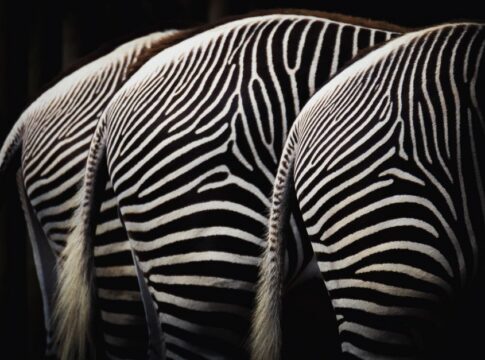
Individual zebras create visual confusion, but groups amplify the effect exponentially. When multiple zebras stand or run together, their stripes align and intersect in chaotic patterns that completely obscure individual outlines. This phenomenon, studied extensively by behavioral ecologists, demonstrates why zebras benefit from staying in groups beyond simple safety in numbers.
The merging stripes create what’s called a “superpattern”—a larger optical illusion composed of many individual patterns. Your brain attempts to identify discrete objects within this visual chaos but struggles to separate one animal from another. Where does one zebra end and the next begin? The question becomes nearly impossible to answer when a herd moves at speed.
This confusion serves a practical purpose in the wild. Predators like lions must single out individual prey to successfully hunt. The stripe patterns make this isolation difficult, buying precious seconds that can mean the difference between escape and capture. For human observers, the effect remains just as potent, even when we know intellectually that we’re looking at separate animals.
Why Your Eyes Can’t Quite Focus
Beyond motion effects, zebra stripes create focusing challenges for the human eye. The high-contrast edges stimulate both the center and periphery of our retinas simultaneously, creating competing signals about where to direct attention. Your eyes may actually make small, rapid movements called microsaccades more frequently when viewing striped patterns, as the visual system searches for a stable point of focus.
The black and white stripes also trigger chromatic aberration in the eye’s lens. Different wavelengths of light focus at slightly different distances, and the extreme contrast between black and white maximizes this effect. The result is a subtle blurriness or “glow” around the edges of stripes that makes precise focusing difficult, especially in bright sunlight where the white stripes reflect intensely.
Frequently Asked Questions
Do zebra stripes actually confuse predators or just humans?
Research indicates that zebra stripes genuinely confuse predators, particularly when zebras move in groups. Studies have shown that lions and other predators have lower success rates when hunting striped prey compared to solid-colored animals, suggesting the visual confusion isn’t limited to human observers but affects mammalian vision more broadly.
Why are zebra stripes black and white instead of other colors?
The black and white coloration creates maximum contrast, which is essential for the optical confusion effect. High contrast produces the strongest edge signals in the visual system, overwhelming motion detection and making it harder to track the animal. Other color combinations wouldn’t generate the same level of visual disruption.
Can you train your eyes to see zebras more clearly?
While you can learn to consciously track individual zebras with practice, the fundamental optical effects remain. The visual confusion operates at a neurological level in how your eyes and brain process contrast and motion, so the shimmer and motion dazzle persist even when you know to expect them.
Do all zebra species have the same stripe patterns?
No, the three zebra species—plains, mountain, and Grévy’s zebras—have different stripe patterns. Plains zebras have broader stripes, Grévy’s zebras have narrower, more numerous stripes, and mountain zebras have intermediate patterns. Despite these differences, all fall within the range that creates visual confusion for observers.
The next time you visit a zoo or watch nature footage, pay attention to how your eyes struggle to pin down a moving zebra. That subtle discomfort you feel isn’t imagination—it’s your visual system encountering one of nature’s most elegant optical tricks, refined over millions of years into a pattern that continues to baffle even the most sophisticated observer: you.