
9 Record-Breaking Facts About the Amazon Rainforest
By Trivia Daily, Staff Writer — Published November 13, 2026
Table of Contents
- Key Takeaways
- Record-Breaking Amazon Facts That Define Earth’s Largest Rainforest
- Comparing Amazon Records to Other Ecosystems
- The Amazon’s Role in Global Climate Regulation
- Biodiversity Beyond the Numbers
- Frequently Asked Questions
The Amazon rainforest holds more world records than almost any other ecosystem on Earth. Stretching across nine countries and covering roughly 2.1 million square miles, this massive jungle produces about 20 percent of the world’s oxygen and houses one in ten known species. These record-breaking Amazon facts reveal a place of extremes—where the world’s largest river by volume flows, where more bird species live than on entire continents, and where trees can live for over a thousand years. Ready to explore some truly amazing trivia about this natural wonder?
From its staggering biodiversity to its crucial role in regulating global climate, the Amazon continues to surprise scientists and curious minds alike. The numbers alone are mind-blowing, but the stories behind them make these facts even more fascinating.
Key Takeaways
- The Amazon River discharges more water than the next seven largest rivers combined, making it the world’s largest river by volume.
- Approximately 390 billion individual trees representing about 16,000 different species grow in the Amazon rainforest.
- The Amazon produces roughly 20 percent of Earth’s oxygen through photosynthesis, earning its nickname “the lungs of the planet.”
- More than 1,300 bird species live in the Amazon, exceeding the bird diversity of all of North America.
- The rainforest influences rainfall patterns thousands of miles away through a phenomenon called “flying rivers.”
- Indigenous communities have lived in the Amazon for at least 11,000 years, developing hundreds of distinct languages and cultures.
Record-Breaking Amazon Facts That Define Earth’s Largest Rainforest
Understanding what makes the Amazon truly exceptional requires looking at the numbers that set it apart from every other ecosystem. These aren’t just impressive statistics—they represent living systems that have evolved over millions of years to create something utterly unique on our planet.
1. The Amazon River Moves More Water Than Any River on Earth
The Amazon River doesn’t just hold records—it shatters them. This massive waterway discharges approximately 209,000 cubic meters of water into the Atlantic Ocean every second during the wet season. That’s more than the next seven largest rivers in the world combined. The river stretches roughly 4,000 miles from its source in the Peruvian Andes to the Atlantic, making it either the longest or second-longest river on Earth, depending on how you measure it. During flood season, parts of the river can exceed 30 miles in width, and the fresh water it pumps into the ocean can be detected more than 100 miles offshore.
2. Home to 390 Billion Trees Across 16,000 Species
Scientists estimate that approximately 390 billion individual trees grow in the Amazon basin. These trees represent about 16,000 different species, though just 227 “hyperdominant” species account for half of all trees in the forest. A single hectare of Amazon rainforest can contain more tree species than exist in all of North America. This incredible diversity creates vertical layers of habitat, from the forest floor to the emergent canopy layer that can reach 200 feet high, with each layer supporting entirely different communities of plants and animals.
3. More Bird Species Than Entire Continents
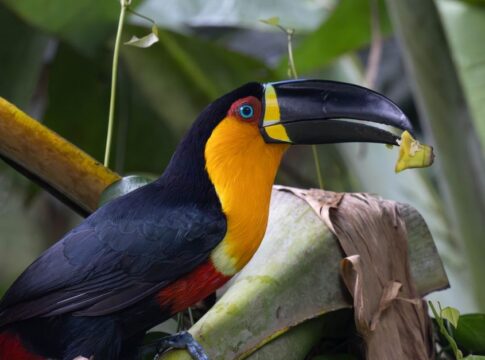
The Amazon hosts more than 1,300 bird species, which represents about one-third of all bird species in South America and exceeds the total bird diversity found across all of North America. Species range from tiny hummingbirds that weigh less than a penny to massive harpy eagles with seven-foot wingspans. The harpy eagle, one of the world’s most powerful raptors, can snatch sloths and monkeys from tree branches. Meanwhile, hoatzins—peculiar birds that digest food like cows do—emit a distinctive manure-like odor that has earned them the nickname “stink birds.”
4. The Lungs of the Planet Produce 20 Percent of Earth’s Oxygen
Through photosynthesis, the Amazon rainforest produces roughly 20 percent of the oxygen in Earth’s atmosphere. The trees absorb carbon dioxide and release oxygen as they convert sunlight into energy, making the forest a critical component of the global carbon cycle. However, the forest also consumes much of this oxygen through decomposition and respiration, meaning the net oxygen contribution is smaller than often claimed. What makes the Amazon truly irreplaceable is its role as a massive carbon sink, storing an estimated 150 to 200 billion tons of carbon in its vegetation and soil—carbon that would otherwise contribute to climate change.
5. Pink River Dolphins Navigate Flooded Forests
The Amazon river dolphin, also called the boto or pink dolphin, holds the record as the largest river dolphin species, with males reaching up to eight feet long and weighing 450 pounds. Unlike their ocean cousins, these freshwater dolphins can turn their heads 90 degrees thanks to unfused neck vertebrae, helping them navigate through flooded forest trees during high water. Their pink coloration intensifies with age and excitement, and they possess echolocation abilities that surpass most other dolphin species—essential for hunting fish in the murky, sediment-rich waters of the Amazon and its tributaries.
6. Flying Rivers Transport Moisture Across a Continent
The Amazon creates what scientists call “flying rivers”—massive aerial currents of water vapor that transport moisture across South America. Trees in the rainforest release water through transpiration, pumping an estimated 20 billion tons of moisture into the atmosphere every day. These invisible rivers of vapor travel westward and southward, eventually hitting the Andes Mountains and falling as rain, providing water to agricultural regions thousands of miles from the forest itself. This atmospheric moisture transport influences weather patterns as far south as Argentina, making the Amazon a climate regulator for much of the continent.
7. The World’s Largest Snake and Heaviest Ant Live Here
The Amazon holds records for extremes in the animal kingdom. The green anaconda, found throughout the Amazon basin, is the world’s heaviest snake, with large females weighing over 200 pounds and measuring more than 20 feet long. These aquatic constrictors can take down prey as large as caimans and deer. On a much smaller scale, the Amazon is home to bullet ants, which deliver what is widely considered the most painful insect sting in the world. Some Indigenous peoples use these ants in initiation ceremonies, requiring young men to wear gloves filled with hundreds of stinging ants—a pain that can last for 24 hours.
8. Ancient Human Settlements Transformed the Forest
Indigenous peoples have lived in the Amazon for at least 11,000 years, and their influence on the forest is far more extensive than previously believed. Archaeological evidence reveals that large, complex societies once thrived in the Amazon, with some settlements supporting tens of thousands of people. These ancient peoples created “terra preta”—nutrient-rich dark earth formed by adding charcoal and organic waste to poor rainforest soil. Patches of this incredibly fertile soil, which can be up to six feet deep, still exist throughout the Amazon and remain more productive than surrounding soils. Scientists now recognize that much of what appears to be pristine wilderness was actually shaped by human hands over millennia.
9. A Single River Tributary Can Exceed Major World Rivers
The Amazon’s tributary system is so vast that several of its branches would rank among the world’s largest rivers if measured independently. The Madeira River, the Amazon’s longest tributary, stretches roughly 2,100 miles and discharges more water than the entire Mississippi River. The Negro River, another major tributary, is so large that where it meets the Amazon’s main channel near Manaus, Brazil, the two differently colored waters flow side by side for several miles without mixing—a phenomenon called the “Meeting of Waters.” This occurs because the rivers have different temperatures, speeds, and sediment loads.
Comparing Amazon Records to Other Ecosystems
| Category | Amazon Rainforest | Congo Basin | Borneo Rainforest |
|---|---|---|---|
| Total Area | ~2.1 million square miles | ~1.5 million square miles | ~102,000 square miles |
| Tree Species | ~16,000 species | ~10,000 species | ~3,000 species |
| Bird Species | ~1,300 species | ~700 species | ~420 species |
| Countries Spanned | 9 countries | 6 countries | 3 countries |
The Amazon’s Role in Global Climate Regulation
The Amazon functions as Earth’s thermostat, absorbing heat and moisture and redistributing both across vast distances. When sunlight hits the dark canopy, trees absorb the energy and use it to pull water from the soil, which then evaporates from leaves in a process that cools the forest. This evaporative cooling effect is so powerful that the Amazon rainforest is typically several degrees cooler than deforested areas nearby.
The forest’s carbon storage capacity is equally impressive. Trees lock away carbon in their trunks, branches, and roots for decades or centuries. When old trees die and fall, much of this carbon gets incorporated into the soil rather than immediately returning to the atmosphere. This makes the Amazon one of the most important buffers against climate change. Scientists estimate that if the Amazon were completely destroyed, it would release enough carbon dioxide to significantly accelerate global warming, creating a feedback loop that could make much of South America too dry to support rainforest at all.
Biodiversity Beyond the Numbers
While the statistics are staggering—10 percent of all species on Earth live in the Amazon—the reality is even more remarkable. Scientists discover new species in the Amazon almost weekly. Between 1999 and 2015, researchers identified more than 2,000 new species of plants and vertebrates in the Amazon, averaging one new species every two days.
This biodiversity exists in layers. The forest floor, despite receiving only about two percent of available sunlight, teems with insects, fungi, and decomposers. The understory hosts shade-tolerant shrubs and young trees. The canopy, where most photosynthesis occurs, shelters monkeys, sloths, and countless birds. The emergent layer, where the tallest trees poke above the canopy, provides hunting grounds for raptors.
Many species have evolved such specific adaptations that they can’t survive anywhere else. Some frogs spend their entire lives in the tiny pools of water that collect in bromeliad plants high in the canopy, never touching the ground. Certain orchids can only be pollinated by a single species of bee. This specialization creates an intricate web of dependencies—remove one thread, and the whole tapestry begins to unravel.
Frequently Asked Questions
How much of the Amazon rainforest has been lost to deforestation?
Approximately 17 to 20 percent of the original Amazon rainforest has been cleared since the 1970s, with the rate of loss fluctuating based on economic conditions and environmental policies. Deforestation removes roughly 1.5 million acres annually, though this rate has varied significantly over the decades.
Why is the Amazon River brown in some places and black in others?
The Amazon’s tributaries carry different types of sediment and organic matter. White-water rivers like the main Amazon channel carry clay sediment from the Andes, giving them a tan color. Black-water rivers like the Rio Negro get their dark tea color from decomposed organic matter, while clear-water rivers originate in older geological formations with less sediment.
Can you see the Amazon rainforest from space?
Yes, the Amazon rainforest is clearly visible from space as a massive expanse of green covering northern South America. Satellites and astronauts can easily distinguish the forest from surrounding grasslands and agricultural areas, and space-based monitoring has become crucial for tracking deforestation and forest health.
How many Indigenous tribes live in the Amazon?
Approximately 400 to 500 Indigenous tribes live in the Amazon basin, speaking roughly 300 different languages. Some tribes maintain little to no contact with the outside world, choosing to remain isolated in remote areas of the forest. These communities possess irreplaceable knowledge about forest ecology and medicinal plants.
The Amazon rainforest remains one of Earth’s most vital and mysterious places, a living library of evolutionary experiments that took millions of years to write. Every record it holds—from the volume of its rivers to the diversity of its inhabitants—reminds us that some things, once lost, can never be recreated. The next time you take a breath, remember that the air filling your lungs may have been touched by a tree standing thousands of miles away in the world’s greatest rainforest.