
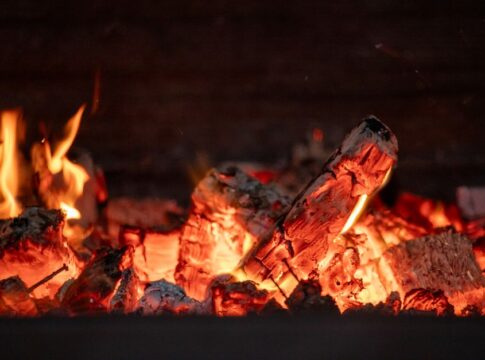
Why Diamonds Burn Like Coal: The Carbon Chemistry Secret
By Trivia Daily, Science Desk — Published July 27, 2026
Table of Contents
- Key Takeaways
- Why Diamonds Burn Like Coal: The Chemistry Fundamentals
- The Physics of Diamond Combustion
- Comparing Carbon Allotropes
- Historical Scientific Discoveries About Diamond Combustion
- Why Diamonds Seem Indestructible
- Frequently Asked Questions
Drop a diamond into a hot enough flame, and it will catch fire and burn. This surprises most people who think of diamonds as indestructible, but the chemistry behind this phenomenon is straightforward: diamonds burn like coal because they’re both made of the same element—carbon. The difference between these two materials isn’t what they’re made of, but how their atoms are arranged. This scientific discovery reveals one of chemistry’s most elegant lessons about structure versus composition.
The combustion of diamonds isn’t just a laboratory curiosity. It’s a window into understanding how the same element can take wildly different forms, and why the physical arrangement of atoms matters as much as the atoms themselves.
Key Takeaways
- Diamonds and coal are both pure carbon, differing only in atomic structure—diamonds have a rigid crystal lattice while coal has a disordered arrangement.
- When heated above approximately 700-900 degrees Celsius in oxygen, diamonds combust completely, producing carbon dioxide just like burning coal.
- The “hardest natural substance” reputation of diamonds refers only to scratch resistance, not heat resistance or chemical stability.
- This combustion experiment demonstrates the chemistry principle that element identity and molecular structure are separate properties.
- Diamond combustion was documented in scientific research as early as the 18th century when scientists began systematic experiments with heat and precious stones.
- Without oxygen, diamonds can withstand much higher temperatures—they won’t burn in a vacuum even at extreme heat.
Why Diamonds Burn Like Coal: The Chemistry Fundamentals
Carbon is the sixth element on the periodic table and the foundation of all organic chemistry. It exists in multiple forms called allotropes, each with distinct physical properties. Diamonds represent carbon atoms bonded in a three-dimensional tetrahedral lattice, with each atom connected to four neighbors. Coal, graphite, and charcoal contain carbon atoms in less organized arrangements, often layered or amorphous.
Despite these structural differences, combustion doesn’t care about arrangement. When carbon burns, it reacts with oxygen to form carbon dioxide. The chemical equation is simple: carbon plus oxygen yields CO₂. Whether that carbon started as a sparkling gemstone or a lump of anthracite coal makes no difference to the chemistry.
The tight crystalline structure of diamond does affect the ignition temperature. Diamonds typically require higher temperatures to begin burning than coal—roughly 700 to 900 degrees Celsius in air, compared to coal’s ignition point of around 300 to 500 degrees Celsius. But once combustion starts, both materials burn completely, leaving no ash or residue if the process is complete.
The Physics of Diamond Combustion
Heat alone won’t destroy a diamond. The key ingredient for combustion is oxygen. In a vacuum or inert atmosphere, diamonds can withstand temperatures exceeding 1,500 degrees Celsius without burning. They may transform into graphite (another carbon allotrope) under extreme heat and pressure, but they won’t vanish into gas.
When oxygen is present, the physics becomes more dramatic. As temperature rises, carbon atoms at the diamond’s surface gain enough energy to break their bonds with neighboring carbon atoms and form new bonds with oxygen molecules. This reaction releases energy as heat and light—fire. The process is exothermic, meaning it sustains itself once started, with the heat from burning carbon atoms igniting adjacent atoms.
Scientists have conducted controlled experiments using pure oxygen to accelerate diamond combustion. In a pure oxygen environment, diamonds burn with an intense, bright flame. The experiment demonstrates that hardness and chemical reactivity are independent properties—a material can be mechanically hard yet chemically vulnerable.
Comparing Carbon Allotropes
| Carbon Form | Atomic Structure | Hardness (Mohs Scale) | Ignition Temperature |
|---|---|---|---|
| Diamond | 3D tetrahedral lattice | 10 (hardest) | 700-900°C in air |
| Graphite | Layered hexagonal sheets | 1-2 | ~700°C in air |
| Coal | Amorphous/disordered | Variable (2-3) | 300-500°C in air |
| Charcoal | Porous, amorphous | Variable (~1) | ~350°C in air |
Historical Scientific Discoveries About Diamond Combustion
The realization that diamonds could burn emerged from 18th-century chemistry experiments. Early scientists used focused sunlight and magnifying lenses to heat various materials, testing their properties. When diamonds were subjected to intense heat in the presence of air, they disappeared—a shocking discovery given their reputation for permanence.
These experiments helped establish fundamental principles of chemistry. Researchers learned to distinguish between physical properties (hardness, crystal structure, optical qualities) and chemical composition (the actual elements present). The fact that diamonds and soot shared the same elemental identity despite vastly different appearances challenged intuitive assumptions about matter.
The discovery also contributed to understanding combustion itself. Scientists realized that burning required both fuel and oxygen, and that the process transformed solid carbon into gaseous carbon dioxide. This research laid groundwork for modern chemistry’s understanding of oxidation reactions and the conservation of matter.
Why Diamonds Seem Indestructible
Diamond’s reputation for being “forever” comes from its exceptional hardness, not invulnerability to all damage. On the Mohs hardness scale, diamond rates a perfect 10, meaning no natural material can scratch it. This property makes diamonds ideal for cutting tools and drill bits.
But hardness measures only resistance to scratching and abrasion. Diamonds can shatter if struck with sufficient force along certain crystal planes—they’re brittle despite being hard. They can also be chemically altered or destroyed through various processes:
- Combustion in oxygen at high temperatures (as discussed)
- Conversion to graphite under extreme heat without oxygen
- Dissolution in molten metals like iron at very high temperatures
- Damage from intense laser radiation
- Degradation from certain chemical treatments under specific laboratory conditions
The marketing phrase “a diamond is forever” refers to durability under normal wearing conditions, not absolute indestructibility under all circumstances. For everyday purposes, diamonds are remarkably stable and long-lasting.
Frequently Asked Questions
Can you accidentally burn a diamond in a house fire?
Most house fires don’t reach temperatures high enough to ignite diamonds. Typical residential fires burn at 600-800 degrees Celsius, near diamond’s ignition threshold but usually insufficient for complete combustion. However, in prolonged, intense fires with good oxygen supply, diamonds could burn or suffer surface damage.
What happens to a diamond in a cremation furnace?
Cremation furnaces operate at 760-1150 degrees Celsius, well above diamond’s combustion temperature. Any diamonds left on a body during cremation will burn completely, leaving only carbon dioxide gas. This is why funeral homes remove jewelry before the cremation process.
Do synthetic diamonds burn the same way as natural diamonds?
Yes, laboratory-grown diamonds burn identically to natural diamonds because they have the same chemical composition and crystal structure. Whether carbon atoms were arranged underground over billions of years or in a lab over weeks makes no difference to combustion chemistry.
Is diamond combustion reversible?
No, once a diamond burns and forms carbon dioxide gas, the process cannot be reversed under normal conditions. While carbon dioxide can theoretically be converted back to solid carbon through industrial processes, it wouldn’t reform as diamond without the extreme pressure and temperature conditions that create diamonds naturally or synthetically.
The next time you see a diamond sparkling on someone’s hand, remember you’re looking at carbon atoms arranged in an extraordinary pattern—the same element that powers coal plants and fills pencil lead. That a gemstone worth thousands can burn like firewood reveals chemistry’s elegant indifference to human values, caring only about atomic bonds and oxidation states.