
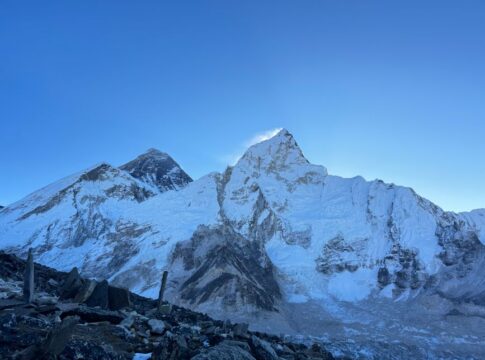
Did You Know Gravity Is Weaker on Top of Mount Everest
By Trivia Daily, Science Desk — Published November 17, 2026
Table of Contents
- Key Takeaways
- Why Gravity Weaker Mount Everest Experiences Make Scientific Sense
- Measuring Gravitational Variations Through Research and Experiment
- How Weight and Mass Differ in Physics
- Gravitational Variations Around the World
- Why This Physics Discovery Matters for Chemistry and Biology
- Frequently Asked Questions
Standing on the summit of Mount Everest, you weigh slightly less than you do at sea level. This isn’t just because you’ve burned calories during the climb—gravity is actually weaker up there. The phenomenon reveals one of physics’ most fundamental truths: gravitational force decreases with distance from Earth’s center. At 29,032 feet above sea level, climbers experience about 0.3% less gravitational pull than someone standing on a beach. While that might sound trivial, this scientific principle has profound implications for everything from satellite orbits to GPS accuracy.
The discovery that gravity weaker mount elevations experience relates directly to Newton’s law of universal gravitation. Every object with mass attracts every other object, and that attraction weakens with distance. Earth’s gravitational field isn’t uniform—it varies based on altitude, latitude, and even the density of rock beneath your feet.
Key Takeaways
- Gravity on Mount Everest’s summit is approximately 0.3% weaker than at sea level due to increased distance from Earth’s center.
- A person weighing 180 pounds at sea level would weigh roughly half a pound less on Everest’s peak.
- Gravitational acceleration at sea level averages 9.81 m/s², while on Everest it drops to about 9.77 m/s².
- Earth’s equatorial bulge means gravity is already weaker at the equator compared to the poles, independent of altitude.
- Precise measurements of gravitational variations help scientists map underground geological features and mineral deposits.
- Satellites in orbit experience even weaker gravity, which is why they can maintain their circular paths without falling back to Earth.
Why Gravity Weaker Mount Everest Experiences Make Scientific Sense
Newton’s law of universal gravitation states that gravitational force is inversely proportional to the square of the distance between two objects’ centers of mass. Earth’s radius at sea level measures approximately 6,371 kilometers. When you climb Mount Everest, you’re adding nearly 9 kilometers to that distance. Though this represents a tiny fraction of Earth’s total radius—about 0.14%—it’s enough to produce a measurable decrease in gravitational pull.
The math is straightforward. Gravitational acceleration follows the formula g = GM/r², where G is the gravitational constant, M is Earth’s mass, and r is the distance from Earth’s center. Increase r even slightly, and g decreases. This principle doesn’t just apply to mountains. Commercial airline passengers flying at 35,000 feet experience about 0.1% less gravity than people on the ground below.
But altitude isn’t the only factor. Earth isn’t a perfect sphere—it bulges at the equator due to its rotation. Someone standing at sea level on the equator is already about 21 kilometers farther from Earth’s center than someone at the North Pole. Combined with the centrifugal effect of Earth’s rotation, this means gravity at the equator is roughly 0.5% weaker than at the poles.
Measuring Gravitational Variations Through Research and Experiment
Scientists use incredibly sensitive instruments called gravimeters to measure these tiny variations in gravitational field strength. Modern gravimeters can detect changes as small as one part per billion—equivalent to noticing the gravitational effect of a nearby mountain range or even underground water reservoirs.
These measurements have practical applications beyond pure physics research. Geologists use gravitational mapping to locate oil deposits, mineral veins, and underground caverns. The technique works because different rock types have different densities, which create subtle variations in local gravitational pull. Dense ore bodies create slightly stronger gravitational fields, while less dense salt domes create weaker ones.
NASA and other space agencies rely on precise gravitational measurements for satellite operations. The GRACE (Gravity Recovery and Climate Experiment) mission used twin satellites to map Earth’s gravitational field with unprecedented accuracy, revealing information about ice sheet melting, groundwater depletion, and ocean currents. This research demonstrates how a fundamental physics principle—objects farther from Earth’s center experience weaker gravity—translates into real-world scientific discovery.
How Weight and Mass Differ in Physics
Here’s where the science gets fascinating. Your mass never changes, whether you’re at sea level or on Everest’s summit. Mass is the amount of matter in your body—a fundamental property that remains constant. Weight, however, is the force of gravity acting on your mass. It’s calculated by multiplying mass times gravitational acceleration (W = mg).
Since gravitational acceleration decreases with altitude, so does your weight. A climber with a mass of 80 kilograms (about 176 pounds) would weigh roughly 784.8 newtons at sea level, where g = 9.81 m/s². On Everest’s peak, where g drops to approximately 9.77 m/s², that same person would weigh about 781.6 newtons—a difference of 3.2 newtons, or about 0.7 pounds.
This distinction between mass and weight confuses many people, but it’s crucial for understanding gravity. Astronauts in orbit are often described as “weightless,” but they still have mass. They’re simply far enough from Earth’s surface that the gravitational force, combined with their orbital velocity, creates the sensation of freefall.
Gravitational Variations Around the World
| Location | Gravitational Acceleration (m/s²) | Variation from Standard |
|---|---|---|
| North Pole (sea level) | 9.832 | +0.22% |
| Standard (45° latitude, sea level) | 9.81 | 0% |
| Equator (sea level) | 9.78 | -0.31% |
| Mount Everest summit | 9.77 | -0.41% |
| Commercial aircraft altitude | 9.80 | -0.10% |
Why This Physics Discovery Matters for Chemistry and Biology
Gravitational variations might seem like purely physics territory, but they influence chemistry and biology in subtle ways. Chemical reactions that depend on sedimentation or buoyancy proceed at slightly different rates in varying gravitational fields. Researchers conducting experiments on the International Space Station have discovered that crystal formation, combustion, and fluid dynamics all behave differently in microgravity environments.
In biology, organisms have evolved under Earth’s specific gravitational conditions. Plants use gravity to orient their roots downward and shoots upward—a phenomenon called gravitropism. Studies of plant growth in space have revealed that reduced gravity disrupts these normal developmental patterns, providing insights into the fundamental mechanisms of plant biology. Similarly, human physiology adapts to gravitational stress; astronauts in long-duration spaceflight experience bone density loss and muscle atrophy because their bodies no longer work against normal gravitational force.
Frequently Asked Questions
Would you actually feel lighter on top of Mount Everest?
No, you wouldn’t notice the difference. The 0.3% reduction in gravity translates to less than a pound for most people—far too small to perceive. The exhaustion from climbing and reduced oxygen levels would dominate your physical sensations.
Is gravity weaker on all mountains or just Everest?
Gravity is weaker on all elevated terrain. Any increase in altitude reduces gravitational pull proportionally. Mount Everest simply represents the most extreme example because it’s the highest point on Earth’s surface.
Does the Moon’s gravity also change with altitude?
Yes, the same principle applies. The Moon’s gravity is already about one-sixth of Earth’s at its surface, and it would decrease further with increased altitude from the lunar surface, following the same inverse-square law.
Can gravitational variations affect scientific experiments?
Absolutely. Precision experiments in physics and chemistry must account for local gravitational variations. High-precision measurements often require calibration for altitude and latitude to achieve accurate results.
The next time you see a photo of Everest’s summit, remember that climbers standing there are experiencing a slightly different universe than the rest of us—one where the fundamental force holding them to the planet has loosened its grip ever so slightly. It’s a reminder that physics isn’t just abstract equations, but the very fabric of our everyday experience.