
7 Bizarre Facts About Mantis Shrimp Vision and Color
By Trivia Daily, Science Desk — Published November 19, 2026
Table of Contents
- Key Takeaways
- The Bizarre Mantis Shrimp Eye Structure Defies Convention
- The Science Behind Their Rainbow of Receptors
- How Mantis Shrimp Vision Compares to Other Animals
- Frequently Asked Questions
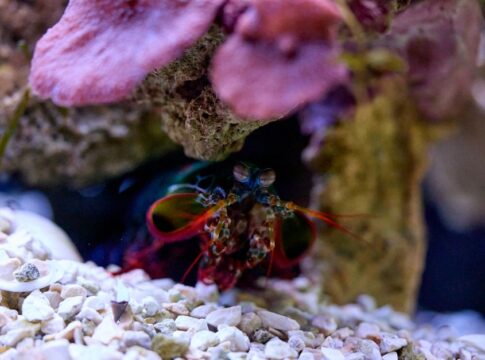
Lurking in shallow tropical waters lives a creature with eyes so alien they’ve rewritten what scientists thought possible about vision. The mantis shrimp—neither mantis nor shrimp, but a stomatopod crustacean—possesses the most complex visual system ever discovered in biology. While humans rely on three types of color receptors, these palm-sized predators pack twelve or more into eyes that move independently and see colors we can’t even imagine.
What makes the bizarre mantis shrimp truly extraordinary isn’t just the number of photoreceptors. It’s how these marine animals process light in ways that challenge our understanding of neuroscience, physics, and evolutionary biology. Their eyes detect polarized light, perceive ultraviolet and infrared wavelengths, and measure depth with a single eye—capabilities that have inspired research into everything from cancer detection to satellite imaging.
Key Takeaways
- Mantis shrimp possess 12 to 16 types of photoreceptor cells, compared to just three in humans, allowing them to detect an extraordinary range of wavelengths.
- Despite having more color receptors, mantis shrimp are surprisingly poor at discriminating between similar colors, processing visual information in a fundamentally different way than humans.
- Their eyes can detect multiple types of polarized light, a capability that may help them communicate secretly and identify prey through camouflage.
- Each eye moves independently and can perceive depth on its own, eliminating the need for binocular vision.
- The mantis shrimp’s visual system has inspired advances in optical technology, including camera sensors and medical imaging devices.
The Bizarre Mantis Shrimp Eye Structure Defies Convention
A mantis shrimp’s eye looks like something from science fiction. Each compound eye sits atop a mobile stalk and contains thousands of individual units called ommatidia. But the real marvel lies in a horizontal band running across the middle of each eye called the midband. This strip contains most of the specialized photoreceptors that give mantis shrimp their legendary color vision.
The midband itself is divided into multiple rows, each packed with different types of visual pigments. Some rows detect specific colors in the visible spectrum, while others respond to ultraviolet or polarized light. This arrangement means a mantis shrimp can scan its environment by moving its eyes, quickly assessing the visual properties of objects in a way no human technology can replicate. The physics behind this setup allows for incredibly fast visual processing—critical for an animal that hunts with strikes reaching speeds of over 50 miles per hour.
The Science Behind Their Rainbow of Receptors
1. Twelve Color Channels Create a Sensory Superpower
Humans see color through three types of cone cells sensitive to red, green, and blue wavelengths. Our brains compare signals from these three channels to create the full spectrum we perceive. Mantis shrimp species have been discovered with 12, 14, or even 16 types of photoreceptors. Each type responds to a narrow band of wavelengths, from deep ultraviolet through visible light and into the near-infrared. This biological discovery initially suggested these creatures might see a kaleidoscope of colors beyond human comprehension, but scientific research revealed a surprising twist to this story.
2. More Receptors Don’t Mean Better Color Discrimination
Here’s where mantis shrimp vision gets truly bizarre. Despite having four times as many color receptors as humans, experiments have shown that mantis shrimp are actually worse at distinguishing between similar shades. When researchers trained mantis shrimp to recognize specific colors, the animals needed wavelengths to differ by 15 to 25 nanometers before they could tell them apart. Humans can detect differences as small as 1 to 4 nanometers.
The explanation lies in how mantis shrimp process visual information. Rather than comparing signals between receptors like our brains do, mantis shrimp appear to use a recognition-based system. Each photoreceptor acts more like an independent channel that either fires or doesn’t when its specific wavelength is present. This allows for incredibly fast color identification without the computational overhead of comparing signals—perfect for a predator that needs split-second decision-making. It’s a completely different approach to vision, one that trades precision for speed.
3. Polarized Light Vision Opens Hidden Dimensions
Light waves vibrate in all directions as they travel, but when reflected off surfaces or filtered through certain materials, they become polarized—vibrating in just one plane. Mantis shrimp can detect both linear and circular polarization, a feat almost unique in the animal kingdom. Their specialized photoreceptors contain molecules arranged in precise orientations that respond differently depending on how light is polarized.
This capability serves multiple purposes in marine biology. Polarized light patterns help mantis shrimp identify the translucent bodies of prey that might otherwise be invisible. Many marine creatures reflect polarized light in patterns that create a form of secret communication, visible only to animals with the right visual equipment. Some researchers believe mantis shrimp use polarized light signals to communicate with each other, displaying patterns on their bodies that appear ordinary to predators but send clear messages to other mantis shrimp.
4. Ultraviolet and Infrared Extend the Visible Spectrum
The mantis shrimp’s visual range extends well beyond human perception at both ends of the spectrum. Several of their photoreceptor types respond to ultraviolet wavelengths as short as 300 nanometers, while others detect near-infrared light above 700 nanometers. This extended range reveals patterns and contrasts in the underwater environment that remain completely hidden to human eyes.
Ultraviolet vision helps mantis shrimp spot prey and recognize members of their own species, many of which display UV-reflective patterns. The infrared sensitivity may help them detect thermal signatures or navigate in deeper waters where red wavelengths are absorbed quickly. The chemistry of their visual pigments has been studied extensively, revealing proteins with unique molecular structures that capture these extreme wavelengths.
5. Independent Eye Movement Creates Dual Visual Streams
Most animals with two eyes need both working together to judge distances—this is binocular vision. Mantis shrimp break this rule entirely. Each eye can move independently on its stalk, looking in different directions simultaneously. Even more remarkably, each eye can gauge depth on its own through a process called monocular depth perception.
This works because the eye’s three regions—top, middle, and bottom—view objects from slightly different angles. The mantis shrimp’s brain compares these three perspectives from a single eye to calculate distance. It’s similar to how rangefinders work in physics, using triangulation from multiple viewpoints. This gives mantis shrimp redundant depth perception systems, making them exceptionally accurate when striking at prey or defending their burrows.
6. Six Types of Polarization Receptors Detect Subtle Patterns
While many animals can detect linear polarization, mantis shrimp take it several steps further. They possess at least six different types of photoreceptors dedicated to analyzing polarized light, including specialized cells for circular polarization—where the light’s orientation rotates as it travels. This makes mantis shrimp one of the only animals known to see circular polarization naturally.
Research suggests this capability might help mantis shrimp recognize the polarized patterns on each other’s bodies, which could serve as identification markers. Since most predators can’t see these patterns, it’s a form of covert signaling. The physics of how their photoreceptors achieve this involves precisely stacked layers of light-sensitive molecules that interact with polarized light in measurable ways.
7. Their Visual System Inspired Breakthrough Technology
The mantis shrimp’s unique approach to vision has sparked numerous experiments in applied science and engineering. Researchers have developed camera sensors modeled after the mantis shrimp’s polarization receptors, creating devices that can detect cancerous tissue by analyzing how it reflects polarized light differently than healthy cells. Other teams have built optical systems inspired by the mantis shrimp’s color recognition method, producing cameras that can quickly identify objects without complex image processing.
The discovery of how mantis shrimp handle visual information has also influenced artificial intelligence research. Their recognition-based approach to color—fast but less precise—offers an alternative model for how machines might process visual data when speed matters more than perfect accuracy. From satellite imaging to medical diagnostics, the bizarre mantis shrimp continues to teach scientists new ways of seeing the world.
How Mantis Shrimp Vision Compares to Other Animals
| Animal | Color Receptors | Polarization Detection | UV Vision |
|---|---|---|---|
| Humans | 3 types | No | No |
| Mantis Shrimp | 12-16 types | Yes (linear and circular) | Yes |
| Dogs | 2 types | No | Limited |
| Birds (most species) | 4 types | No | Yes |
| Butterflies | 5-6 types | Some species | Yes |
Frequently Asked Questions
Can mantis shrimp see colors humans cannot?
Yes, mantis shrimp can detect ultraviolet and near-infrared wavelengths that are invisible to humans. However, their ability to distinguish between similar shades within the visible spectrum is actually poorer than ours despite having more photoreceptor types.
How fast can a mantis shrimp process visual information?
Mantis shrimp can identify colors and objects extremely quickly because their recognition-based visual system requires minimal neural processing. This speed is essential for their hunting strategy, which involves strikes that take only milliseconds to complete.
Do all mantis shrimp species have the same vision capabilities?
No, different species have varying numbers of photoreceptor types and visual capabilities depending on their habitat and lifestyle. Species living in shallow, colorful reef environments tend to have more complex visual systems than those in deeper or murkier waters.
Why haven’t other animals evolved similar visual systems?
The mantis shrimp’s visual system requires significant biological resources to maintain—larger eyes, more neural connections, and specialized proteins. For most animals, the benefits of such complex vision don’t outweigh these costs. Mantis shrimp evolved this system to support their unique hunting style and communication needs.
The mantis shrimp reminds us that evolution can produce solutions radically different from our own. These small crustaceans don’t see the world as a richer version of what we experience—they perceive it through an entirely alien sensory framework. Every time scientists think they’ve unraveled the mysteries of mantis shrimp vision, new experiments reveal another layer of complexity, another unexpected adaptation that challenges our assumptions about what’s possible in biology.