
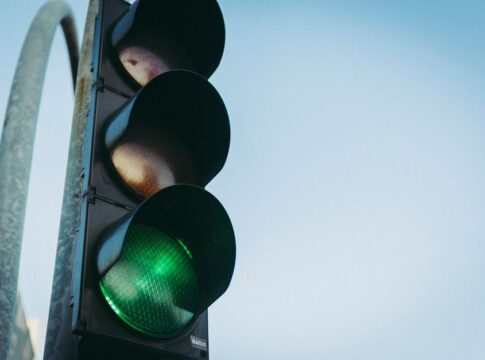
Why Traffic Lights Are Red Yellow Green: Color History
By Trivia Daily, Staff Writer — Published July 27, 2026
Table of Contents
- Key Takeaways
- The Railroad Origins of Traffic Lights Yellow and Red
- Why Yellow Became the Middle Ground
- The Science Behind the Colors
- Global Adoption and Standardization
- Comparing Traffic Light Specifications
- Frequently Asked Questions
Every day, millions of drivers glance up at traffic lights without giving them a second thought. But have you ever wondered why these signals use red, yellow, and green instead of, say, blue, purple, and orange? The answer takes us back to 19th-century railroads, the science of human vision, and some surprising facts about how traffic lights yellow and red became the universal language of the road. What started as borrowed technology from train signals evolved into one of the most recognizable color codes on the planet.
The story behind these three colors is more interesting than you might expect. It blends physics, physiology, and practical problem-solving from an era when cities were transitioning from horse-drawn carriages to automobiles. Discover why red means stop across nearly every culture, why yellow was chosen as the cautionary middle ground, and what amazing trivia lies hidden in the history of the world’s most common traffic control device.
Key Takeaways
- Traffic light colors were borrowed from railroad signals, which used red and green as early as the 1830s because red light travels farthest through fog and dust.
- Red became the universal “stop” signal because it has the longest wavelength of visible light, making it visible from the greatest distance and least likely to scatter in poor weather.
- Yellow was added as the caution signal in the 1920s after early traffic lights used only red and green, creating dangerous situations when lights switched instantly.
- Green was chosen for “go” partly because it contrasts sharply with red and is easily distinguished by most people, including many with color vision deficiencies.
- The first electric traffic light was installed in Cleveland, Ohio, in 1914, though earlier gas-powered versions existed in London as far back as 1868.
- The three-color system became standardized internationally to prevent confusion as automobile travel expanded across borders in the early 20th century.
The Railroad Origins of Traffic Lights Yellow and Red
Long before cars crowded city streets, railroads faced a critical safety challenge: how to signal train engineers from a distance whether the track ahead was clear or occupied. In the early 1800s, railroad companies experimented with various signaling methods. Red emerged as the color for danger or stop because of a fundamental property of light itself.
Red light has the longest wavelength in the visible spectrum, typically around 620-750 nanometers. This physical characteristic means red light scatters less than shorter wavelengths when passing through particles in the atmosphere like fog, rain, or smoke. For railroad engineers peering through the coal smoke and industrial haze of 19th-century cities, a red signal could be seen from farther away than any other color. Green, with its shorter wavelength, was adopted for “all clear” because it provided strong contrast with red and was still visible at reasonable distances.
White was initially used by some railroads to indicate safety, but this created a dangerous problem. If a red lens broke or fell off a signal lantern, the white light behind it would shine through, falsely indicating that the track was clear. After several accidents, railroads standardized on red for stop and green for go, eliminating white as a primary signal color.
Why Yellow Became the Middle Ground
The earliest traffic signals borrowed directly from railroad technology, using just red and green. But this two-color system had a serious flaw on busy streets. Drivers approaching an intersection had no warning before a green light suddenly turned red. The instant switch caused confusion and accidents as drivers slammed on brakes or attempted to speed through changing signals.
Traffic engineers in the 1920s recognized the need for a transitional warning. Yellow was selected for several practical reasons. Its wavelength falls between red and green, making it highly visible and distinct from both. The human eye is particularly sensitive to yellow light, which registers quickly in our peripheral vision. This matters when drivers are watching the road ahead while monitoring signals at the edge of their visual field.
The addition of yellow transformed traffic control. Drivers gained precious seconds to prepare for a stop, reducing rear-end collisions and intersection crashes. The three-phase cycle—green, yellow, red—created a rhythm that became intuitive once drivers learned the pattern. Some cities experimented with different caution colors, but yellow’s superior visibility in both bright sunlight and dim conditions made it the clear winner.
The Science Behind the Colors
The choice of red, yellow, and green isn’t arbitrary—it’s rooted in how human vision works. Our eyes contain photoreceptor cells called cones that respond to different wavelengths of light. Most people have three types of cones sensitive to long (red), medium (green), and short (blue) wavelengths.
Red and green provide maximum contrast for the majority of the population, including many individuals with color vision deficiencies. The most common form of color blindness affects the ability to distinguish red from green when they’re similar in brightness. Traffic lights solve this by using position (red always on top in vertical signals, or on the left in horizontal ones) as a secondary cue. The addition of yellow, which appears distinctly different from both red and green even to most colorblind individuals, adds another layer of safety.
Traffic engineers also consider light intensity. Modern LED traffic signals are calibrated to specific brightness levels that remain visible in direct sunlight without being blindingly bright at night. The exact shades of red, yellow, and green are standardized by organizations like the Institute of Transportation Engineers to ensure consistency across jurisdictions.
Global Adoption and Standardization
As automobiles spread globally in the early 20th century, the need for international traffic signal standards became apparent. Imagine the chaos if red meant “stop” in one country but “go” in another. The League of Nations and later the United Nations worked to establish uniform traffic control conventions.
The 1949 Geneva Convention on Road Traffic and the 1968 Vienna Convention on Road Signs and Signals codified red-yellow-green as the international standard for traffic lights. Nearly every country adopted this system, making it one of the most successful examples of global standardization. Whether you’re driving in Tokyo, Toronto, or Timbuktu, red means stop.
Some variations exist around the edges. A few countries use a flashing green or yellow phase. Others incorporate arrows or pedestrian symbols. But the core three-color system remains universal—a remarkable achievement in international cooperation that saves countless lives every year.
Comparing Traffic Light Specifications
| Color | Wavelength Range | Primary Purpose | Visibility Advantage |
|---|---|---|---|
| Red | 620-750 nm | Stop / Danger | Longest wavelength; travels farthest through fog and haze |
| Yellow/Amber | 570-590 nm | Caution / Prepare to stop | High sensitivity in human peripheral vision; distinct from red and green |
| Green | 495-570 nm | Go / Proceed | Strong contrast with red; distinguishable by most colorblind individuals |
Frequently Asked Questions
Why don’t traffic lights use blue instead of green?
Blue light has a shorter wavelength than green, which means it scatters more easily in the atmosphere and is harder to see from a distance, especially in fog or rain. Green provides better visibility and contrast with red while still being distinguishable by people with common forms of color blindness.
When was the first electric traffic light installed?
The first electric traffic light was installed in Cleveland, Ohio, on August 5, 1914, at the corner of Euclid Avenue and East 105th Street. It had red and green lights with a buzzer to warn of color changes, though it only operated for a short time before being replaced with improved designs.
Do all countries put red on top of vertical traffic lights?
Yes, international conventions require red to be positioned at the top of vertical traffic signals and on the left of horizontal ones. This standardization ensures that even if someone cannot distinguish the colors, they can identify the signal by position alone—a critical safety feature for colorblind drivers.
How long does a yellow light typically last?
Yellow light duration varies based on the speed limit of the road, typically ranging from three to six seconds. Higher-speed roads get longer yellow phases to give drivers traveling faster enough time to safely stop before the light turns red.
Next time you’re stopped at a red light, take a moment to appreciate the elegant simplicity of this color-coded system. What seems like common sense today resulted from decades of trial, error, and scientific understanding about light, vision, and human behavior. The humble traffic light represents a quiet triumph of engineering—a solution so effective that it’s become invisible in its ubiquity, silently organizing the chaos of modern traffic one intersection at a time.