
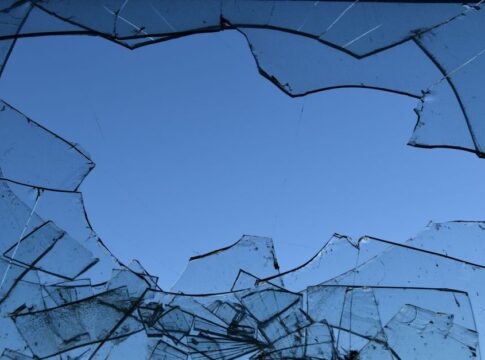
Why Does Glass Shatter Into Sharp Edges When Broken
By Trivia Daily, Staff Writer — Published October 20, 2026
Table of Contents
- Key Takeaways
- The Amorphous Structure That Makes Glass Shatter Sharp
- The Physics of Catastrophic Failure
- Types of Glass and Their Breaking Patterns
- The Sharpest Edges in Nature and Medicine
- Common Myths About Broken Glass
- Frequently Asked Questions
Drop a ceramic mug and it might crack into a few dull pieces. Break a pane of glass and you’ll find yourself surrounded by razor-sharp fragments that can slice through skin with alarming ease. This stark difference isn’t just bad luck—it’s the result of glass’s unique molecular structure and the way energy travels through this ancient yet amazing material. Understanding why glass shatter sharp edges form reveals fascinating physics hiding in plain sight.
The answer lies in glass’s atomic arrangement, which differs fundamentally from most solid materials. Unlike metals or ceramics with organized crystalline structures, glass exists in what scientists call an amorphous state—a frozen liquid where molecules are locked in random positions. When stress fractures this rigid chaos, the break follows the path of least resistance at incredible speed, creating edges that can be sharper than surgical scalpels.
Key Takeaways
- Glass lacks the crystalline structure of most solids, existing instead as an amorphous material with randomly arranged molecules that fracture unpredictably.
- Cracks in glass propagate at speeds up to 3,000 miles per hour, far too fast for the material to deform or round off edges as it breaks.
- The molecular bonds in glass break cleanly rather than bending, creating smooth surfaces at the atomic level that translate to dangerously sharp macroscopic edges.
- Tempered and laminated safety glass are engineered to break into less dangerous patterns, with tempered glass shattering into thousands of small, relatively blunt cubes.
- Obsidian, a naturally occurring volcanic glass, can produce edges just a few molecules wide—sharper than any steel blade.
- Modern glass manufacturing techniques can control fracture patterns, but standard window glass remains one of the sharpest materials when broken.
The Amorphous Structure That Makes Glass Shatter Sharp
Most solid materials organize their atoms into repeating crystalline patterns. Think of salt crystals or metal grains—orderly arrangements that give materials predictable properties. Glass defies this convention entirely.
When silica sand melts at temperatures exceeding 3,000 degrees Fahrenheit and then cools rapidly, its molecules don’t have time to arrange themselves into neat rows. Instead, they freeze in a disordered state that resembles a snapshot of liquid water. This supercooled liquid structure remains stable at room temperature, creating what materials scientists call an amorphous solid.
This random arrangement has profound consequences for fracture behavior. When glass breaks, there are no predetermined weak points like the grain boundaries found in metals. The crack must forge its own path through the material, and it does so by breaking individual molecular bonds in whatever direction requires the least energy. Because these bonds are rigid and don’t stretch or deform significantly before breaking, the fracture surface remains atomically smooth.
That smoothness matters. A rough surface at the molecular level would create a dull edge. But glass fractures with such precision that the resulting edge can be smoother than surfaces polished by human hands, creating sharpness that rivals obsidian blades used by ancient civilizations for cutting tools.
The Physics of Catastrophic Failure
Speed plays a critical role in creating sharp edges. When glass begins to crack, the fracture propagates through the material at extraordinary velocity—often reaching several thousand miles per hour. At these speeds, the material has no opportunity to undergo plastic deformation, the gradual bending and reshaping that allows metals to dent before breaking.
The energy stored in stressed glass gets released almost instantaneously. Imagine compressing a spring and then cutting it with scissors. The sudden energy release in glass creates a similar violent separation, but at the molecular level. This rapid energy dispersal prevents the kind of gradual tearing that might create rougher, safer edges.
Glass also exhibits what engineers call brittle fracture—it breaks without warning and without significant deformation. The material absorbs stress up to a critical threshold, then fails completely. This binary behavior contrasts sharply with ductile materials like copper wire, which stretch and thin before eventually breaking. That stretching process creates rounded edges. Glass gets no such opportunity.
Why Other Materials Break Differently
Ceramic materials, while also brittle, typically have crystalline structures with grain boundaries. These boundaries act as crack deflectors, forcing fractures to change direction repeatedly. The result? Rougher break surfaces and somewhat duller edges compared to glass.
Plastics, being polymeric materials with long molecular chains, can stretch and tear. Even when they break cleanly, their molecular structure prevents the atomically smooth fractures that glass achieves. Wood splinters rather than shatters, following the grain of its fibrous structure. Each material’s unique composition dictates its fracture personality.
Types of Glass and Their Breaking Patterns
Not all glass shatters the same way. Engineers have developed several varieties designed to break more safely, though the underlying physics remains unchanged.
| Glass Type | Breaking Pattern | Edge Characteristics | Common Uses |
|---|---|---|---|
| Annealed (Standard) | Large irregular shards | Extremely sharp, dangerous | Windows, picture frames |
| Tempered | Thousands of small cubes | Still sharp but less penetrating | Car windows, shower doors |
| Laminated | Cracks but stays together | Sharp edges remain trapped | Windshields, security glass |
| Wired | Fragments held by mesh | Sharp but contained | Fire-resistant applications |
Tempered glass undergoes heat treatment that creates internal stresses. When it finally breaks, these stresses cause the entire pane to shatter simultaneously into small pieces. While these fragments still have sharp edges, their smaller size makes them less likely to cause deep lacerations. Laminated glass sandwiches a plastic layer between two glass sheets, holding fragments in place even after breakage—the principle behind modern windshields.
The Sharpest Edges in Nature and Medicine
Glass’s sharpness isn’t just a household hazard—it’s a feature that humans have exploited for millennia. Obsidian, volcanic glass formed when lava cools rapidly, was prized by ancient toolmakers for its ability to hold an edge sharper than any metal blade available to them.
Modern medical applications take advantage of this property. Some surgeons prefer obsidian scalpels for delicate procedures because the blades can be sharper than steel instruments, causing less tissue trauma and potentially improving healing. The edges of freshly broken glass can measure just a few nanometers thick—approaching the width of individual molecules.
This molecular-scale sharpness explains why glass cuts are often so clean and deep. The edge is thin enough to slip between cells rather than crushing through them, creating precise incisions that may bleed profusely but leave clean wound margins.
Common Myths About Broken Glass
One persistent myth suggests that older glass is more brittle than new glass. While antique windows may have imperfections from historical manufacturing processes, glass itself doesn’t age in ways that affect its fracture properties. A hundred-year-old pane breaks the same way as one made yesterday—the molecular structure remains stable indefinitely.
Another misconception holds that thicker glass breaks into less dangerous pieces. Thickness affects how much force is needed to break glass, but once fracture begins, the edge sharpness depends on molecular structure, not thickness. A thick pane simply creates larger sharp shards.
Some believe that safety glass isn’t really sharp. While tempered glass breaks into smaller, less dangerous pieces, those pieces still have sharp edges—they’re just less likely to cause severe injuries due to their size and shape. No glass is truly safe when broken; some types are merely safer than others.
Frequently Asked Questions
Can broken glass edges become duller over time?
Yes, but very slowly. Exposure to moisture and mechanical abrasion can gradually round sharp glass edges through a process called weathering. However, freshly broken glass remains dangerously sharp for extended periods, especially when protected from the elements.
Why do some glass breaks create long cracks while others shatter completely?
The pattern depends on how stress is applied and the glass type. A single point impact may create radiating cracks, while distributed stress or pre-tempered glass causes complete shattering. Internal stresses and flaws also influence whether breaks propagate slowly or catastrophically.
Is it possible to break glass without creating sharp edges?
Not with standard glass. The amorphous structure and brittle nature ensure sharp edges form during fracture. Only specialized materials like acrylic or polycarbonate—which aren’t true glass—can break with relatively duller edges due to their different molecular structures.
What makes obsidian sharper than manufactured glass?
Obsidian and manufactured glass have similar amorphous structures, so both can achieve extreme sharpness. Obsidian’s reputation comes from its historical use and the fact that it can be knapped (flaked) to create controlled edges. Both materials can produce molecular-level sharpness when freshly fractured.
The next time you handle glass—whether admiring a window’s transparency or carefully sweeping up broken fragments—you’re interacting with a material whose very structure defies the orderly world of crystals. That frozen disorder, combined with physics that favors speed over safety, creates edges sharp enough to remind us that some of the most dangerous things in our homes are also the most commonplace. The humble drinking glass is, in its way, a blade waiting to be born.